Konstverket som visas på denna sida skyddas av upphovsrättslagen, vilket innebär att vi inte lagligt kan skapa eller sälja en identisk reproduktion. Detta skydd upprätthålls genom internationella avtal såsom den Bernkonventionen och genom nationella lagar, inklusive de som fastställs av Amerikansk upphovsrättslag – Titel 17. Alla rättigheter förbehållna. Återgivning av konstverk är förbjuden utan skriftligt tillstånd från WahooArt.
Denna metod följer fullt ut upphovsrättsliga regler eftersom den inte innebär kopiering eller duplicering av det skyddade konstverket. Istället är det en kreativ nytolkning – en ny målning som är influerad av originalet men inte identisk med det.
Giclée- eller canvasprint av museumskvalitet med snabb produktion och flexibla ytbehandlingsalternativ. ( Beställ handmålad reproduktion Byt till digital bild)





























Välj bland våra förinställda storlekar som motsvarar konstverkets ursprungliga proportioner.

Ange den bredd och höjd du behöver för att passa din ram eller vägg. Ett tryck kan endast beskäras, aldrig göras större än originalbilden, vilket innebär att ett format med en annan proportion leder till att en del av bilden går förlorad. Vi skickar en digital mockup för godkännande innan vi påbörjar tryckningen. Bilden som visas på denna sida visar inte den faktiska beskärningen — det är endast mockuppen som gör det.
Leverans över hela världen () på 2 veckor istället för standard 4/5 veckor. (8 november)
Opus 2604
Storlek på reproduktion
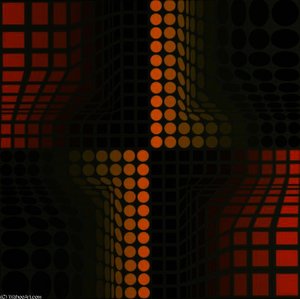
Victor Vasarely's *Opus 2604* is not merely a painting; it’s an invitation to question the very nature of visual reality. This mesmerizing work, dominated by a vibrant blue spiral punctuated with meticulously arranged circles, embodies the core tenets of Op Art – Optical Art – a movement that emerged in the mid-20th century and continues to captivate viewers with its illusionistic power. Born Károly Vaszary in 1906 in Pécs, Croatia, Vasarely’s artistic trajectory began unexpectedly, initially driven by an interest in medicine before he was drawn to the expressive possibilities of color and form. His formative years within the Bauhaus-influenced workshop of Sándor Bortnyik instilled a profound understanding of geometric abstraction and functional design, principles that would become the bedrock of his groundbreaking style.
At its heart, *Opus 2604* is a testament to Vasarely’s mastery of optical illusion. The painting employs a complex system of concentric circles – varying in size and hue – arranged within a spiraling framework. This arrangement deliberately exploits the human visual system's tendency to perceive movement and depth. The eye, constantly attempting to resolve the conflicting cues presented by the overlapping circles, creates the sensation of three-dimensionality, even though the painting itself is strictly two-dimensional. Vasarely meticulously controlled these elements, understanding that subtle shifts in scale and color could dramatically alter the viewer’s perception. This technique, central to Op Art, aimed to stimulate the eye and challenge traditional notions of representation.
The predominantly blue palette of *Opus 2604*, accented with strategic green highlights, contributes significantly to its visual impact. Blue, often associated with tranquility and infinity, reinforces the sense of depth within the spiral. The use of varying shades and intensities within the circles further enhances this illusionistic effect. Created during a period of rapid technological advancement and shifting artistic sensibilities, *Opus 2604* reflects the broader cultural fascination with science, technology, and the exploration of perception. Vasarely’s work aligns with the post-war interest in abstract art and its potential to convey complex ideas through purely visual means – a reaction against representational painting's perceived limitations.
*Opus 2604* transcends mere optical trickery; it evokes a sense of dynamism, movement, and perhaps even the feeling of infinite space. The spiral itself is a powerful symbol – often associated with growth, evolution, and the cyclical nature of time. Vasarely’s deliberate arrangement of circles creates a visual rhythm that draws the viewer's eye across the canvas, generating a meditative experience. The painting’s enduring appeal lies in its ability to stimulate both intellectual curiosity and emotional response, prompting viewers to contemplate their own relationship with perception and reality.
Du kan beställa en handmålad reproduktion av "Opus 2604" av Victor Vasarely direkt på dess Handmålad reproduktion-sida: en handmålad oljereproduktion på linneväv, tillverkad efter beställning.
"Opus 2604" av Victor Vasarely är utförd i Acrylic On Canvas. Reproduktionerna strävar efter att återge teknikens särpräglade utseende.
Färgerna i "Opus 2604" av Victor Vasarely har en Vivid intensitet.

1906 - 1997 , Kroatien

Explore the mesmerizing world of Victor Vasarely. Discover how his Bauhaus-inspired Op Art masters the science of perception through geometric abstraction and vibrant color. A sophisticated guide for discerning art collectors seeking to understand the legacy of optical illusion.

Explore the profound spiritual depth of geometric abstraction. From Malevich's Suprematism to modern masters, our expert guide reveals how pure form and color command presence in fine art collections.
 Förhandsvisa
 Skicka
 Dela
Dela
 Visa detaljer
 Guide
Guide

 Ladda ner
 Liknande objekt
 Röntgen
 Bildspel
 Frågor och svar
 Statistik

 Visa mer









 Glasalternativet är endast tillgängligt i storlekar under 110 cm.