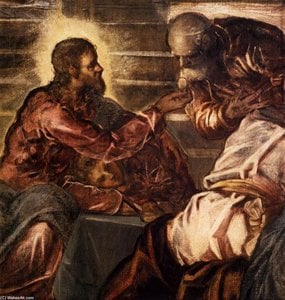
Jacopo Tintoretto’s Revolutionary “The Last Supper”
Tintoretto’s “The Last Supper,” completed in 1594 for the church of San Giorgio Maggiore in Venice, isn't merely a depiction of a biblical event; it’s a visceral experience. Far removed from the serene and contemplative portrayals so common in earlier depictions of this pivotal moment, Tintoretto plunges us directly into the heart of the drama – the immediate aftermath of Christ’s announcement of his impending betrayal. This monumental fresco isn't about a peaceful meal; it’s about suspended disbelief, the agonizing tension between unwavering faith and the chilling certainty of treachery. It’s a scene brimming with dynamic energy, psychological complexity, and an overwhelming sense of spiritual weight – qualities that immediately distinguish it from its predecessors.
The painting's power stems not just from its subject matter but from Tintoretto’s masterful manipulation of technique and his deep understanding of Venetian artistic traditions. He was known as “Il Furioso” (the Furious) for a reason: his approach to the canvas was characterized by astonishing speed, an almost frenetic energy that translated directly onto the fresco. This wasn't simply rapid painting; it was a deliberate choice to capture the fleeting emotions and dramatic unfolding of the narrative. Tintoretto employed bold brushstrokes – thick, visible strokes that contribute significantly to the work’s texture – and a dramatic *chiaroscuro*—a stark contrast between light and dark—that creates a theatrical atmosphere, drawing the viewer into the emotional core of the scene. The composition itself is deliberately asymmetrical and dynamic; figures swirl and gesture with unrestrained emotion, disrupting any sense of static order. This innovative approach, deeply rooted in Venetian Mannerism, prioritizes expressive power over the rigid balance favored by classical art.
A Masterclass in Venetian Style – Oil on Canvas
The choice of oil paint was crucial to Tintoretto’s vision. While fresco traditionally involved pigments mixed with water applied directly to wet plaster, Tintoretto utilized oil paints on canvas—a technique that allowed for richer textures, a greater luminosity, and the ability to build up layers of color with remarkable subtlety. This layering is evident in the painting's surface – a tapestry of subtle hues and shimmering highlights. The use of oil also provided him with the flexibility to rework sections of the fresco as he progressed, correcting imperfections and refining details with unprecedented precision. The canvas itself, stretched taut and primed meticulously, became an integral part of his expressive vocabulary.
Furthermore, Tintoretto’s understanding of color was exceptional. He didn't shy away from bold, vibrant hues – deep reds, intense blues, and shimmering golds—to heighten the drama and convey the emotional intensity of the scene. The lighting, too, plays a critical role; it emanates primarily from above, casting dramatic shadows that emphasize the figures’ gestures and expressions, creating a sense of theatricality reminiscent of Renaissance stage productions.
Historical Context: Faith, Betrayal, and the Counter-Reformation
“The Last Supper” was created during a period of profound religious upheaval – the Counter-Reformation. The Catholic Church was actively seeking to reaffirm its doctrines and inspire devotion in the face of Protestant challenges. Commissioned for the Benedictine monastery of San Giorgio Maggiore, a significant spiritual center in Venice, this fresco served as a powerful visual sermon, intended to engage worshippers on an emotional level. It’s important to note that Tintoretto's work wasn't simply a historical depiction; it was a deliberate attempt to evoke a specific response – one of awe, reverence, and ultimately, faith.
Decoding the Symbolism: Bread, Wine, and Divine Presence
At the heart of the composition lies Christ’s gesture towards the bread and wine—potent symbols representing the Eucharist. These elements are not merely decorative; they are imbued with profound theological significance. The upward sweep of Christ's hand, combined with the dramatic lighting illuminating these central objects, draws the viewer’s eye to their importance. Above them, a subtle divine light suggests God’s presence and reinforces the sacredness of the moment. The figures themselves are carefully arranged to emphasize this symbolism – each reaction, each gesture, contributing to the overall narrative of faith, betrayal, and sacrifice. The painting is a complex tapestry of religious iconography, inviting contemplation on themes of loyalty, denial, and redemption.



 Förhandsvisa
 Beställ handmålad reproduktion
 Skicka
 Dela
Dela
 Visa detaljer

 Ladda ner
 Liknande objekt
 Röntgen
 Bildspel
 Statistik


 Visa mer






































 Glasalternativet är endast tillgängligt i storlekar under 110 cm.