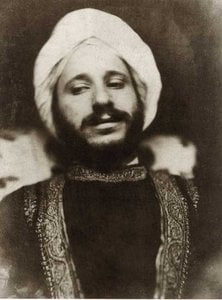
A Vision of Ethereal Melancholy
In the delicate, watercolor strokes of Simeon Solomon’s "Head," we encounter a moment of profound introspection that transcends the boundaries of time. The painting presents a captivating portrait of a woman, her vibrant red hair cascading like a silken flame across the frame, partially veiled by a rich red scarf that clings to her neck. Her gaze, directed toward an unseen horizon, is heavy with a pensive, almost haunting longing. This is not merely a portrait of a person, but a window into a psychological landscape, where the boundaries between the physical self and the dreaming mind begin to blur. The soft, translucent layers of watercolor lend the piece a vintage, dreamlike quality, allowing the light to seem as though it is emanating from within the subject herself.
The composition is masterfully intimate, with the woman's head dominating the visual field, creating an immediate and inescapable connection between the viewer and her internal world. Behind her, the subtle suggestion of mountains and drifting clouds provides a sense of vastness, contrasting the closeness of the portrait with the infinite scale of nature. This juxtaposition serves to heighten the emotional weight of her solitude; she is a figure caught in a quiet, monumental stillness, framed by the grandeur of an atmospheric wilderness.
The Aesthetic Spirit and Symbolic Depth
To understand "Head," one must look toward the artistic currents that flowed through Solomon’s London during the late nineteenth century. As a figure deeply connected to the Aesthetic Movement, Solomon drew immense inspiration from the lush, symbolic worlds of Dante Gabriel Rossetti and the dream-heavy imagery of Gustave Moreau. In this work, we see the hallmarks of that era: a devotion to beauty for its own sake and a profound use of color to evoke mood rather than mere reality. The fiery reds of her hair and scarf act as a powerful emotional anchor, symbolizing passion, vitality, and perhaps a hidden, burning intensity beneath her calm exterior.
The symbolism within the piece invites deep contemplation. The mountains in the background may represent the formidable obstacles of life or the lofty heights of spiritual aspiration, while the clouds suggest the ephemeral and fleeting nature of human thought. For the discerning collector or interior designer, this painting offers more than just visual appeal; it provides a focal point of intellectual and emotional depth. It is a piece that demands a space of reflection—a quiet corner of a library or a sophisticated gallery wall where its subtle nuances can be rediscovered with every glance.
A Timeless Addition to the Modern Interior
For those seeking to curate an environment of elegance and soul, a high-quality reproduction of Solomon’s "Head" serves as a bridge between the Victorian era's romanticism and contemporary aesthetic sensibilities. The painting’s soft palette and evocative subject matter make it an incredibly versatile choice for various interior styles, from classical European estates to modern, minimalist lofts that crave a touch of historical warmth. Its ability to evoke a sense of nostalgia and quiet drama allows it to anchor a room, providing a conversation piece that is both accessible in its beauty and complex in its meaning.
Investing in such a work is an invitation to surround oneself with the enduring power of the Pre-Raphaelite spirit. Whether used to add a layer of texture to a curated collection or as a singular statement of grace, "Head" remains a testament to Solomon's unique ability to capture the fleeting beauty of the human soul through the delicate medium of watercolor.
Frågor och svar
Upplevs färgerna i "Head" som starka eller mjuka?
"Head" av Simeon Solomon uppvisar en Balanced färgintensitet.
Vilka färger dominerar "Head" av Simeon Solomon?
"Head" av Simeon Solomon använder en Earthy-palett, där Clay (#856c52) är den dominerande färgen.
Vilket stämningsläge och vilken känsla uttrycker "Head" av Simeon Solomon?
I "Head" ackompanjeras en Romantic stämning av en Melancholic känsla.
Vilken färg dominerar kompositionen i "Head" av Simeon Solomon?
Den färg som framträder mest i "Head" är Clay (#856c52). Den dominerande färgen är användbar när man matchar ett konstverk med en inredning.
Vad har "Head" gemensamt med resten av Simeon Solomons produktion?
Inom Simeon Solomons produktion är "Head" skapad i Aestheticism-stil, med de återkommande temana rossetti and moreau influences, aestheticism and symbolism, victorian identity themes, exploration of desire, key late career work.
Vem är konstnären bakom "Head"?
"Head" skapades av Simeon Solomon. Informationen på denna sida beskriver Simeon Solomons originalverk.
Vilken kontrastnivå uppvisar "Head" av Simeon Solomon?
Ljus-mörker-kontrasten i "Head" är registrerad som Gentle. Kontrast beskriver hur starkt ljusa och mörka partier skiljer sig åt.
Vilken underliggande nyans genomsyrar "Head" av Simeon Solomon?
Den dominerande nyansen i "Head" av Simeon Solomon är Ochre to Sepia. Nyansen utgör den underliggande tonen i färgpaletten.



 Visa i rummet
 Köp handmålat konstverk
 Skicka
 Dela
Dela
 Detaljer
 Studentguide för konstverk

 Ladda ner
 Liknande objekt
 Röntgen
 Bildspel
 Besökstatistik


 Läs mer






































 Glasalternativet är endast tillgängligt i storlekar under 110 cm.