

Giclée- eller canvasprint av museumskvalitet med snabb produktion och flexibla ytbehandlingsalternativ. ( Beställ handmålad reproduktion Byt till digital bild)





























Välj bland våra förinställda storlekar som motsvarar konstverkets ursprungliga proportioner.

Ange den bredd och höjd du behöver för att passa din ram eller vägg. Ett tryck kan endast beskäras, aldrig göras större än originalbilden, vilket innebär att ett format med en annan proportion leder till att en del av bilden går förlorad. Vi skickar en digital mockup för godkännande innan vi påbörjar tryckningen. Bilden som visas på denna sida visar inte den faktiska beskärningen — det är endast mockuppen som gör det.
Leverans över hela världen () på 2 veckor istället för standard 4/5 veckor. (8 november)
The Wedding Banquet
Storlek på reproduktion
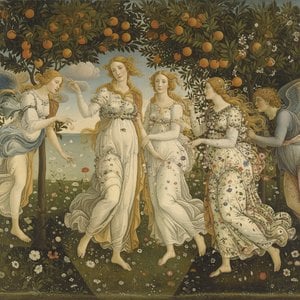
Sandro Botticelli's “The Wedding Banquet,” painted around 1483, isn’t merely a depiction of a festive occasion; it’s a shimmering window into the heart of Renaissance Florence – a city pulsating with artistic innovation and humanist ideals. Commissioned by Antonio Pucci for his son’s marriage, this painting transcends its simple subject matter to become a complex meditation on social status, love, and the revival of classical themes. Botticelli masterfully employs his signature elongated figures and graceful poses, setting them against a backdrop that subtly blends the opulent details of a Florentine wedding with echoes of ancient Roman architecture – a deliberate nod to the burgeoning interest in antiquity that characterized the era.
The scene unfolds within a richly decorated hall, overflowing with the trappings of wealth and celebration. Guests, rendered with Botticelli’s characteristic elegance, are engaged in various activities: musicians play lively tunes, servants attend to the needs of the assembled company, and tables groan under the weight of lavish food and drink. Notice particularly the careful attention to detail – the intricate patterns on the fabrics, the delicate rendering of the goblets and serving dishes, all contribute to a sense of immersive realism. However, Botticelli doesn’t simply aim for photographic accuracy; he elevates these details into symbols, hinting at the social hierarchies and expectations that governed Florentine society.
Botticelli’s artistic style is immediately recognizable. He favored a delicate and refined use of color, often employing muted tones – ochres, blues, and greens – to create a sense of harmony and balance within the composition. Yet, he wasn't afraid to introduce vibrant accents, particularly in the clothing and decorative elements, drawing attention to specific details. Crucially, Botticelli’s work is defined by his masterful command of line; each figure is delineated with precise contours, lending them an almost ethereal quality. This emphasis on line, combined with his elongated figures – a characteristic inherited from earlier Gothic traditions – creates a sense of movement and grace that is both captivating and subtly unsettling.
The painting’s composition itself reflects Botticelli's engagement with classical principles. The arrangement of the figures, the use of perspective (though not strictly linear), and the inclusion of architectural elements—a subtle archway in the background—all allude to the ideals of harmony, proportion, and beauty that were central to Renaissance art. Botticelli’s deliberate incorporation of these classical motifs wasn't simply decorative; it was a conscious effort to revive interest in the artistic achievements of ancient Greece and Rome, contributing significantly to the intellectual and cultural climate of his time.
“The Wedding Banquet” is more than just a celebration; it’s a subtle commentary on social dynamics. The varying attire of the guests – some adorned in elaborate robes, others dressed more modestly – clearly indicates their respective social standing. Botticelli subtly critiques the superficiality of wealth and status, suggesting that outward appearances can often mask deeper complexities. The scene also hints at the constraints placed upon individuals within a rigid social hierarchy. While the wedding itself is a joyous occasion, there’s an underlying tension—a sense that the festivities are merely a performance, masking unspoken anxieties and desires.
Botticelli's work continues to resonate today because it captures not only the beauty of Renaissance Florence but also its complexities – its artistic brilliance alongside its social constraints. Reproductions of “The Wedding Banquet” offer a remarkable opportunity to experience this captivating painting firsthand, bringing Botticelli’s vision to life in your own home or studio.
"The Wedding Banquet" skapades av Sandro Botticelli, född i Italien, inom Early Renaissance-rörelsen. Konstnärens ursprung knyter verket till Early Renaissance så som det utövades av konstnärer från Italien.
Sidan Faktablad för elever för "The Wedding Banquet" av Sandro Botticelli erbjuder ett utskrivbart faktablad på två sidor: konstverket med sin identitetstabell, en tidslinje som placerar det i konstnärens livstid, andra verk av konstnären, den mätta färgpaletten samt färdiga citatmallar i fyra olika stilar.
"The Wedding Banquet" är utförd i Oil.


1445 - 1510 , Italien

Discover why a hand-painted wedding portrait is the ultimate luxury heirloom. Elevate your wedding memories beyond photography with bespoke oil paintings that transcend generations through timeless artistry and meticulous craftsmanship.
Explore the ethereal beauty of Sandro Botticelli's masterpieces. Delve into the profound symbolism, mythological grace, and technical mastery that define the Italian Renaissance through an expert art-historical lens.

Elevate your wedding planning with expert-led ideas for unique wedding art beyond portraits. Discover how custom oil paintings, bespoke murals, and fine art commissions create timeless, heirloom memories that transcend photography to celebrate a lasting love story.
 Förhandsvisa
 Skicka
 Dela
Dela
 Visa detaljer
 Guide
Guide

 Ladda ner
 Liknande objekt
 Röntgen
 Bildspel
 Frågor och svar
 Statistik
 Visa mer









 Glasalternativet är endast tillgängligt i storlekar under 110 cm.


