


Giclée- eller canvasprint av museumskvalitet med snabb produktion och flexibla ytbehandlingsalternativ. ( Beställ handmålad reproduktion Köp högupplöst bild)





























Välj bland våra förinställda storlekar som motsvarar konstverkets ursprungliga proportioner.

Du kan ange egna mått för att passa en specifik ram eller yta. Om det valda måttet inte överensstämmer med originalbildens proportioner kommer vi antingen att beskära konstverket eller utöka bilden med en speglad eller enfärgad kant. En digital mockup skickas för ditt godkännande innan produktionen påbörjas.
Vänligen notera att förhandsvisningen på skärmen inte återspeglar den faktiska beskärningen eller utökningen. Endast mockuppen visar den slutgiltiga kompositionen korrekt.
Även om anpassade storlekar är möjliga, rekommenderar vi att du väljer ett mått från den fördefinierade listan för att bevara de ursprungliga proportionerna.
Leverans över hela världen () på 2 veckor istället för standard 4/5 veckor. (7 september)


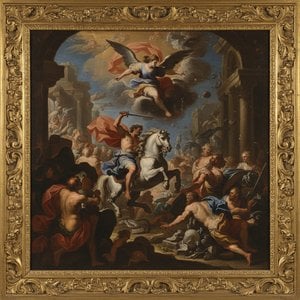
HERCULE SUR LE BUCHER
Storlek på reproduktion
In the grand theater of the Baroque era, few images capture the raw intersection of human agony and divine destiny as poignantly as Guido Reni’s Hercules Sur Le Bucher. Painted during the height of the seventeenth century, this monumental work serves as a breathtaking window into a moment of profound mythological crisis. As the legendary hero Hercules prepares for his pyre, the canvas vibrates with an almost palpable tension. Reni does not merely depict a scene from antiquity; he orchestrates a cosmic drama where the muscular weight of the mortal form meets the swirling, ethereal uncertainty of the heavens. For the discerning collector or lover of classical beauty, this piece offers more than just visual splendor—it provides a window into the very soul of Baroque classicism.
The composition is a masterclass in directed movement, utilizing a sweeping diagonal trajectory that pulls the viewer’s gaze from the lower left toward the upper right. This upward surge mimics the hero's own struggle, creating a sense of breathless ascension amidst a turbulent sky. Reni employs chiaroscuro with unparalleled skill, casting deep, oppressive shadows that contrast sharply against the radiant light illuminating Hercules’ torso and face. This interplay of light and dark does more than create depth; it mirrors the internal conflict of a man caught between his earthly labors and his impending apotheosis. The flesh tones are rendered with an anatomical precision that celebrates the strength of the human spirit, while the surrounding clouds appear as restless, painterly strokes of grey and azure, suggesting a world in flux.
Beyond its striking visual impact, Hercules Sur Le Bucher is steeped in layers of symbolic meaning that resonate with anyone moved by themes of resilience and transformation. The figure of Hercules, stripped of his armor and vulnerable yet powerful, represents the eternal struggle against adversity. The swirling clouds and stormy atmosphere serve as metaphors for the chaotic forces of fate and divine intervention that govern the lives of even the greatest legends. In the context of interior design, such a piece acts as a profound focal point, bringing an air of intellectual depth and dramatic gravitas to any curated space. It is a work that demands attention, inviting contemplation on the nature of suffering and the eventual triumph of the heroic will.
The palette chosen by Reni—a sophisticated blend of earthy ochres, deep browns, and sudden flashes of ivory—grounds the mythological subject in a tangible, visceral reality. This careful balance of warmth and coolness ensures that the painting remains both emotionally accessible and aesthetically timeless. For those seeking to adorn a home or gallery with a high-quality reproduction, this artwork offers an unparalleled opportunity to embrace the elegance of the Italian Baroque. It is an invitation to live surrounded by art that does not merely decorate a wall, but tells a story of enduring strength, capturing a moment where the mortal and the divine collide in a spectacular display of artistic mastery.

Guido Reni, även känd som Le Guide, föddes i Bologna, Italien, år 1575. Han var enda barnet till Daniele Reni, en musiker, och Ginevra Pozzi, också från en musikalisk familj. Denna uppväxt instillerade honom med en uppskattning för harmoni och form som senare skulle påverka hans konstnärliga stil. Redan i nio års ålder började Guido sin lärlingsutbildning under Denis Calvaert, en flamländsk målare verksam i Bologna. Han studerade tillsammans med blivande konstnärer Albani och Domenichino, vilket lade en stark grund i klassiska principer.
Renis konstnärliga karriär sträckte sig över flera italienska städer, inklusive Rom, Neapel och hans hemstad Bologna. Hans tidiga verk visade inflytandet av Calvaert och Carracci-bröderna, med betoning på anatomisk noggrannhet och dramatisk komposition. Reni utvecklade dock snabbt en distinkt stil som kännetecknades av dess eleganta klassicism, förfinad teknik och emotionell intensitet. Han blev en dominant figur i den Bolognesiska skolan, känd för sin betoning på akademisk utbildning och idealiserade former.
Renis oeuvre omfattar ett brett spektrum av ämnen, inklusive religiösa scener, mytologiska berättelser och allegoriska representationer. Några av hans mest kända verk inkluderar:
Renis stil beskrivs ofta som eklektisk klassicism. Han blandade precisionen i klassisk konst med dynamiken och känslorna i barockperioden. Hans figurer är typiskt idealiserade, med en lugn skönhet och graciös rörelse.
Guido Reni spelade en avgörande roll för att forma utvecklingen av High Baroque-stilen i Italien. Han påverkade generationer av konstnärer med sin förfinade teknik, eleganta kompositioner och emotionella djup. Hans verk finns i framstående museer över hela världen, inklusive Palatset Capodimonte i Neapel. Renis arv sträcker sig bortom måleriet; han var också en poet och en respekterad intellektuell figur under sin tid.
Hans konst fortsätter att inspirera konstnärer och konstentusiaster idag, vilket befäster hans plats som en av de viktigaste målarna på 1600-talet. Hans inflytande kan ses i efterföljande barockkonstnärer som sökte emulera hans graciösa stil och emotionella kraft.
Guido Reni dog i Bologna år 1642, och lämnade efter sig ett rikt konstnärligt arv som fortsätter att fängsla publiken århundraden senare.

1575 - 1642 , Italien
Explore the breathtaking power of Baroque art. Delve into the dramatic interplay of light, shadow, and motion through the works of masters like Caravaggio. Discover how the era's intense emotional realism continues to inspire collectors and connoisseurs of classical grandeur.

Embark on a sophisticated journey through Italian Baroque art. Discover the dramatic interplay of light and emotion in Caravaggio’s masterpieces and explore how to bring this timeless grandeur into your collection with expert art insights.

 Förhandsvisa
 Skicka
 Dela
Dela
 Visa detaljer

 Ladda ner
 Liknande objekt
 Röntgen
 Bildspel


 Visa mer







 Glasalternativet är endast tillgängligt i storlekar under 110 cm.


