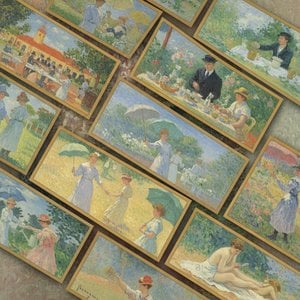
En Mästare av Ljus och Liv: Pierre-Auguste Renoirs Värld
Pierre-Auguste Renoir, född 1841 i den provinsiella franska staden Limoges, representerar en fascinerande resa från en ödmjuk början som porslinsmålare till att bli en hyllad mästare inom impressionismen. Hans tidiga liv präglades av en flytt till Paris med familjen, driven av ekonomiska möjligheter – en upplevelse som skulle forma hans konstnärliga känslighet i grunden. Den pulserande staden, med sitt vibrerande gatuliv och mångfald av karaktärer, blev inspirationskällan för mycket av hans senare verk. Som ung lärde sig Renoir att måla porslin, en praktisk nödvändighet dikterad av ekonomiska begränsningar, men han fann tröst i frekventa besök på Louvren där han noggrant studerade de gamla mästarna och absorberade deras tekniker. Han utvecklade en uppskattning för skönhet som skulle bli ett kännetecken för hans stil. Denna tidiga exponering tände en passion inom honom som överträffade hantverket; det var en kallelse att fånga ljusets flyktighet och livets essens på duken. Senare skrevs han in i Charles Gleyres studio, där han knöt livslånga vänskapsband med blivande konstnärer som Claude Monet, Alfred Sisley och Frédéric Bazille – ett avgörande ögonblick som lade grunden för impressioniströrelsen.
Från Realism till Strålande Intryck
Renoirs konstnärliga utveckling var en fascinerande process, påverkad av en mängd olika mästare. Han drogs initialt till Gustave Courbets och Édouard Manets realism, beundrade deras engagemang för att skildra samtida liv med ärlighet och direkthet. Det var dock Peter Paul Rubens och Jean-Antoine Watteaus ljusa paletter och sensuella former som verkligen fängslade honom, vilket inspirerade ett djupt uppskattande för skönhet i hans verk och en benägenhet att porträttera scener av glädje och fritid. Dessa tidiga influenser kulminerade när Renoir började forma sin egen unika stil, präglad av livfulla färger, brutna penseldrag och ett fokus på att fånga ljusets flyktiga effekter. Hans deltagande i den första impressionistutställningen 1874 var ett vattendelarmoment, även om det möttes med kritik från traditionella konstkretsar. Detta djärva drag signalerade en avvisning av akademiska konventioner och en omfamning av en ny konstnärlig vision – en som syftade till att fånga inte bara vad ögat ser, utan hur det *känns* att uppleva ett visst ögonblick. Målningar som
Bal du moulin de la Galette (1876) exemplifierar detta tillvägagångssätt och fördjupar tittarna i den livliga atmosfären på Paris nattliv med sitt fläckiga solljus och glädjefulla figurer.
Att Fånga Livets Flyktiga Ögonblick: Nyckelverk och Teman
Renoirs oeuvre är en hyllning till livets enkla nöjen – intima sammankomster, sollätta landskap och den strålande skönheten i den mänskliga formen.
Luncheon of the Boating Party (1880-81) står som ett av hans mest ikoniska verk, som skildrar en sällskaplig grupp som njuter av en lugn eftermiddag på Seine. Målningen är en mästerklass i att fånga ljus och rörelse, med figurer badade i varmt solljus och reflektioner som skimrar i vattnet.
After the Bath (1885-87) visar Renoirs utsökta skicklighet i att porträttera den kvinnliga nakenheten, med betoning på delikat hudton och graciösa poser. Hans målningar är inte bara representationer av verkligheten; de genomsyras av en känsla av värme, intimitet och glädje som resonerar djupt hos tittarna. Han var inte intresserad av storslagna historiska berättelser eller dramatiska allegorier; istället fokuserade han på att fånga skönheten i vardagen och lyfta vanliga ögonblick till konstverk.
Dance at Bougival, ett annat hyllat verk, demonstrerar hans förmåga att fånga flyktiga intryck och atmosfäriska effekter, vilket skapar en känsla av rörelse och spontanitet.
En Förskjutning Mot Form och Struktur: Senare År och Arv
Under 1890-talet genomgick Renoirs stil en betydande förändring. Även om han aldrig helt övergav sina impressionistiska rötter, började han röra sig mot ett mer skulpturalt och klassiskt tillvägagångssätt, påverkat av hans resor till Italien och ett förnyat intresse för form och struktur. Denna förändring berodde delvis på fysiska begränsningar – artrit begränsade gradvis hans rörlighet, vilket tvingade honom att anpassa sin teknik. Trots dessa utmaningar fortsatte Renoir att måla med orubblig hängivenhet och producerade verk som kännetecknas av fylligare figurer och en varmare palett. Hans senare målningar återspeglar ofta ett mer kontemplativt humör, men de behåller samma underliggande hyllning till skönhet som definierade hans tidigare arbete. Utöver sina konstnärliga prestationer sträcker sig Renoirs arv genom hans familj; hans son, Jean Renoir, blev en känd filmskapare och bar vidare en kreativ anda över generationerna. Pierre-Auguste Renoir dog 1919 och lämnade efter sig ett bestående verk som fortsätter att inspirera och glädja publiken världen över. Han förblir en av de mest älskade figurerna inom konsthistorien, hyllad för sin förmåga att fånga livets glädje och den mänskliga upplevelsens skönhet med oöverträffad känslighet och grace.
Bestående Inflytande
- Renoirs inflytande på efterföljande generationer av konstnärer är obestridligt. Hans betoning på ljus, färg och att fånga flyktiga ögonblick banade väg för många moderna konstnärliga rörelser.
- Hans hyllning till skönhet och sensualitet fortsätter att resonera med publiken idag, vilket gör hans verk universellt tilltalande.
- Han spelade en avgörande roll i etableringen av impressionismen som en stor kraft inom konsthistorien, utmanade traditionella konventioner och öppnade upp nya möjligheter för konstnärligt uttryck.
- Den bestående populariteten hos hans målningar – reproducerade på otaliga affischer, kalendrar och andra varor – vittnar om den tidlösa kvaliteten i hans verk.



 Förhandsvisa
 Beställ handmålad reproduktion
 Skicka
 Dela
Dela
 Visa detaljer

 Ladda ner
 Liknande objekt
 Röntgen
 Bildspel
 Statistik

 Visa mer






































 Glasalternativet är endast tillgängligt i storlekar under 110 cm.