Early Years and Artistic Foundations
Born in Zweibrücken, Germany, in 1857, Peter Kraemer II emerged from a lineage deeply rooted in the artistic traditions of Bavaria. His family’s history was interwoven with creativity; his father, Peter Krämer I, distinguished himself as an artist, notably for his depictions of the American Liberation War, and had studied under Julius Schnorr von Carolsfeld – a renowned figure in German Romanticism. This familial connection to art provided Kraemer II with an invaluable foundation, immersing him from a young age in the techniques and sensibilities of painting. While details about his early formal training remain somewhat sparse, it’s clear that he absorbed a profound appreciation for visual storytelling and the expressive potential of color and form.
Kraemer's artistic journey began during a period of significant social and cultural change in Germany. The late 19th century witnessed a resurgence of interest in regional identity and folklore, fueled by nationalist sentiments and a desire to preserve traditional crafts and customs. This context profoundly shaped Kraemer’s subject matter – he chose to capture the essence of Bavarian life, particularly its rural landscapes and the lives of its people.
A Specialist in Genre Painting: Portraits of Rural Life
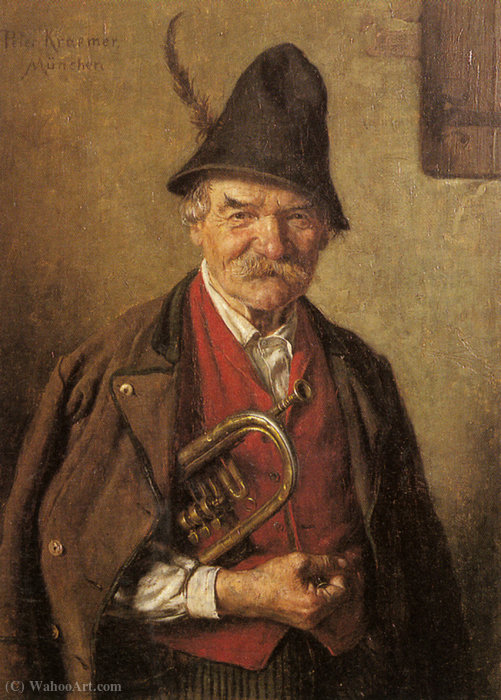
Kraemer II quickly established himself as a master of genre painting, specializing in scenes that offered intimate glimpses into the everyday routines and customs of rural Bavaria. Unlike grand historical or mythological subjects favored by many artists of his time, Kraemer focused on the humble realities of peasant life – hunters pausing for rest, musicians gathering in village squares, farmers tending their fields, and elderly men engaged in quiet pursuits. His paintings are not merely depictions; they’re imbued with a palpable sense of authenticity, capturing the weathered faces, worn clothing, and simple joys of his subjects.
- Detailed Observation: Kraemer's remarkable skill lay in his meticulous observation of detail. He paid particular attention to the textures of fabrics, the expressions on faces, and the nuances of light and shadow, creating a sense of immediacy and realism that drew viewers into the scenes he depicted.
- Costumes as Narrative: The costumes worn by Kraemer’s figures were not simply decorative elements; they served as powerful indicators of social status, occupation, and regional identity. He meticulously researched traditional Bavarian attire, ensuring that each garment reflected its historical context and cultural significance.
- The Essence of Character: Kraemer sought to capture the character of his subjects – their dignity, resilience, and connection to the land. His portraits are not idealized representations; they’re honest portrayals of individuals who had lived full lives rooted in tradition.
Technique and Style
Kraemer II's artistic style is characterized by a remarkable blend of realism and sentimentality. He employed a technique that combined meticulous detail with a loose, expressive brushstroke, creating paintings that are both technically proficient and emotionally resonant. His palette was typically muted, dominated by earthy tones – browns, greens, and ochres – reflecting the colors of the Bavarian landscape. He favored watercolor as his primary medium, allowing for delicate washes of color and a sense of atmospheric depth.
Influenced by the Realist movement, Kraemer’s work shares a commitment to depicting everyday life with honesty and sincerity. However, he also incorporated elements of Romanticism – particularly in his use of light and shadow – to evoke a sense of nostalgia and longing for a bygone era. His paintings are not simply records of the past; they're meditations on memory, tradition, and the enduring spirit of the Bavarian people.
Legacy and Recognition
Peter Kraemer II enjoyed considerable success during his lifetime, exhibiting his work in galleries throughout Germany and Bavaria. He was particularly well-regarded for his depictions of elderly men, capturing their wisdom, experience, and connection to the land with remarkable sensitivity. His paintings are now held in several collections, including those of the Auktionshaus Stahl in Hamburg, where they continue to be appreciated for their artistic merit and historical significance.
Kraemer’s work offers a valuable window into the cultural landscape of 19th-century Bavaria. Through his paintings, he preserved the traditions, customs, and values of a region that was undergoing rapid social and economic change. His legacy as a master of genre painting endures, reminding us of the beauty and dignity found in the everyday lives of ordinary people.



 Förhandsvisa
 Beställ handmålad reproduktion
 Skicka
 Dela
Dela
 Visa detaljer

 Ladda ner
 Liknande objekt
 Röntgen
 Bildspel
 Visa mer






































 Glasalternativet är endast tillgängligt i storlekar under 110 cm.





