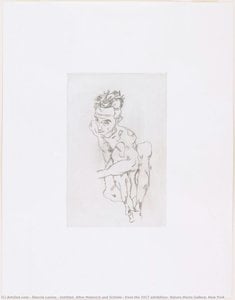
Expressionism
 1970
1970 56.0 x 78.0 cm
Köp en högupplöst, förbättrad digital bild med betydligt högre kvalitet än förhandsvisningen online.
Varje fil är noggrant förberedd av våra interna specialister med hjälp av avancerade verktyg och professionell manuell retuschering. Vi säkerställer att varje bild har exceptionell skärpa, exakt färgåtergivning och fina detaljer.
Den slutgiltiga filen levereras via e-post inom 72 timmar, optimerad för omedelbar användning i professionella sammanhang, redaktionellt bruk och tryckmiljöer. Detta är samma kvalitet som med förtroende används av ledande designstudior, förlag och gallerier.
Ladda ner en högupplöst fil för personlig visning, utskrift och kreativa projekt. ( Beställ tryck Beställ handmålad reproduktion)
När du väljer WahooArt.com får du inte bara en bild – du får ett professionellt förädlat digitalt konstverk, skapat med precision och med en garanterad tillfredsställelse. Här är allt som ingår i din beställning, automatiskt:

Din högupplösta digitala bild skickas till dig via e-post inom 72 timmar efter beställning – redo för omedelbar användning.

Ditt konstverk optimeras professionellt med hjälp av avancerade AI-verktyg och manuell redigering, vilket garanterar maximal detaljrikedom, skärpa och färgnoggrannhet.

Har du råkat radera eller tappa bort din fil? Ingen oro – vi skickar den kostnadsfritt till dig när som helst.

Njut av ditt konstverk omedelbart utan tull, importavgifter eller leveranskostnader – digitala nedladdningar är alltid skattefria.

Vi säkerställer att din digitala bild återger de ursprungliga färgerna så exakt som möjligt med hjälp av professionella verktyg och färghantering.

Om du inte är nöjd med din digitala bild kommer vi att revidera den eller återbetala 100% inom 100 dagar – utan frågor.

Inte nöjd? Få full återbetalning inom 100 dagar efter att du har tagit emot din digitala fil – utan frågor och diskussioner.

Köp 3 bilder, spara 10% – Köp 5, spara 15% – Köp 10+, spara 20%. Perfekt för kreativa projekt, gallerier och byråer.

Born amidst the sun-drenched landscapes of Beaulieu-sur-Mer, France, in 1921, Peter Laurent de Francia emerged as a profound and stirring voice within the realm of British modernism. His life was a tapestry woven from diverse cultural threads, born to an Italian father and an English mother, a heritage that perhaps prepared him for a career defined by the intersection of different perspectives and deep humanistic concerns. De Francia’s artistic odyssey began with rigorous formative studies at the Academy of Brussels, followed by intensive training at the prestigious Slade School of Art in London. These early academic foundations provided him with the technical mastery required to later tackle the most turbulent themes of the twentieth century, establishing a cornerstone for a practice that would eventually bridge the gap between classical discipline and radical social commentary.
As his career unfolded, de Francia’s reach extended far beyond the borders of Britain. His early professional years were marked by significant international exposure, including a pivotal commission for the Canadian Government Exhibition Commission in Ottawa and a period contributing to the architects’ department at the American Museum in New York City. These experiences served as more than mere professional milestones; they acted as windows into a broader world of architectural structure and global social dynamics, instilling in him an acute awareness of how art could reflect—and perhaps influence—the shifting political landscapes of the era.
Beyond the canvas and the sketchbook, de Francia’s impact on the art world was profoundly felt through his role as a mentor and scholar. He became a central figure in British painting education, leaving an indelible mark on generations of artists through his long-standing tenure at St Martin's School of Art and the Royal College of Art (RCA). His ascent within the RCA—moving from Principal of Fine Art to Professor of Painting—allowed him to shape the very curriculum of modern art instruction, fostering an environment where technical excellence met intellectual rigor.
His scholarly contributions were as significant as his creative output. De Francia possessed a rare ability to dissect the complexities of modernism through meticulous research, most notably in his seminal books dedicated to Fernand Léger. Through works such as Leger: The Great Parade and his later study Fernand Léger, he provided the art world with essential keys to understanding Léger’s stylistic innovations and socio-political depth. By illuminating the connection between Léger's vision and the broader movements of Expressionism and Surrealism, de Francia cemented his own reputation as a vital art historian capable of translating complex aesthetic shifts into profound human narratives.
The true heart of de Francia’s work lies in its unflinching engagement with the human condition. Influenced by the nineteenth-century socialist masters such as Gustave Courbet and Honoré Daumier, as well as contemporary giants like Pablo Picasso and Max Beckmann, his art sought to expose the contradictions of everyday life. His paintings and drawings were never merely aesthetic exercises; they were vessels for social urgency and emotional truth. Whether through the dramatic oil textures of African Prison, which captures the raw defiance of an escape attempt, or the haunting, fragmented figures in Figures 1965 (Adrian Family), his work vibrates with a sense of struggle and resilience.
His mastery extended across mediums, from the vibrant, impasto-heavy oils that evoke intimate atmospheres to the stark, expressionistic lines of his black and white drawings. In works like The Disparates, he utilized the starkness of monochrome to convey profound existential anxieties, while his illustrations for Aimé Césaire demonstrated a capacity to translate literary chaos into visual energy. Ultimately, Peter de Francia’s significance rests in this rare duality: he was both a guardian of artistic tradition and a fearless explorer of the modern struggle, leaving behind a body of work that continues to demand our attention and empathy.

1921 - 2012 , France

 Förhandsvisa
 Skicka
 Dela
Dela
 Visa detaljer

 Ladda ner
 Liknande objekt
 Röntgen
 Bildspel
 Visa mer