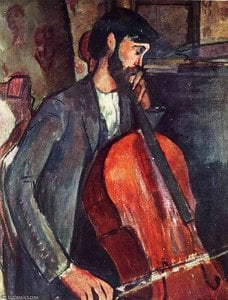
John Minton with a Violin (1939) av Patrick Millard, handmålad oljemålning i reproduktion utförd av en mästare
Förhandsvisa Förhandsgranska i AR Byt till tryck Byt till digital bild Skicka
Visa detaljer Guide Lägg till i favoriter Ladda ner Liknande objekt Röntgen Bildspel Frågor och svar Ladda ner presentation Statistik

John Minton with a Violin Handmålad oljemålning i reproduktion

Mått
102.0 x 76.0 cm

Patrick Ferguson Millard (1902-1972) was a British artist & educator known for his animal drawings, life studies, and landscapes influenced by Samuel Palmer. Taught John Minton & Michael Ayrton. Exhibited at the RA & RBA.

Konstverket som visas på denna sida skyddas av upphovsrättslagen, vilket innebär att vi inte lagligt kan skapa eller sälja en identisk reproduktion. Detta skydd upprätthålls genom internationella avtal såsom den Bernkonventionen och genom nationella lagar, inklusive de som fastställs av Amerikansk upphovsrättslag – Titel 17. Alla rättigheter förbehållna. Återgivning av konstverk är förbjuden utan skriftligt tillstånd från WahooArt.

Som ett respektfullt och lagligt alternativ erbjuder vi skräddarsydda, handmålade konstverk inspirerade av originalet. Våra skickliga och professionella konstnärer studerar noggrant originalets stil, stämning och konstnärliga essens för att skapa ett nytt, unikt verk som väcker samma känsla – samtidigt som det förblir en originell skapelse i egen rätt.

Denna metod följer fullt ut upphovsrättsliga regler eftersom den inte innebär kopiering eller duplicering av det skyddade konstverket. Istället är det en kreativ nytolkning – en ny målning som är influerad av originalet men inte identisk med det.

Handgjord oljereproduktion

Handmålad olja på duk i din valda storlek och ram, tillverkad efter beställning av våra konstnärer. ( Byt till tryck Byt till digital bild)

Standardstorlek
skräddarsydd
CM
INCH

Välj bland våra förinställda storlekar som motsvarar konstverkets ursprungliga proportioner.

bredd
höjd

Ange den bredd och höjd du behöver för att passa din ram eller din vägg. Eftersom detta är handmålat kan konstnären, vid ett annat format, måla lite mer runt bilden eller beskära den något – det är du som väljer. Vi skickar en digital mockup för godkännande innan målningen påbörjas. Bilden som visas på denna sida representerar inte det slutgiltiga resultatet — det är endast mockuppen som visar det.

Exempel på vad som kan anpassas: Byt ut ansiktet mot ett foto av kunden; Lägg till ett husdjur (t.ex. byt ut en katt mot en hund); Inkludera ett dolt meddelande i bakgrunden; Ändra bakgrundens landskap eller element.
Efter beställning kommer WahooArt.com team att mejla kunden för instruktioner och tillhandahålla en skissförhandsvisning

Leverans över hela världen () på 3–4 veckor istället för standard 5 veckor. (11 november). Inga kompromisser med kvaliteten.

Fri expressfrakt över hela världen
Högkvalitativ linnecanvas
Fullständig fraktförsäkring
Garantier för återbetalning av tullavgifter
Garantier för exakt färgåtergivning
100 dagars returrätt (endast vid fel)
100% pengarna tillbaka-garanti
Mängdrabatt erbjuds

Totalt pris

Skr 2729

John Minton with a Violin

Reproduktionsmetod

Storlek på reproduktion

-

Slutgiltigt pris

Skr 2729


Konstnärsbiografi

The Lyrical Vision of Patrick Ferguson Millard

In the tapestry of twentieth-century British art, few threads weave together the delicate strands of Romanticism and Modernism as gracefully as Patrick Ferguson Millard. Born in 1902 amidst the rugged beauty of Aspatria, Cumberland, Millard’s very origins were steeped in a profound connection to the English landscape and intellectual heritage. The son of Reverend F.L.H. Millard, his upbringing was shaped by an environment where scholarly curiosity and natural splendor coexisted. This duality—a reverence for the historical weight of the land and an openness to new aesthetic frontiers—would become the cornerstone of his artistic identity. His lineage, connected to the esteemed historian Robert S. Ferguson, anchored him to the traditions of Cumbria, yet his spirit was destined to wander far beyond the borders of his birthplace.

Millard’s formal journey into the heart of the art world began through a series of prestigious institutions, including the Carlisle School of Art and the Liverpool School of Art, eventually leading him to the Royal Academy Schools between 1921 and 1925. It was during this formative period that he encountered the influential mentor Walter Sickert, whose guidance proved transformative. Sickert encouraged Millard to look toward the continent, prompting a journey through Paris, Italy, and Spain. This exposure to the vibrant currents of European art—the dramatic intensity of El Greco and the structural innovations of Cubism and Surrealism—deeply enriched his palette and perspective. While he absorbed these modernistic whispers, Millard remained fundamentally tethered to a more lyrical, emotive approach, seeking to capture the soul of his subjects rather than merely their geometric essence.

A Legacy of Light and Line

The artistry of Millard is characterized by an exquisite sensitivity to atmosphere, often described as a visual interpretation of emotion. He was not merely a painter of scenes, but a translator of moods. His work frequently echoes the pastoral legacy of Samuel Palmer, channeling a sense of quiet contemplation and the idealized beauty of the English countryside. Through delicate linework and subtle washes of watercolor, he breathed life into landscapes that felt both ancient and immediate. His mastery extended beyond the horizon of the landscape to include intimate life studies and animal drawings, where his keen understanding of anatomy and form met a soft, poetic touch.

Beyond his personal practice, Millard’s influence permeated the academic landscape of British art education. As a lecturer and teacher, he held prestigious positions that allowed him to shape the next generation of visionaries, including notable artists such as John Minton and Michael Ayrton. His ability to bridge the gap between the traditional Victorian sensibility and the burgeoning modern era made him a vital figure in art pedagogy. His career was marked by significant accolades, including the Royal Academy Gold Medal and the Traveling Scholarship in 1925, which served as a testament to his rising prominence on the international stage.

To reflect upon the breadth of his contribution, one might consider these defining elements of his career:

  • The Romantic Connection: A profound stylistic debt to the pastoral traditions of Samuel Palmer and the expressive power of El Greco.
  • Educational Impact: His role as a mentor and educator at institutions like St John's Wood Art School, influencing mid-century British art.
  • Technical Versatility: An ability to move seamlessly between the precision of pen and ink and the ethereal qualities of watercolor and wash.
  • Historical Synthesis: The unique ability to harmonize the scholarly, historical weight of his Cumbrian roots with the experimental spirit of European Modernism.

Ultimately, Patrick Ferguson Millard remains a pivotal figure whose work serves as a bridge between eras. He captured the fleeting light of the English landscape and the enduring strength of tradition, leaving behind a body of work that continues to invite viewers into a world of quiet, luminous beauty.

Patrick Millard

Patrick Millard

1902 - 1972

Kortfakta

  • Artistic Movement Or Style: Animal Drawings & Landscape Painting
  • Artists Or Movements Influenced By This Artist: Samuel Palmer
  • Artists Who Influenced This Artist: Walter Sickert
  • Date Of Birth: 1902
  • Date Of Death: 1972
  • Full Name: Patrick Ferguson Millard
  • Nationality: British
  • Notable Artworks:
    • The Shepherdess
    • The Old Oak
  • Place Of Birth: Aspatria, Cumberland