Förhandsvisa Förhandsgranska i AR Beställ handmålad reproduktion Byt till digital bild Skicka
Visa detaljer Guide Lägg till i favoriter Ladda ner Liknande objekt Röntgen Bildspel Statistik

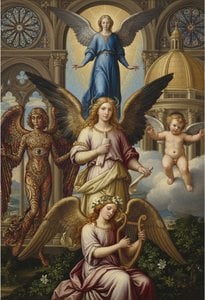
Two angels and two devils

Paolo Uccello’s “Two Angels and Two Devils,” completed in 1469, showcases a revolutionary perspective technique—a masterful illusion of depth achieved through mathematical precision—capturing the dramatic tension between divine grace and earthly temptation within this iconic Early Renaissance masterpiece.

Paolo Uccello (1397-1475): En florentinsk konstnär som banade väg för perspektiv och dynamiska bataljscener. Utforska hans färg, ljus och matematiska principer!

Giclée / Konsttryck

Giclée- eller canvasprint av museumskvalitet med snabb produktion och flexibla ytbehandlingsalternativ. ( Beställ handmålad reproduktion Byt till digital bild)

Corner sample of the P118B picture frame: formgjuten polystyren, 5 cm wide and 3 cm thick
P118B Skr10
Corner sample of the P118H picture frame: formgjuten polystyren, 5 cm wide and 3 cm thick
P118H Skr10
Corner sample of the P118W picture frame: formgjuten polystyren, 5 cm wide and 3 cm thick
P118W Skr10
Corner sample of the P438Z picture frame: formgjuten polystyren, 5.5 cm wide and 3.5 cm thick
P438Z Skr10
Corner sample of the P508JH picture frame: formgjuten polystyren, 7 cm wide and 3.5 cm thick
P508JH Skr12
Corner sample of the P508YH picture frame: formgjuten polystyren, 7 cm wide and 3.5 cm thick
P508YH Skr12
Corner sample of the P805H picture frame: formgjuten polystyren, 5 cm wide and 3.5 cm thick
P805H Skr10
Corner sample of the P805Z picture frame: formgjuten polystyren, 5 cm wide and 3.5 cm thick
P805Z Skr10
Corner sample of the P919BZ picture frame: formgjuten polystyren, 7 cm wide and 3.5 cm thick
P919BZ Skr10
Corner sample of the P919G picture frame: formgjuten polystyren, 7 cm wide and 3.5 cm thick
P919G Skr10
Corner sample of the P919XJ picture frame: formgjuten polystyren, 7 cm wide and 3.5 cm thick
P919XJ Skr10
Corner sample of the P959ZH picture frame: formgjuten polystyren, 5 cm wide and 3 cm thick
P959ZH Skr10
Corner sample of the P968JZ picture frame: formgjuten polystyren, 6 cm wide and 4 cm thick
P968JZ Skr12
Corner sample of the W106C picture frame: massivt trä, 5 cm wide and 3 cm thick
W106C Skr8
Corner sample of the W218G picture frame: massivt trä, 5 cm wide and 3 cm thick
W218G Skr10
Corner sample of the W218JH picture frame: massivt trä, 5 cm wide and 3 cm thick
W218JH Skr8
Corner sample of the W218Y picture frame: massivt trä, 5 cm wide and 3 cm thick
W218Y Skr10
Corner sample of the W307PJ picture frame: massivt trä, 6 cm wide and 3 cm thick
W307PJ Skr10
Corner sample of the W316G picture frame: massivt trä, 6 cm wide and 3 cm thick
W316G Skr10
Corner sample of the W316PJ picture frame: massivt trä, 6 cm wide and 3 cm thick
W316PJ Skr8
Corner sample of the W316Y picture frame: massivt trä, 6 cm wide and 3 cm thick
W316Y Skr10
Corner sample of the W398PJ picture frame: massivt trä, 5 cm wide and 3 cm thick
W398PJ Skr8
Corner sample of the W4111J picture frame: massivt trä, 6.5 cm wide and 3.5 cm thick
W4111J Skr10
Corner sample of the W500HY picture frame: massivt trä, 7 cm wide and 5 cm thick
W500HY Skr15
Corner sample of the W500JH picture frame: massivt trä, 7 cm wide and 5 cm thick
W500JH Skr15
Corner sample of the W692G picture frame: massivt trä, 8 cm wide and 4 cm thick
W692G Skr12
Corner sample of the W849H picture frame: massivt trä, 5 cm wide and 3 cm thick
W849H Skr8
Corner sample of the W940BG picture frame: massivt trä, 7.5 cm wide and 4.5 cm thick
W940BG Skr15
Corner sample of the W953PJ picture frame: massivt trä, 6 cm wide and 3.5 cm thick
W953PJ Skr8

Standardstorlek
skräddarsydd
CM
INCH

Välj bland våra förinställda storlekar som motsvarar konstverkets ursprungliga proportioner.

bredd
höjd

Ange den bredd och höjd du behöver för att passa din ram eller vägg. Ett tryck kan endast beskäras, aldrig göras större än originalbilden, vilket innebär att ett format med en annan proportion leder till att en del av bilden går förlorad. Vi skickar en digital mockup för godkännande innan vi påbörjar tryckningen. Bilden som visas på denna sida visar inte den faktiska beskärningen — det är endast mockuppen som gör det.

Leverans över hela världen () på 2 veckor istället för standard 4/5 veckor. (27 oktober)

Fri expressfrakt över hela världen
Högkvalitativ linnecanvas
Fullständig fraktförsäkring
Garantier för återbetalning av tullavgifter
Garantier för exakt färgåtergivning
100 dagars returrätt (endast vid fel)
100% pengarna tillbaka-garanti
Mängdrabatt erbjuds

Totalt pris

Skr 675

Two angels and two devils

Giclée / Konsttryck

Storlek på reproduktion

-

Slutgiltigt pris

Skr 675

Kortfakta

  • Movement: Early Renaissance
  • Artist: Paolo Uccello
  • Medium: Oil Painting
  • Subject or theme: Religious Narrative
  • Title: Two angels and two devils
  • Year: 1469

Konstquiz

Det finns endast ett korrekt svar på varje fråga.

Fråga 1:
What artistic technique is Paolo Uccello most renowned for pioneering in this painting?
Fråga 2:
The painting depicts a scene featuring angelic and demonic figures. What is the primary purpose of this juxtaposition?
Fråga 3:
According to Giorgio Vasari, what was Paolo Uccello obsessed with regarding his artistic endeavors?
Fråga 4:
What is the dominant color palette employed by Uccello in ‘Two angels and two devils’?
Fråga 5:
The painting's setting includes a bed and couches. What role do these elements contribute to the overall atmosphere?

A Pioneering Vision of Spiritual Drama: Paolo Uccello’s “Two Angels and Two Devils”

Paolo Uccello's "Two Angels and Two Devils," completed in 1469, stands as a cornerstone of Early Renaissance art—a testament to his revolutionary approach to perspective and an embodiment of the period’s fascination with theological narratives. More than just a depiction of biblical figures, this painting represents a profound exploration of moral duality and the human struggle between good and evil, skillfully rendered through meticulous observation and innovative artistic techniques. Giorgio Vasari famously recounted Uccello's obsessive dedication to mastering linear perspective, spending countless hours studying mathematical principles to achieve an unprecedented illusion of depth within his canvases—a pursuit that cemented his legacy as a true innovator.

The Anatomy of Perspective: Uccello’s Mathematical Breakthrough

Uccello wasn’t merely interested in portraying beauty; he sought to represent reality itself with astonishing accuracy. His meticulous calculations and diagrams, documented in his own treatise “Lives of the Most Excellent Painters,” Sculptors, and Architects, demonstrate a commitment to scientific rigor rarely seen at the time. He painstakingly constructed a stage-like setting—a dining room adorned with furniture, beds, couches, and a landscape backdrop—to illustrate the principles of aerial perspective. This technique cleverly simulates atmospheric haze, reducing color intensity and blurring distant objects, creating an immersive experience for the viewer that transcends mere visual representation. The artist’s deliberate framing contributes to this illusion, guiding the eye towards a central vanishing point – a pivotal element in conveying spatial realism.

Symbolism Within Sacred Narrative

The composition itself is laden with symbolic significance. The two angels, positioned on the left side of the painting, represent divine grace and righteousness—their flowing robes and majestic wings convey an aura of serenity and spiritual authority. Their posture exudes calm contemplation, reflecting the virtues associated with God’s benevolent influence. Conversely, the devils dominate the right side, embodying temptation and darkness. Their grotesque features and twisted postures underscore their opposition to angelic ideals, symbolizing evil's insidious intrusion into human affairs. The central figure—a man lying on a bed—represents humanity caught between these opposing forces—a poignant reminder of the ongoing battle for moral fortitude.

A Window Into Florentine Renaissance Thought

“Two Angels and Two Devils” reflects the broader intellectual climate of Florence during Uccello’s era – a period marked by burgeoning humanist scholarship alongside fervent religious devotion. The painting exemplifies the Renaissance preoccupation with reconciling faith and reason, mirroring the philosophical debates surrounding Augustine's theology and its influence on artistic interpretation. Uccello’s masterful use of color—particularly the vibrant reds and blues—further enhances the dramatic impact of the scene, capturing not only visual beauty but also conveying emotional intensity. It is a piece that invites contemplation on themes of morality, spirituality, and the human condition – enduring legacies of Uccello's artistic vision.

A Legacy Enduring Through Reproduction

Today, reproductions of “Two Angels and Two Devils” continue to inspire admiration for their technical brilliance and profound symbolic depth. WahooArt offers exceptional quality prints that allow collectors and interior designers alike to experience the captivating artistry of Paolo Uccello firsthand—bringing a masterpiece of Early Renaissance art into homes around the world.

Frågor och svar

Vilken färgharmoni uppvisar "Two angels and two devils" av Paolo Uccello?

"Two angels and two devils" av Paolo Uccello uppvisar en Strong Color Unity färgharmoni.

Vad rekommenderas för användning av ett tryck av "Two angels and two devils"?

Det rekommenderade användningsområdet för "Two angels and two devils" av Paolo Uccello är Statement. Den kan även användas till andra ändamål.

Hur förhåller sig stilen i "Two angels and two devils" till sin skapares epok?

"Two angels and two devils" tillhör den Early Renaissance rörelsen och dess skapare verkade under Renässansen-eran.


Konstnärsbiografi

A Florentine Visionary: The Life and Art of Paolo Uccello

Paolo Uccello, född Paolo di Dono omkring 1397 i Pratovecchio nära Arezzo, är en av de mest fascinerande och gåtfulla figurerna inom den tidiga renässansen. Hans smeknamn – “Uccello” (italiensk för ”fågel”) – antyder en lekfull natur och ett konstnärligt intresse för fågelliv, men döljer en tankefull personlighet djupt engagerad i de växande intellektuella strömningarna under hans tid. Han var inte bara en målare; han var en pionjär, en matematiker av duken, som sökte upplösa hemligheterna bakom visuell rymd och översätta dem till betagande konstverk. Hans far, Dono di Paolo, bedrev både barber-kirurgi och konst, medan hans mor, Antonia, härstammade från en florentinsk adelsfamilj – en bakgrund som kanske inställde både en praktisk känsla och ett uppskattande för raffinerad estetik hos den unga Paolo. Mellan 1412 och 1416 tillbringades Uccellos formativa år under Lorenzo Ghibertis ledning, vars verkstad var en katalysator för konstnärliga innovationer, fokuserad på skapandet av de magnifika bronsdörrarna till Florens Baptisterium. Denna tidiga exponering etsade in den rådande gotiska stilen, med dess betoning på dekorativ elegans och berättande klarhet, men tände också en längtan efter att gå utöver etablerade gränser.

The Pursuit of Perspective: A Mathematical Mind at Play

Uccello’s konstnärliga utveckling var inte bara ett äventyr i teknik; den drevs av en outtröttlig nyfikenhet kring de underliggande principerna som styr perception. Han blev besatt av matematik, särskilt geometri och perspektiv, inte som abstrakta discipliner utan som verktyg för att låsa upp en mer sanningsenlig representation av verkligheten. Medan Filippo Brunelleschi ofta krediteras med att upptäcka linjärt perspektiv, var Uccello bland de första att systematiskt tillämpa det på målning, noggrant beräkna vanishing points och ortogonala linjer för att skapa en illusion av djup som tidigare hade varit i stort sett obefintlig i konsten. Detta handlade inte bara om teknisk precision; för Uccello var perspektiv ett medel för att strukturera berättelser, förstärka drama och införliva en känsla av ordning och intellektuell rigor i hans kompositioner. Hans fascination gränsade till besatthet, som beskrivs av Giorgio Vasari, som beskrev Uccello som ständigt sysselsatt med att studera vanishing points och rumsliga relationer sent på kvällen. Denna dedikation, även om den ibland uppfattades som excentrisk, förändrade i grunden måleriet och banade väg för framtida generationers konstnärer.

Masterpieces of Illusion: Key Works and Stylistic Traits

Uccello’s oeuvre, även om den är relativt liten, kännetecknas av en distinkt stil som blandar gotisk elegans med renässansinnovation. The Battle of San Romano, en serie på tre pannåer beställda för att minnesmärka en florentinsk seger, står som kanske hans mest berömda prestation. Dessa målningar är inte bara skildringar av krigföring; de är dynamiska kompositioner fyllda med virvlande figurer, fragmenterade rustningar och dramatiskt förkortade lansar – allt målat i livfulla färger och arrangerat enligt noggrant beräknade perspektiv. The Birth of the Virgin visar Uccello’s behärskning av linjärt perspektiv, vilket skapar en övertygande illusion av djup inom ett begränsat utrymme, medan hans St George and the Dragon presenterar en slående skildring av den legendariske helgonen, präglad av djärva färger och stiliserade former. Även i verk som *The Flood and the Ark*, del av freskerna i San Miniato al Monte, Uccello’s fascination med arkitektoniska detaljer och komplexa kompositioner märks tydligt. Hans stil avslöjar konsekvent:
  • En livfull palett och en djärv användning av färg.
  • En betoning på linjärt perspektiv, ofta pressat till sina gränser för dramatiska effekter.
  • Stiliserade figurer och dekorativa mönster som är typiska för gotisk konst.
  • En djupgående fascination med geometriska former och rumsliga relationer.

Historical Significance and Lasting Influence

Paolo Uccello’s bidrag till renässansen sträcker sig bortom hans individuella målningar. Hans banbrytande utforskning av perspektiv förändrade i grunden konstens gång, och påverkade otaliga konstnärer som följde efter honom. Albrecht Dürer, den kända tyska tryckaren och målaren, var djupt inspirerad av Uccello’s verk och ägnade sig åt att studera perspektiv och införliva dess principer i sin egen konstpraktik. Även om Uccello’s stil förblev något excentrisk under hela hans karriär – en unik blandning av gotisk elegans och renässansinnovation – säkerställde hans banbrytande syn på rymd och form hans plats som en nyckelperson i utvecklingen av västerländsk konst. Han dog i Florens 1475, lämnade efter sig ett arv inte bara av vackra målningar utan också av intellektuell nyfikenhet och konstnärligt mod. Hans verk fortsätter att inspirera beundran och upptäckt, påminner oss om att sanna konst ligger inte bara i det som ses, utan i förståelsen av hur vi ser det.

Paolo Uccello

Paolo Uccello

1397 - 1475 , Italien

Kortfakta

  • Artistic Movement Or Style: Tidig Renässans
  • Artists Or Movements Influenced By This Artist:
    • Dürer
    • Renässans
  • Artists Who Influenced This Artist:
    • Ghiberti
    • Donatello
  • Date Of Birth: 1397
  • Date Of Death: 1475
  • Full Name: Paolo di Dono
  • Nationality: Italienare
  • Notable Artworks:
    • San Romano
    • Jungfrukristens födelse
    • Sankt Göran och draken
  • Place Of Birth: Pratovecchio, Italien
Utforska konstverk sorterade efter tema, stil och egenskaper.