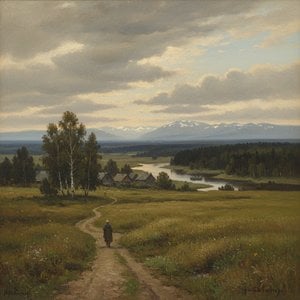
A Life Immersed in Art and Spirit
Nicholas Roerich, född den 9 oktober 1874 i det pulserande kulturella hjärtat av Sankt Petersburg, Ryssland, var en gestalt vars liv sträckte sig bortom de konstnärliga uttryckens gränser. Han var inte bara en målare; han var en arkeolog, en författare, en filosof och en envis förespråkare för fred och kulturell bevarande. Hans uppväxt, djupt rotad i både intellektuell rigor – hans far var notarie – och konstnärlig uppskattning tack vare sin mor, lade grunden för en otroligt mångfacetterad karriär. Roerich studerade samtidigt juridik och konsthantverk vid Sankt Petersburgs universitet och den kejserliga konstakademin från 1893, vilket visade ett tidigt engagemang för att förstå världen i sin helhet. Detta dubbla väg var inte motsägelsefullt för honom; snarare återspeglade det en tro på att konstnärlig vision behövde vara grundad i historiskt sammanhang och intellektuell disciplin. Han fick sin konstnärliga betygning 1897 och avslutade sin juristutbildning året därpå, vilket lade grunden för ett liv dedikerat till både kreativ utforskning och välgrundad handling.
Den Lockande Symbolismen och Teaterns Innovation
Roerichs konstnärliga utveckling formas djupt av de strömningar som präglade den ryska symbolismen, en rörelse som sökte framkalla emotionella och andliga djup genom suggestiva bilder och ledande former. Han engagerade sig snabbt i Sergei Diaghilevs inflytelserika “World of Art” – samhället, och tog senare dess presidentskap från 1910 till 1916. Detta förhållande visade sig vara avgörande, eftersom det exponerade honom för ett nätverk av innovativa konstnärer, kompositörer och tänkare som omdefinierade den ryska konstens landskap. Hans tidiga verk avslöjade en fascination för arkeologi och scenografi, vilket ledde till banbrytande samarbeten med Diaghilevs Ballets Russes. Roerichs design för produktioner som Alexander Borodins *Prince Igor* (1909) och framför allt Igor Stravinskijs revolutionerande *The Rite of Spring* (1913), var inte bara bakgrunder; de var integrerade delar av den teateriska upplevelsen. Han blandade noggrann historisk forskning med en djärv fantasivision, skapade därför visuellt slående miljöer som förstärkte musiken och koreografins känslomässiga kraft. Dessa design var inte bara dekorativa; de var försök att väcka primordiala krafter och gamla ritualer, vilket återspeglade symbolistens intresse för mytologi och andlighet. Hans verk påverkades också av apokryfa texter och medeltida sektära skrifter som *Dove Book*, vilket lade till djupare esoteriska betydelser till hans konstnärliga skapelser.
En Resa Mot Mystik och Himalajas Visioner
När Roerichs karriär utvecklades, förändrades hans målningar avsevärt och omfamnade alltmer mystiska och andliga teman. Denna förflyttning drevs av hans växande intresse för Theosophin och österländska religioner, filosofier som betonade sammanhanget mellan alla ting och strävan efter inre visdom. Hans *Architectural Studies* – serien (1904–1905) visade inte bara hans arkitektoniska skicklighet utan också ett djupt engagemang för att bevara kulturarv, vilket förutspådde hans senare förespråkande för att skydda konsten under tider av konflikt. Återkommande motiv började dyka upp i hans verk: majestätiska landskap, gamla städer vilseledande i mysterium och figurer fyllda med andlig betydelse som St. Panteleimon och Kuan Yin. Han företog omfattande resor genom Centralasien, där han utförde arkeologisk forskning och dokumenterade antika kulturer, upplevelser som djupt påverkade hans konstnärliga vision och förstärkte tron på vikten av kulturell förståelse.
Arv av Bevarande och Bestående Inverkan
Nicholas Roerichs engagemang sträckte sig bortom duken; han var en dedikerad förespråkare för att skydda konsten och arkitekturen under tider av krig. Erkännande av den sårbara egenskapen hos kulturella skatter, initierade han skapandet av Roerich Pact 1935 – ett internationellt avtal som var utformat för att skydda konstobjekt från förstörelse. Denna initiativ gav honom flera nomineringar till Nobelpriset, vilket understryker hans djupa humanitära engagemang. Hans uttråkade ansträngningar visade en tro på att bevara kulturarv inte bara var viktigt för att förstå det förflutna utan också för att bygga en fredligare framtid. Idag hyllas Roerichs verk i framstående museisamlingar över hela världen, inklusive Astrakhan State Picture Gallery och framför allt Nicholas Roerich Museum i New York City. Hans inflytande på den ryska konsten och kulturen är obestridligt. Han brottade gapet mellan konstnärligt uttryck och andlig utforskning, vilket påverkade generationer av konstnärer och tänkare med sin visionära metodik.
Nyckelverk & Bestående Relevans
- Saint Nicholas: En detaljerad svartvit fresk som visar medeltida konst och heraldiska symboler.
- City: Suggestiva bilder av gamla stadslandskap, som återspeglar hans arkeologiska intressen.
- Lake of the Nagas: Ett temperafärg som blandar symbolik och natur, exemplifierar hans unika konstnärliga vision.



 Förhandsvisa
 Byt till tryck
 Skicka
 Dela
Dela
 Visa detaljer

 Ladda ner
 Liknande objekt
 Röntgen
 Bildspel
 Statistik

 Visa mer






































 Glasalternativet är endast tillgängligt i storlekar under 110 cm.