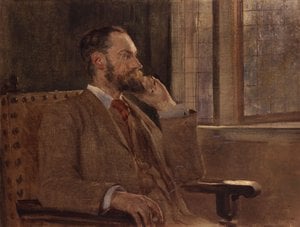
A Vision of Light: The Life and Legacy of Matthew Ridley Corbet
In the golden age of Victorian landscape painting, few artists captured the ephemeral dance of light and atmosphere with as much soul as Matthew Ridley Corbet. Born on May 20, 1850, in the quiet village of South Willingham, Lincolnshire, Corbet’s origins were rooted in a world of classical scholarship and religious tradition. As the son of the Reverend Andrew Corbet, his early life was shaped by the disciplined intellect of Cheltenham College, yet his heart was destined for the vibrant, sun-drenched vistas of the Mediterranean. This tension between his structured English upbringing and his burgeoning passion for the natural world would eventually define his unique contribution to the nineteenth-century art canon.
Corbet’s formal artistic journey began within the prestigious halls of the Slade School of Art, where he studied under Alexander Davis Cooper, and later at the Royal Academy Schools under the legendary Frederic Leighton. These institutions provided him with a rigorous foundation in neoclassical technique, yet it was his departure for Italy in 1880 that truly ignited his creative spirit. In the warmth of the Italian sun, Corbet moved beyond the rigid boundaries of academic realism to embrace a more fluid, expressive way of seeing. It was during this transformative period that he formed a profound and lasting bond with the painter Giovanni Costa. This partnership became a cornerstone of his development, as together they explored the rugged beauty of Tuscany and Umbria, seeking to capture the very essence of the landscape.
The Macchiaioli Influence and Stylistic Evolution
The true metamorphosis of Corbet’s style occurred through his immersion in the Macchiaioli movement. Often referred to as the "splashed" painters, this group of Italian innovators sought to reject the stale conventions of academic painting in favor of direct observation and the emotive power of light. Influenced by Costa, Corbet began to master the art of the macchia—the use of distinct patches or "spots" of color to define form and atmosphere. His brushwork grew looser and more spontaneous, allowing him to render the fleeting moments of a sunset or the hazy shimmer of heat over an Italian valley with unprecedented vitality.
His canvases became windows into a world of luminous color palettes and soft, atmospheric textures. This evolution is perhaps most evident in his ability to blend Romanticism with a burgeoning Impressionistic sensibility. While his compositions often retained a sense of classical grandeur and structural integrity, the surface of his paintings pulsed with life. He did not merely paint a mountain or a field; he painted the way light clung to the stone and the way shadows stretched across the grass at dusk. This mastery of light allowed him to evoke deep emotional responses, transporting the viewer from the grey skies of England to the idyllic, sun-soaked landscapes of the Mediterranean.
Masterworks and Historical Significance
Throughout his career, Corbet exhibited extensively across Europe, earning a reputation as a premier chronicler of the Italian countryside. His oeuvre contains several landmarks of Victorian landscape art that continue to captivate collectors and historians alike:
- Etruscan Scene (1890): A breathtaking panoramic vista of the Carrara Mountains, where Corbet demonstrates his ability to capture the monumental scale and rugged majesty of the Italian terrain.
- The Arcadian Shepherd and His Flock (1883): An evocative, idyllic portrayal of rural tranquility that showcases his skill in creating peaceful, pastoral narratives imbued with a sense of timelessness.
- Val d'Arno Evening: A celebrated work held in the prestigious Tate Britain collection, which exemplifies his late-career mastery of twilight atmospheres and soft, receding horizons.
Though his life was tragically short, ending in 1902, Matthew Ridley Corbet left an indelible mark on the trajectory of landscape painting. He served as a vital bridge between the structured traditions of the Royal Academy and the experimental freedom of the modern era. By integrating the classical training of his English heritage with the revolutionary light-centric techniques of the Italian Macchiaioli, he created a body of work that remains a testament to the enduring power of nature and the transformative beauty of light.



 Förhandsvisa
 Byt till tryck
 Skicka
 Dela
Dela
 Visa detaljer

 Ladda ner
 Liknande objekt
 Röntgen
 Bildspel
 Statistik
 Visa mer