

Konstverket som visas på denna sida skyddas av upphovsrättslagen, vilket innebär att vi inte lagligt kan skapa eller sälja en identisk reproduktion. Detta skydd upprätthålls genom internationella avtal såsom den Bernkonventionen och genom nationella lagar, inklusive de som fastställs av Amerikansk upphovsrättslag – Titel 17. Alla rättigheter förbehållna. Återgivning av konstverk är förbjuden utan skriftligt tillstånd från WahooArt.
Denna metod följer fullt ut upphovsrättsliga regler eftersom den inte innebär kopiering eller duplicering av det skyddade konstverket. Istället är det en kreativ nytolkning – en ny målning som är influerad av originalet men inte identisk med det.
Giclée- eller canvasprint av museumskvalitet med snabb produktion och flexibla ytbehandlingsalternativ. ( Beställ handmålad reproduktion Byt till digital bild)





























Välj bland våra förinställda storlekar som motsvarar konstverkets ursprungliga proportioner.

Ange den bredd och höjd du behöver för att passa din ram eller vägg. Ett tryck kan endast beskäras, aldrig göras större än originalbilden, vilket innebär att ett format med en annan proportion leder till att en del av bilden går förlorad. Vi skickar en digital mockup för godkännande innan vi påbörjar tryckningen. Bilden som visas på denna sida visar inte den faktiska beskärningen — det är endast mockuppen som gör det.
Leverans över hela världen () på 2 veckor istället för standard 4/5 veckor. (8 november)
Chessboard (Echiquier)
Storlek på reproduktion
Marcel Duchamp, a name synonymous with artistic revolution, consistently challenged the very definition of art throughout his prolific career. While celebrated for audacious “readymades” like *Fountain*, a porcelain urinal presented as sculpture, his explorations extended far beyond shock value. ‘Chessboard (Echiquier)’ from around 1937 offers a quieter, yet equally profound glimpse into Duchamp’s intellectual and artistic preoccupations. This isn't merely a depiction of a game; it is an embodiment of the artist’s lifelong fascination with strategy, intellect, and the dematerialization of art itself.
Duchamp’s relationship with chess was far from casual. He didn't simply play the game; he immersed himself in it, even contemplating a professional career as a chess master after largely abandoning painting in the early 1920s. This wasn’t a flight *from* art, but rather a redirection of artistic energy into a realm demanding logic, foresight, and abstract thought – qualities Duchamp increasingly valued over purely aesthetic concerns. ‘Chessboard (Echiquier)’ therefore becomes symbolic of this shift. The worn wood, the missing pieces, suggest not a game in progress, but a contemplation *of* the game, a frozen moment representing endless possibilities and strategic calculations. It’s a visual metaphor for the artist's own creative process: a deliberate arrangement of elements, a calculated disruption of expectations.
The simplicity of ‘Chessboard (Echiquier)’ is deceptive. Duchamp wasn’t interested in virtuoso painting or sculptural skill; his focus lay elsewhere. The work consists of sixty-four wooden squares nailed and glued onto plywood, a deliberately unrefined construction that emphasizes the object's conceptual nature over its aesthetic qualities. This deliberate lack of traditional artistic flourish aligns with Duchamp’s Dadaist principles – a rejection of bourgeois values and conventional artistic standards. By presenting a commonplace object—a chessboard—in an almost rudimentary form, he forces the viewer to question what constitutes art. Is it skill? Beauty? Or simply the artist's intention?
Duchamp’s impact on 20th and 21st-century art is immeasurable. He paved the way for Conceptual Art, Minimalism, and countless other movements that prioritize ideas over execution. ‘Chessboard (Echiquier)’ encapsulates this legacy perfectly. It's a work that doesn't demand to be *looked at* in the traditional sense; it demands to be *thought about*. Its enduring appeal lies not in its visual splendor, but in its ability to provoke questions and challenge assumptions. For collectors and interior designers alike, a reproduction of this piece offers more than just an aesthetic addition—it’s an invitation to engage with a pivotal moment in art history and a testament to the power of intellectual curiosity.
Marcel Duchamp är även känd under namnen Henri-Robert-Marcel Duchamp, Rrose Sélavy.
"Chessboard (Echiquier)" finns tillgänglig som en handmålad oljereproduktion på linneväv. Du kan lägga din beställning på dess Handmålad reproduktion-sida, där du kan välja mellan olika storlekar.
"Chessboard (Echiquier)" tillhör Marcel Duchamps Conceptual/Later Period i konstnärskarriären. Denna klassificering relaterar verket till konstnärens utveckling.


1887 - 1968 , Frankrike

Utforska de 10 mest inflytelserika verken inom abstrakt expressionism – från Rothkos färgfält till Pollocks action painting. Lär känna konstnärerna och deras teknik. Hitta museumskvalitativa tryck på WahooArt.com och förvandla ditt hem med tidlös konst!

Explore the radical origins of Dadaism. From the chaos of WWI to Marcel Duchamp's revolutionary readymades, discover how this anti-art movement dismantled tradition and birthed modern conceptual art. An essential guide for students and collectors of fine art history.

Utforska de 10 mästerverk som definierade geometrisk abstraktion! Lär känna Mondrian, Kandinsky & Malevich. Hitta inspiration och museumskvalitativa konsttryck för ditt hem på WahooArt.com. Upptäck hela samlingen online!

Utforska Wassily Kandinskys 25 mest ikoniska verk – från expressionism till abstrakt konst. Lär känna historien bakom mästerverken och hitta inspiration för din heminredning med WahooArt.com. Upptäck hela samlingen online!
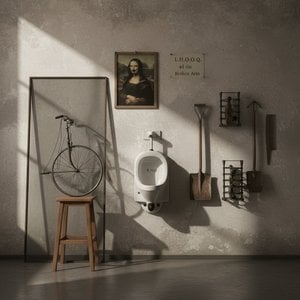
Explore the revolutionary art of Marcel Duchamp! Discover how his Dadaist readymades challenged artistic conventions & redefined modern art. A deep dive into 'Fountain', conceptual shifts, and his lasting impact.
 Förhandsvisa
 Skicka
 Dela
Dela
 Visa detaljer
 Guide
Guide

 Ladda ner
 Liknande objekt
 Röntgen
 Bildspel
 Frågor och svar
 Statistik
 Visa mer









 Glasalternativet är endast tillgängligt i storlekar under 110 cm.


