A Parisian Life Intertwined with Art and Activism
Lucie Cousturier, born Lucie Brû in Paris on December 19, 1876, was a woman of remarkable breadth—a painter whose canvases shimmered with the light of Neo-Impressionism, and a writer who dared to challenge colonial perspectives. Her life unfolded against a backdrop of artistic ferment and social change, a period where traditional boundaries were being questioned and new forms of expression were emerging. Born into privilege – her father, Léon Casimir Brû, owned a successful doll factory – Lucie benefited from opportunities for education and artistic development that were unavailable to many women of her time. From the age of fourteen, she demonstrated a keen interest in painting, an inclination nurtured by exposure to the vibrant art scene of Belle Époque Paris. This early passion led her to study under luminaries like Paul Signac and Henri-Edmond Cross, pivotal figures in the Neo-Impressionist movement, and fostered a close artistic kinship with Georges Seurat himself. These influences would profoundly shape her aesthetic sensibilities and technical approach, laying the foundation for a career that seamlessly blended artistic innovation with social consciousness.
The Embrace of Pointillism and Evolving Style
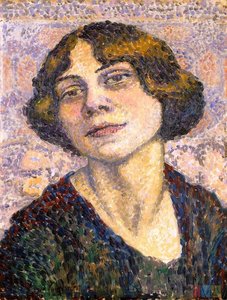
Cousturier’s early work is deeply rooted in Neo-Impressionism, a technique characterized by the meticulous application of small, distinct dots of pure color intended to optically blend in the viewer's eye. This method, championed by Seurat and Signac, allowed for an extraordinary luminosity and vibrancy, qualities that Cousturier masterfully embraced in her landscapes and still lifes. However, she wasn’t merely a follower; her style evolved over time, subtly incorporating elements of Fauvism – a movement known for its bold, non-naturalistic colors and expressive brushstrokes. This transition is evident in her outdoor scenes, which became increasingly dynamic and infused with warmth. She frequently depicted the serene beauty of landscapes, intimate still lifes often featuring flowers and vases, and insightful portraits that offered glimpses into the personalities of her subjects. Her 1919 self-portrait stands as a compelling testament to her artistic vision and inner life, revealing a woman confident in her craft and keenly aware of her place within the evolving art world. By 1907, Cousturier had achieved a remarkable level of technical skill and color mastery, establishing herself as a significant voice within the Neo-Impressionist circle.
A Journey into the Heart of Colonial Africa
The trajectory of Lucie Cousturier’s life took an unexpected turn following World War I. Granted a mission by the French Minister of Colonies, she embarked on a journey to French West Africa in October 1921, returning in April 1922. This wasn't simply a voyage of exploration; it was a deliberate attempt to understand family life and the role of women within the colonial context. Her experiences during this period proved transformative, prompting her to meticulously document her observations in a detailed journal. These writings formed the basis for two groundbreaking books: *Mes inconnus chez eux: mon ami Fatou* (My Strangers in Their Home: My Friend Fatou) and *Mes inconnus chez eux: mon ami Soumaré* (My Strangers in Their Home: My Friend Soumaré), published posthumously in 1925. Cousturier’s accounts offered a refreshingly unprejudiced perspective on colonial relationships, emphasizing her genuine friendships with African women and acknowledging the complexities of her own position within the colonial hierarchy. She was unafraid to critique both the structural injustices of colonialism and the patriarchal attitudes prevalent in local societies, making her work a pioneering contribution to anti-colonial thought.
Legacy of Art and Advocacy
Upon returning to France, Cousturier dedicated herself to the cause of racial emancipation, contributing articles to *Le Paria*, a newspaper that served as a platform for advocating the rights of people of color. This commitment to social justice underscored her belief in the power of art not only to reflect reality but also to challenge it. In 1923, she was honored with an exhibition showcasing her work alongside that of Paul Signac in Brussels, further solidifying her reputation within artistic circles. Sadly, Lucie Cousturier’s life was cut short by illness; she died in Paris on June 16, 1925, at the age of forty-eight. Writer René Maran poignantly described her as “two eyes and a heart,” recognizing her profound empathy and insightful observations. While much of her artwork remains in private collections, her writings continue to be studied for their unique perspective on colonialism and race relations, and her art is experiencing a renewed appreciation for its vibrant colors and expressive style.
- Early Exhibitions: Began exhibiting at the Salon des Artistes Indépendants in 1901.
- Literary Works: Author of *Mes inconnus chez eux: mon ami Fatou* and *Mes inconnus chez eux: mon ami Soumaré*.
- Social Activism: Contributed to *Le Paria*, advocating for racial emancipation.
Lucie Cousturier’s legacy extends beyond her artistic achievements. She was a woman who dared to look beyond the conventions of her time, embracing both aesthetic innovation and social responsibility. Her life serves as an inspiration—a testament to the power of art to illuminate, challenge, and ultimately, contribute to a more just and equitable world.
Her work remains a vital reminder that artistic expression can be a powerful force for change.



 Beställ handmålad reproduktion
 Skicka
 Dela
Dela
 Visa detaljer

 Ladda ner
 Liknande objekt
 Bildspel
 Statistik


 Visa mer






































 Glasalternativet är endast tillgängligt i storlekar under 110 cm.