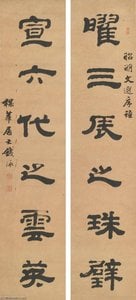
The Calligraphic Soul of a Reformer
In the turbulent twilight of the Qing Dynasty, few figures loomed as large or as complexly as Kang Youwei. To view his calligraphy is to witness more than mere ink on paper; it is to encounter the rhythmic pulse of a man caught between the ancient weight of Confucian tradition and the surging tides of Western modernity. Born in 1858 in the village of Su, within Guangdong province, Kang was a scholar whose intellect was forged in the rigorous fires of classical study but tempered by a visionary's desire to reshape a nation. His life was a profound struggle to reconcile the eternal ethics of the past with the urgent political necessities of a changing world, a tension that found its most graceful expression in the fluid, decisive strokes of his brushwork.
The intellectual foundation of Kang’s artistry was deeply rooted in the Confucian classics, yet he possessed an uncommon ability to reinterpret these ancient texts through a lens of progress. While many of his contemporaries clung to a reactionary preservation of tradition, Kang sought a way to revitalize the very essence of Chinese identity. This philosophical duality—the reverence for heritage and the hunger for reform—is palpable in his artistic output. His work often reflects a sense of intellectual rigor paired with an artistic sensitivity, where the structural discipline of formal scripts meets the spontaneous energy of more liberated styles. In his hands, calligraphy became a medium through which the stability of the old world and the dynamism of the new could coexist.
A Legacy Written in Ink and Action
The historical significance of Kang Youwei cannot be decoupled from his political audacity. As a primary architect of the Hundred Days’ Reform in 1898, he attempted to steer the Guangxu Emperor toward a constitutional monarchy, seeking to modernize education, strengthen the military, and overhaul the bureaucracy. This period of intense creativity and political maneuvering was marked by a high-stakes drama that eventually led to his exile following the coup by Empress Dowager Cixi. Yet, even in displacement, Kang’s influence remained undiminished. He continued to advocate for a reformed China, influencing generations of thinkers, including the prominent scholar Liang Qichao, who found inspiration in Kang's revolutionary reinterpretations of classical thought.
His artistic achievements serve as a serene counterpoint to his often violent political reality. The works that survive him, such as his Calligraphy in Running Script and various poetic scrolls, offer a window into a more meditative aspect of his character. In these pieces, one can observe:
- The Mastery of Line: A meticulous command of brushwork that balances formal structure with the organic flow of ink.
- Symbolic Resonance: The use of traditional characters to convey complex political and philosophical ideologies.
- Rhythmic Balance: A sense of movement within his scrolls that mirrors the ebb and flow of historical change.
Ultimately, Kang Youwei remains a monumental figure whose legacy is etched into both the political history of China and the aesthetic heritage of East Asian calligraphy. He was a man who lived through the collapse of an empire, yet through his art, he achieved a form of immortality, capturing the spirit of an era in every stroke of black ink upon white paper.



 Förhandsvisa
 Byt till tryck
 Skicka
 Dela
Dela
 Visa detaljer

 Ladda ner
 Liknande objekt
 Röntgen
 Bildspel
 Statistik

 Visa mer