Oil On CanvasWallArtSynthetic Cubism
 1913Modern
 81.0 x 65.0 cm
Köp en högupplöst, förbättrad digital bild med betydligt högre kvalitet än förhandsvisningen online.
Varje fil är noggrant förberedd av våra interna specialister med hjälp av avancerade verktyg och professionell manuell retuschering. Vi säkerställer att varje bild har exceptionell skärpa, exakt färgåtergivning och fina detaljer.
Den slutgiltiga filen levereras via e-post inom 72 timmar, optimerad för omedelbar användning i professionella sammanhang, redaktionellt bruk och tryckmiljöer. Detta är samma kvalitet som med förtroende används av ledande designstudior, förlag och gallerier.
Ladda ner en högupplöst fil för personlig visning, utskrift och kreativa projekt. ( Beställ tryck Beställ handmålad reproduktion)
När du väljer WahooArt.com får du inte bara en bild – du får ett professionellt förädlat digitalt konstverk, skapat med precision och med en garanterad tillfredsställelse. Här är allt som ingår i din beställning, automatiskt:

Din högupplösta digitala bild skickas till dig via e-post inom 72 timmar efter beställning – redo för omedelbar användning.

Ditt konstverk optimeras professionellt med hjälp av avancerade AI-verktyg och manuell redigering, vilket garanterar maximal detaljrikedom, skärpa och färgnoggrannhet.

Har du råkat radera eller tappa bort din fil? Ingen oro – vi skickar den kostnadsfritt till dig när som helst.

Njut av ditt konstverk omedelbart utan tull, importavgifter eller leveranskostnader – digitala nedladdningar är alltid skattefria.

Vi säkerställer att din digitala bild återger de ursprungliga färgerna så exakt som möjligt med hjälp av professionella verktyg och färghantering.

Om du inte är nöjd med din digitala bild kommer vi att revidera den eller återbetala 100% inom 100 dagar – utan frågor.

Inte nöjd? Få full återbetalning inom 100 dagar efter att du har tagit emot din digitala fil – utan frågor och diskussioner.

Köp 3 bilder, spara 10% – Köp 5, spara 15% – Köp 10+, spara 20%. Perfekt för kreativa projekt, gallerier och byråer.
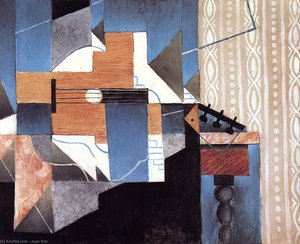
Juan Gris's "The Siphon," created in 1913, stands as a pivotal work within the Synthetic Cubist movement. This oil on canvas (81 x 65 cm), currently residing at the Rose Art Museum, exemplifies Gris’s unique approach to abstraction – one that grounded itself in recognizable objects while dismantling traditional representational techniques. The painting depicts a commonplace kitchen scene—a vase, bottles, cups, and a chair—rendered through a fractured lens of geometric shapes and muted colors.
The artwork's power lies in its deliberate fragmentation. Gris doesn’t aim to depict the objects as they appear from a single viewpoint; instead, he presents them simultaneously from multiple perspectives, breaking them down into interlocking planes and geometric forms. This technique, characteristic of Synthetic Cubism, moves beyond the Analytical Cubism that preceded it by incorporating simpler shapes and flatter areas of color. The monochromatic palette—primarily blues, grays, and whites with subtle accents of red and brown—contributes to a sense of harmony and balance despite the apparent chaos of fragmented forms. Overlapping planes create an illusion of depth within the flattened picture plane, while sharply defined lines add dynamism and visual interest.
"The Siphon" emerged during a period of radical artistic experimentation in the early 20th century. Following the pioneering work of Pablo Picasso and Georges Braque in Analytical Cubism, Gris spearheaded the development of Synthetic Cubism. This new phase emphasized simplification, collage elements (though absent here), and a greater emphasis on color. Gris’s approach was notably more structured and mathematically precise than that of his contemporaries, reflecting his engineering background. He sought to create a rational order within abstraction, using geometric forms to construct a coherent visual language.
While seemingly depicting mundane objects—a kitchen still life—"The Siphon" transcends mere representation. The fragmentation of these familiar items invites viewers to reconsider their perception of reality. The geometric abstraction evokes a sense of intellectual engagement rather than purely emotional response. There's a quiet dignity in the way Gris elevates everyday objects to the realm of high art, transforming them into complex visual puzzles. The muted color palette and carefully balanced composition create an atmosphere of contemplative stillness, inviting viewers to pause and appreciate the beauty inherent in deconstructed form.
Juan Gris (1887-1927) was a Spanish painter who became a central figure in the Cubist movement. Born José Victoriano González-Pérez, he adopted the pseudonym Juan Gris and moved to Paris in 1906, where he encountered influential artists like Matisse, Braque, and Picasso. His unique contribution lay in his systematic approach to Cubism, emphasizing geometric precision and a more structured composition than many of his contemporaries. Other notable works by Gris include "Glass of beer and playing cards" and "Newspaper and Fruit Dish," further demonstrating his mastery of Synthetic Cubism and his ability to transform ordinary subjects into extraordinary works of art.


1887 - 1927 , Spanien

 Förhandsvisa
 Skicka
 Dela
Dela
 Visa detaljer

 Ladda ner
 Liknande objekt
 Röntgen
 Bildspel
 Visa mer