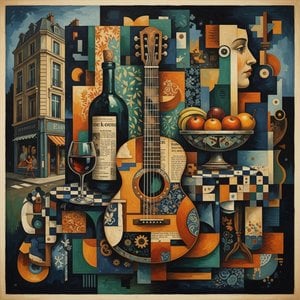
A Spanish Visionary of Cubism: The Life and Art of Juan Gris
Juan Gris, pseudonym för José Victoriano Carmelo Carlos González-Pérez, född 23 mars 1887 i Madrid, Spanien, död 11 maj 1927 i Boulogne-sur-Seine, Frankrike, var en spansk målare, skulptör och tecknare, förknippad med kubismen. Hans konst är ett fascinerande möte mellan analytisk precision och syntetisk lekfullhet, där geometriska former och färgpaletter samspelar för att skapa en unik visuell upplevelse. Gris’s resa från maskinritare till en av modernismens mest inflytelserika konstnärer är lika intressant som hans verk.
Early Life and Artistic Beginnings
Gris föddes i Madrid och fick tidigt ett intresse för både teknik och konst. Han studerade maskinritning vid den spanska skolan för ingenjörsvetenskap, men det var under influensen av historiemålaren José Moreno Carbonero som hans passion för måleri verkligen blomstrade. Under 1904-1905 bidrog han med teckningar till lokala tidskrifter, vilket visade en redan etablerad förmåga att observera och återge världen visuellt. Det var i slutet av 1905 som han antog namnet Juan Gris – ett namn som skulle bli synonymt med hans konstnärliga identitet. Denna förändring markerade en avgörande vändpunkt, en övergång från den praktiska världen till den kreativa utmaningen av måleriet.
Parisian Awakening and the Embrace of Cubism
1906 flyttade Gris till Paris, en stad som redan då var ett centrum för konstnärlig innovation och experimenterande. Där blev han snabbt en del av en dynamisk konstnärskrets, omgiven av namn som Henri Matisse, Georges Braque och Fernand Léger. Initialt arbetade han med satiriska illustrationer för tidningar som *L'Assiette au Beurre*, där hans skarpa blick och humoristiska stil utvecklades ytterligare. Men det var mötet med Pablo Picasso som skulle förändra hans konstnärliga riktning helt och hållet. Från 1910 började Gris att ägna sig helhjärtat åt kubismen, inte som en passiv kopia utan som en aktiv utforskare av nya visuella möjligheter. Han sökte efter ett sätt att fånga verklighetens essens genom att reducera den till grundläggande former och rumsliga relationer – en radikal avvikelse från traditionell representation.
The Geometry of Perception: Style and Key Works
Gris’s konstnärliga produktion kännetecknas av en exceptionell klarhet och intellektuell precision. Han analyserade inte bara objekt, utan rekonstruerade dem med ett genomtänkt och metodiskt tillvägagångssätt. Hans kompositioner följer en strikt geometri och tydliga linjestrukturer i skildringar av vardagliga föremål. Detta ledde till vad som blev känt som hans "kristallperiod", illustrerad av mästerverk som *Still Life Before an Open Window* (1912) och *Place Ravignan* (1915). Dessa verk visar en fascinerande interaktion mellan plan och vinkel, vilket skapar en känsla av djup och soliditet samtidigt som de utmanar traditionella perspektiv. Han var en pionjär inom kubismen, och hans arbete bidrog till att forma dess utveckling.
- Key Works: *Still Life Before an Open Window* (1912), *Place Ravignan* (1915), *Guitar in front of the sea* (1925), *Homage à Pablo Picasso* (1912)
Synthetic Cubism and the Integration of Collage
Efter 1913 tog Gris ett steg vidare i kubismen och omfamnade den syntetiska formen. Han började använda *papier collé* – collage – genom att integrera verkliga material, som tidningsutskrifter och texturerade papper, i sina kompositioner. Detta tillvägagångssätt ökade komplexiteten och taktiliteten i hans konst, suddade ut gränserna mellan måleri och skulptur. Han var en av de första att experimentera med denna teknik på ett sådant sätt, och det bidrog till att definiera den syntetiska kubismen. Hans verk från 1917-1920 visar en förenklad geometrisk struktur, en förvrängning av skillnaden mellan objekt och miljö, samt en harmonisk färgpalett som påverkade många andra konstnärer.
Legacy and Lasting Influence
Juan Gris’s bidrag till kubismen sträcker sig bortom bara stilistiska innovationer; han introducerade en unik intellektuell djup och strukturell klarhet i rörelsen. Han gick utöver den analytiska fasen och sökte efter ett mer organiserat och syntetiskt tillvägagångssätt, med fokus på ordning och precision. Hans konst har haft en betydande inverkan på Purist-rörelsen, som främjades av Amédée Ozenfant och Charles Edouard Jeanneret (Le Corbusier), och betonade vikten av klassiska principer för form och komposition. Gris’s betoning på geometriska former, harmoniska färgpaletter och integrationen av vardagliga objekt i hans konst etablerade honom som en nyckelperson i 20-talets konsthistoria. Hans arv inspirerar fortfarande konstnärer idag, vilket visar den bestående kraften hos kubismen och den visionära geni hos Juan Gris – en spansk mästare som omformade vår förståelse av perception och representation.



 Förhandsvisa
 Beställ handmålad reproduktion
 Skicka
 Dela
Dela
 Visa detaljer
 Guide
Guide

 Ladda ner
 Liknande objekt
 Röntgen
 Bildspel
 Q&A
Q&A Statistik


 Visa mer






































 Glasalternativet är endast tillgängligt i storlekar under 110 cm.