Förhandsvisa Förhandsgranska i AR Byt till tryck Byt till digital bild Skicka
Visa detaljer Guide Lägg till i favoriter Ladda ner Liknande objekt Röntgen Bildspel Statistik

Untitled

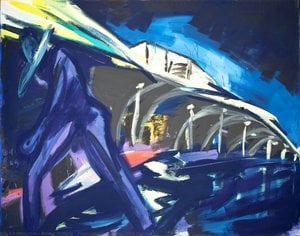
A man in visible distress lies amidst scattered birds in this evocative 1979 painting by Jörg Immendorff, offering a profound glimpse into the artist's provocative vision that you can bring to your collection.

Explore the provocative art of jörg immendorff – a German painter & sculptor known for 'Lidl,' political cycles, & experimental stage design. Discover his unique vision.

Konstverket som visas på denna sida skyddas av upphovsrättslagen, vilket innebär att vi inte lagligt kan skapa eller sälja en identisk reproduktion. Detta skydd upprätthålls genom internationella avtal såsom den Bernkonventionen och genom nationella lagar, inklusive de som fastställs av Amerikansk upphovsrättslag – Titel 17. Alla rättigheter förbehållna. Återgivning av konstverk är förbjuden utan skriftligt tillstånd från WahooArt.

Som ett respektfullt och lagligt alternativ erbjuder vi skräddarsydda, handmålade konstverk inspirerade av originalet. Våra skickliga och professionella konstnärer studerar noggrant originalets stil, stämning och konstnärliga essens för att skapa ett nytt, unikt verk som väcker samma känsla – samtidigt som det förblir en originell skapelse i egen rätt.

Denna metod följer fullt ut upphovsrättsliga regler eftersom den inte innebär kopiering eller duplicering av det skyddade konstverket. Istället är det en kreativ nytolkning – en ny målning som är influerad av originalet men inte identisk med det.

Handgjord oljereproduktion

Handmålad olja på duk i din valda storlek och ram, tillverkad efter beställning av våra konstnärer. ( Byt till tryck Byt till digital bild)

Corner sample of the P118B picture frame: formgjuten polystyren, 5 cm wide and 3 cm thick
P118B Skr10
Corner sample of the P118H picture frame: formgjuten polystyren, 5 cm wide and 3 cm thick
P118H Skr10
Corner sample of the P118W picture frame: formgjuten polystyren, 5 cm wide and 3 cm thick
P118W Skr10
Corner sample of the P438Z picture frame: formgjuten polystyren, 5.5 cm wide and 3.5 cm thick
P438Z Skr10
Corner sample of the P508JH picture frame: formgjuten polystyren, 7 cm wide and 3.5 cm thick
P508JH Skr12
Corner sample of the P508YH picture frame: formgjuten polystyren, 7 cm wide and 3.5 cm thick
P508YH Skr12
Corner sample of the P805H picture frame: formgjuten polystyren, 5 cm wide and 3.5 cm thick
P805H Skr10
Corner sample of the P805Z picture frame: formgjuten polystyren, 5 cm wide and 3.5 cm thick
P805Z Skr10
Corner sample of the P919BZ picture frame: formgjuten polystyren, 7 cm wide and 3.5 cm thick
P919BZ Skr10
Corner sample of the P919G picture frame: formgjuten polystyren, 7 cm wide and 3.5 cm thick
P919G Skr10
Corner sample of the P919XJ picture frame: formgjuten polystyren, 7 cm wide and 3.5 cm thick
P919XJ Skr10
Corner sample of the P959ZH picture frame: formgjuten polystyren, 5 cm wide and 3 cm thick
P959ZH Skr10
Corner sample of the P968JZ picture frame: formgjuten polystyren, 6 cm wide and 4 cm thick
P968JZ Skr12
Corner sample of the W106C picture frame: massivt trä, 5 cm wide and 3 cm thick
W106C Skr8
Corner sample of the W218G picture frame: massivt trä, 5 cm wide and 3 cm thick
W218G Skr10
Corner sample of the W218JH picture frame: massivt trä, 5 cm wide and 3 cm thick
W218JH Skr8
Corner sample of the W218Y picture frame: massivt trä, 5 cm wide and 3 cm thick
W218Y Skr10
Corner sample of the W307PJ picture frame: massivt trä, 6 cm wide and 3 cm thick
W307PJ Skr10
Corner sample of the W316G picture frame: massivt trä, 6 cm wide and 3 cm thick
W316G Skr10
Corner sample of the W316PJ picture frame: massivt trä, 6 cm wide and 3 cm thick
W316PJ Skr8
Corner sample of the W316Y picture frame: massivt trä, 6 cm wide and 3 cm thick
W316Y Skr10
Corner sample of the W398PJ picture frame: massivt trä, 5 cm wide and 3 cm thick
W398PJ Skr8
Corner sample of the W4111J picture frame: massivt trä, 6.5 cm wide and 3.5 cm thick
W4111J Skr10
Corner sample of the W500HY picture frame: massivt trä, 7 cm wide and 5 cm thick
W500HY Skr15
Corner sample of the W500JH picture frame: massivt trä, 7 cm wide and 5 cm thick
W500JH Skr15
Corner sample of the W692G picture frame: massivt trä, 8 cm wide and 4 cm thick
W692G Skr12
Corner sample of the W849H picture frame: massivt trä, 5 cm wide and 3 cm thick
W849H Skr8
Corner sample of the W940BG picture frame: massivt trä, 7.5 cm wide and 4.5 cm thick
W940BG Skr15
Corner sample of the W953PJ picture frame: massivt trä, 6 cm wide and 3.5 cm thick
W953PJ Skr8

Standardstorlek
skräddarsydd
CM
INCH

Välj bland våra förinställda storlekar som motsvarar konstverkets ursprungliga proportioner.

bredd
höjd

Ange den bredd och höjd du behöver för att passa din ram eller din vägg. Eftersom detta är handmålat kan konstnären, vid ett annat format, måla lite mer runt bilden eller beskära den något – det är du som väljer. Vi skickar en digital mockup för godkännande innan målningen påbörjas. Bilden som visas på denna sida representerar inte det slutgiltiga resultatet — det är endast mockuppen som visar det.

Exempel på vad som kan anpassas: Byt ut ansiktet mot ett foto av kunden; Lägg till ett husdjur (t.ex. byt ut en katt mot en hund); Inkludera ett dolt meddelande i bakgrunden; Ändra bakgrundens landskap eller element.
Efter beställning kommer WahooArt.com team att mejla kunden för instruktioner och tillhandahålla en skissförhandsvisning

Leverans över hela världen () på 3–4 veckor istället för standard 5 veckor. (26 oktober). Inga kompromisser med kvaliteten.

Fri expressfrakt över hela världen
Högkvalitativ linnecanvas
Fullständig fraktförsäkring
Garantier för återbetalning av tullavgifter
Garantier för exakt färgåtergivning
100 dagars returrätt (endast vid fel)
100% pengarna tillbaka-garanti
Mängdrabatt erbjuds

Totalt pris

Skr 2700

Untitled

Reproduktionsmetod

Storlek på reproduktion

-

Slutgiltigt pris

Skr 2700

Kortfakta

  • Year: 1979
  • Artist: Jörg Immendorff
  • Subject or theme: Distress, birds, and nature

A Vision of Disquiet: Decoding Immendorff’s Untitled

In the vast, evocative landscape of late 20th-century German painting, few voices resonate with as much raw, psychological intensity as that of Jörg Immendorff. His 1979 work, Untitled, serves as a profound window into a mind grappling with the complexities of existence, identity, and the fractured reality of post-war Europe. At first glance, the canvas presents a striking, almost surreal tableau: a solitary figure lies prone upon the earth, hands clasped behind him in a posture that oscillates between weary resignation and acute physical distress. This central subject, rendered with a visceral sense of weight, anchors the composition, drawing the viewer into a silent dialogue regarding human vulnerability and the heavy burden of being.

The painting’s atmosphere is thick with a sense of restless movement, achieved through a masterful orchestration of symbolic elements. Scattered throughout the scene, birds act as ethereal messengers—some perched in quiet contemplation, others caught in mid-flight, slicing through the composition. These avian figures introduce a layer of kinetic energy that contrasts sharply with the stillness of the man on the ground. The presence of a solitary potted plant to the right adds a touch of domesticity or perhaps a symbol of cultivated life amidst a wilder, more chaotic environment. Through this interplay of the grounded and the airborne, Immendorff creates a visual tension that keeps the eye wandering, searching for meaning within the layers of the scene.

Technique and the Language of Expressionism

Immendorff’s technique in this piece is a testament to his ability to blend expressive freedom with structural intent. The brushwork, though appearing spontaneous, possesses a deliberate rhythm that guides the viewer's emotional response. There is a palpable texture to the work, where the application of pigment feels as much like an emotional outburst as it does a formal application of paint. This approach, deeply rooted in the traditions of Neo-Expressionism, allows the artist to bypass mere representation and instead tap into a more primal, symbolic language. The scale of the 145 x 145 cm canvas demands attention, enveloping the viewer in its large-format presence and making the psychological landscape feel immersive and inescapable.

For the discerning collector or interior designer, this artwork offers more than just aesthetic beauty; it provides a profound intellectual anchor. The piece functions as a conversation starter, inviting scrutiny of its historical context—a period marked by political upheaval and the search for a new German identity. Its ability to command a room through its sheer emotional gravity makes it an ideal centerpiece for spaces dedicated to contemplation, modern curation, or avant-garde design. To possess a high-quality reproduction of this work is to bring a piece of art history’s most provocative era into one's personal sanctuary, offering a permanent connection to the turbulent, beautiful spirit of Jörg Immendorff.

Frågor och svar

Vad föreställer "Untitled" av Jörg Immendorff och vilken stämning förmedlar det?

"Untitled" av Jörg Immendorff förenar man in distress, birds, potted plant, distress, figures, composition med en Dramatic atmosfär.

Vilken mättnad och intensitet har "Untitled" av Jörg Immendorff?

Färgerna i "Untitled" av Jörg Immendorff uppvisar en Clear Color Presence mättnad med en Vivid intensitet.

Vad rekommenderas för användning av ett tryck av "Untitled"?

Det rekommenderade användningsområdet för ett tryck av "Untitled" är Conversation.


Konstnärsbiografi

Early Life and Artistic Awakening

Jörg Immendorff, born in 1945 in Bleckede, Lower Saxony, emerged from the fractured landscape of post-World War II Germany—a context that would indelibly shape his artistic vision. The early departure of his father cast a long shadow, fostering a sense of emotional distance and inadequacy that resonated throughout his life and work. This personal trauma became a catalyst for exploring themes of identity, belonging, and the weight of history. Immendorff’s initial foray into the art world began at sixteen with an exhibition in a Bonn jazz cellar, a modest beginning hinting at the provocative path ahead. His formal training commenced in 1963 at the prestigious Kunstakademie Düsseldorf, initially under the tutelage of theater designer Teo Otto. However, Immendorff’s rebellious spirit and refusal to compromise his artistic integrity led to a swift expulsion from Otto's class—a pivotal moment that propelled him towards the mentorship of the iconoclastic Joseph Beuys.

The Radical Years: Expulsion and the Birth of LIDL

Immendorff’s time with Beuys was transformative, yet his inherent contrarianism and fervent political activism ultimately led to another expulsion from the academy. This rejection fueled a period of intense experimentation and defiance. From 1969 to 1980, he navigated a dual existence as an art teacher and a free artist, accepting visiting professorships across Europe while simultaneously challenging conventional artistic boundaries. It was during this time that Immendorff founded the “LIDL Academy,” a deliberately provocative gesture mocking the elitism of established art institutions. The name itself—inspired by the sound of a child’s rattle—underscored his fascination with new beginnings and innocence, contrasting sharply with the complexities of postwar German society. The LIDL project wasn't a formal group but rather a constellation of artists – including James Lee Byars, Marcel Broodthaers, and Nam June Paik – engaging in actions that ridiculed artistic pretension. His early work incorporated sculptures, performances, and documents alongside paintings, all imbued with a playful yet subversive energy.

Café Deutschland: A Stage for National Identity

The late 1970s marked a turning point in Immendorff’s career with the creation of his renowned *Café Deutschland* series. Inspired by Renato Guttuso’s *Caffè Greco*, these sixteen large-scale paintings transformed nightclubs into vibrant stages for exploring Germany's fractured cultural and political landscape. These weren’t mere depictions of scenes; they were elaborate tableaux vivants populated with a cast of historical figures—from Adolf Hitler to Otto Dix—engaged in chaotic, often unsettling interactions. The series served as a poignant reflection on the division between East and West Germany, grappling with themes of guilt, memory, and national identity. The paintings are characterized by expressive realism, caricature, and symbolic imagery, creating a visually arresting and emotionally charged experience for the viewer. Immendorff’s masterful use of color and composition draws the eye into these complex narratives, inviting contemplation on the enduring legacy of Germany's past.

Grand Cycles and Political Engagement

Immendorff consistently worked in what he termed “grand cycles of paintings,” ambitious projects that spanned years and were deeply rooted in political commentary. Beyond *LIDL* and *Café Deutschland*, notable series included the *Maoist Paintings* and *The Rake’s Progress*. These weren't simply artistic statements; they were attempts to engage directly with the pressing social and ideological issues of his time. His work often reflected a profound inner conflict—a tension between his desire for artistic expression and his commitment to political activism. He questioned the efficacy of art as a tool for change, famously asking in one painting, “Can one change anything with these?” Despite this skepticism, Immendorff continued to use his art as a platform for challenging established norms and provoking critical dialogue.

Legacy and Historical Significance

Jörg Immendorff’s return to the Düsseldorf Art Academy—the institution that had once dismissed him—in 1996 solidified his position as a leading figure in contemporary German art. He mentored a new generation of artists, including Oda Jaune and Renata Jaworska, passing on his rebellious spirit and commitment to artistic innovation. Immendorff’s work remains profoundly relevant today, offering a powerful commentary on the complexities of identity, memory, and political engagement. His willingness to confront difficult truths and challenge conventional boundaries continues to inspire artists and viewers alike. He left behind a body of work that is not only visually striking but also intellectually stimulating—a testament to his enduring legacy as one of Germany’s most provocative and important painters.

Jörg Immendorff

Jörg Immendorff

1945 - 2007

Kortfakta

  • Artistic Movement Or Style: Neue Wilde
  • Artists Who Influenced This Artist:
    • Joseph Beuys
    • Renato Guttuso
  • Date Of Birth: 1945
  • Date Of Death: 2007
  • Full Name: Jörg Immendorff
  • Nationality: German
  • Notable Artworks:
    • Lidl paintings
    • Café Deutschland
    • The Rake's Progress
  • Place Of Birth: Bleckede, Germany