Konstverket som visas på denna sida skyddas av upphovsrättslagen, vilket innebär att vi inte lagligt kan skapa eller sälja en identisk reproduktion. Detta skydd upprätthålls genom internationella avtal såsom den Bernkonventionen och genom nationella lagar, inklusive de som fastställs av Amerikansk upphovsrättslag – Titel 17. Alla rättigheter förbehållna. Återgivning av konstverk är förbjuden utan skriftligt tillstånd från WahooArt.
Denna metod följer fullt ut upphovsrättsliga regler eftersom den inte innebär kopiering eller duplicering av det skyddade konstverket. Istället är det en kreativ nytolkning – en ny målning som är influerad av originalet men inte identisk med det.
Giclée- eller canvasprint av museumskvalitet med snabb produktion och flexibla ytbehandlingsalternativ. ( Beställ handmålad reproduktion Byt till digital bild)





























Välj bland våra förinställda storlekar som motsvarar konstverkets ursprungliga proportioner.

Ange den bredd och höjd du behöver för att passa din ram eller vägg. Ett tryck kan endast beskäras, aldrig göras större än originalbilden, vilket innebär att ett format med en annan proportion leder till att en del av bilden går förlorad. Vi skickar en digital mockup för godkännande innan vi påbörjar tryckningen. Bilden som visas på denna sida visar inte den faktiska beskärningen — det är endast mockuppen som gör det.
Leverans över hela världen () på 2 veckor istället för standard 4/5 veckor. (8 november)
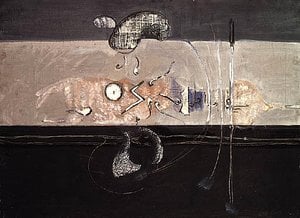
The Trial
Storlek på reproduktion
Bland John Samuel Tunnards dokumenterade teman – modern fabric design, jazz player inspiration, maritime landscape views, philosophical reflection, artist’s major works – har "The Trial" ett eget fokus på cornwall landscape, british surrealism, marine life, perspective play, void motif, jazz influence, dark palette.
"The Trial" av John Samuel Tunnard visas på British Council, London, Storbritannien. Museilistan avser originalverket, inte reproduktioner.
Upphovsrättsläget för "The Trial" - fortfarande skyddat av upphovsrätt - baseras på konstnärens dödsår 1971.

John Samuel Tunnard (1900-1971) was an English modernist painter and designer. Born in Sandwich, Kent, he initially studied design at the Royal College of Art from 1919 to 1923. This foundational training would prove crucial throughout his artistic career, influencing both his painting style and his later ventures into textile design.
During the 1920s, Tunnard worked in various textile design roles in Manchester. This period provided him with practical experience and an understanding of pattern, color, and form – elements that would later become prominent features of his paintings. In 1926, he married Mary May Robertson, a partnership that would significantly shape both their personal and professional lives.
By 1928, Tunnard began to focus seriously on painting. He taught design at the Central School of Arts and Crafts in London from 1929 onwards, further solidifying his engagement with artistic principles and pedagogy. His work during this time demonstrates a growing interest in modernist aesthetics. Tunnard’s style was notably influenced by Surrealism, although he never formally joined the movement. He participated in several surrealist exhibitions throughout the 1930s, including one at the Gordon Fraser Gallery in Cambridge.
In 1933, Tunnard and his wife moved to Cadgwith, Cornwall. There, they established a business producing printed silks, allowing them to combine their artistic talents with entrepreneurial endeavors. The Cornish landscape profoundly impacted Tunnard’s art, inspiring many of his later landscapes and providing a new source of visual motifs.
Tunnard's oeuvre encompasses both paintings – including notable landscapes and portraits – and textile designs. His painting style is characterized by its lyrical abstraction, dreamlike qualities, and vibrant color palettes. He often blended representational elements with abstract forms, creating a unique visual language that reflects his surrealist leanings.
Tunnard exhibited widely throughout his career. He showed work at the Royal Academy and with the London Group (which he joined in 1934). His participation in surrealist exhibitions further cemented his position within the British avant-garde.
John Samuel Tunnard is now considered one of the most important English modernist painters. His work represents a unique synthesis of Surrealism, abstraction, and landscape painting. Examples of his art can be found in prominent collections such as the National Galleries of Scotland. He contributed significantly to the development of modern British art, bridging the gap between traditional representation and abstract expression.

1900 - 1971 , United Kingdom
Explore the life & work of John Hoppner, a leading Georgian portraitist. Discover his vibrant style, influential patrons, and lasting impact on British art history. Expert insights for collectors.

Utforska John Constables 25 mest ikoniska målningar – romantikens mästare av det engelska landskapet. Upptäck historien, tekniken & skönheten i verk som 'Hay Wain'. Köp exklusiva konsttryck på WahooArt.com.

Explore the captivating world of John Piper, a celebrated British painter whose evocative landscapes & iconic church art captured the spirit of his time. Discover his legacy and find high-quality reproductions at WahooArt.
Utforska John Singer Sargents 25 mest ikoniska målningar! Lär känna porträttkonsten, impressionismen och hans unika ljusspel. Hitta inspiration & köp högkvalitativa konsttryck på WahooArt.com – för en elegant heminredning.

Explore the poignant war poetry of Wilfred Owen, a key figure in British Modernism. Discover his innovative style, themes of loss & camaraderie, and lasting impact on 20th-century literature. Analysis & historical context included.
 Förhandsvisa
 Skicka
 Dela
Dela
 Visa detaljer
 Guide
Guide

 Ladda ner
 Liknande objekt
 Röntgen
 Bildspel
 Frågor och svar
 Statistik


 Visa mer









 Glasalternativet är endast tillgängligt i storlekar under 110 cm.