
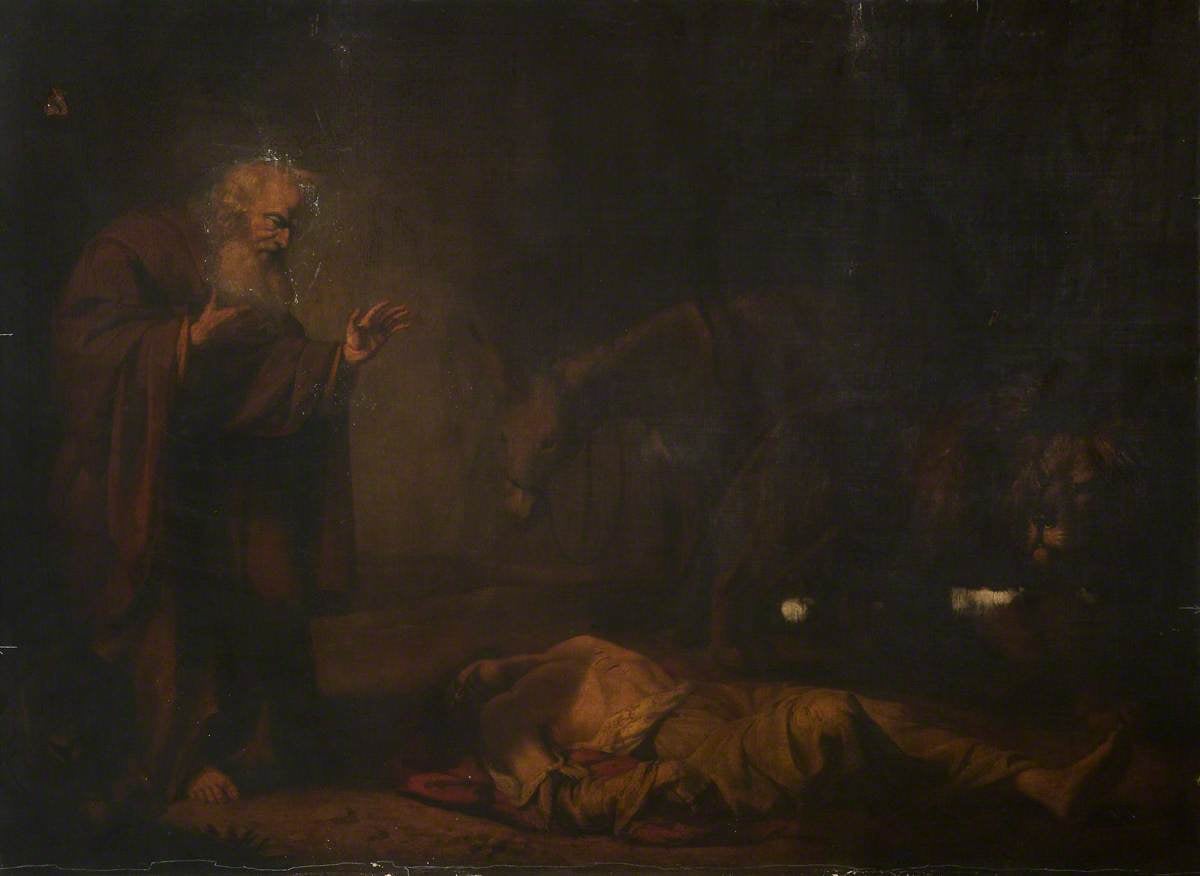
The Disobedient Prophet (1790) av John Graham, handmålad oljemålning i reproduktion utförd av en mästare
Förhandsvisa Förhandsgranska i AR Byt till tryck Byt till digital bild Skicka
Visa detaljer Guide Lägg till i favoriter Ladda ner Liknande objekt Röntgen Bildspel Frågor och svar Ladda ner presentation Statistik

The Disobedient Prophet Handmålad oljemålning i reproduktion

Mått
243.0 x 332.0 cm

Explore John Graham’s ‘The Disobedient Prophet,’ a dramatic 1790 oil painting of biblical proportions. Witness Baroque drama & intense emotion in this Scottish masterpiece – available as reproductions.

John D. Graham (1886-1961) was a Ukrainian-born American modernist painter, collector & pivotal mentor to Abstract Expressionists like Pollock & de Kooning. Known for figurative work, system theory of art & bridging European avant-garde with the NY S

Konstverket som visas på denna sida skyddas av upphovsrättslagen, vilket innebär att vi inte lagligt kan skapa eller sälja en identisk reproduktion. Detta skydd upprätthålls genom internationella avtal såsom den Bernkonventionen och genom nationella lagar, inklusive de som fastställs av Amerikansk upphovsrättslag – Titel 17. Alla rättigheter förbehållna. Återgivning av konstverk är förbjuden utan skriftligt tillstånd från WahooArt.

Som ett respektfullt och lagligt alternativ erbjuder vi skräddarsydda, handmålade konstverk inspirerade av originalet. Våra skickliga och professionella konstnärer studerar noggrant originalets stil, stämning och konstnärliga essens för att skapa ett nytt, unikt verk som väcker samma känsla – samtidigt som det förblir en originell skapelse i egen rätt.

Denna metod följer fullt ut upphovsrättsliga regler eftersom den inte innebär kopiering eller duplicering av det skyddade konstverket. Istället är det en kreativ nytolkning – en ny målning som är influerad av originalet men inte identisk med det.

Handgjord oljereproduktion

Handmålad olja på duk i din valda storlek och ram, tillverkad efter beställning av våra konstnärer. ( Byt till tryck Byt till digital bild)

Corner sample of the P118B picture frame: formgjuten polystyren, 5 cm wide and 3 cm thick
P118B Skr10
Corner sample of the P118H picture frame: formgjuten polystyren, 5 cm wide and 3 cm thick
P118H Skr10
Corner sample of the P118W picture frame: formgjuten polystyren, 5 cm wide and 3 cm thick
P118W Skr10
Corner sample of the P438Z picture frame: formgjuten polystyren, 5.5 cm wide and 3.5 cm thick
P438Z Skr10
Corner sample of the P508JH picture frame: formgjuten polystyren, 7 cm wide and 3.5 cm thick
P508JH Skr12
Corner sample of the P508YH picture frame: formgjuten polystyren, 7 cm wide and 3.5 cm thick
P508YH Skr12
Corner sample of the P805H picture frame: formgjuten polystyren, 5 cm wide and 3.5 cm thick
P805H Skr10
Corner sample of the P805Z picture frame: formgjuten polystyren, 5 cm wide and 3.5 cm thick
P805Z Skr10
Corner sample of the P919BZ picture frame: formgjuten polystyren, 7 cm wide and 3.5 cm thick
P919BZ Skr10
Corner sample of the P919G picture frame: formgjuten polystyren, 7 cm wide and 3.5 cm thick
P919G Skr10
Corner sample of the P919XJ picture frame: formgjuten polystyren, 7 cm wide and 3.5 cm thick
P919XJ Skr10
Corner sample of the P959ZH picture frame: formgjuten polystyren, 5 cm wide and 3 cm thick
P959ZH Skr10
Corner sample of the P968JZ picture frame: formgjuten polystyren, 6 cm wide and 4 cm thick
P968JZ Skr12
Corner sample of the W106C picture frame: massivt trä, 5 cm wide and 3 cm thick
W106C Skr8
Corner sample of the W218G picture frame: massivt trä, 5 cm wide and 3 cm thick
W218G Skr10
Corner sample of the W218JH picture frame: massivt trä, 5 cm wide and 3 cm thick
W218JH Skr8
Corner sample of the W218Y picture frame: massivt trä, 5 cm wide and 3 cm thick
W218Y Skr10
Corner sample of the W307PJ picture frame: massivt trä, 6 cm wide and 3 cm thick
W307PJ Skr10
Corner sample of the W316G picture frame: massivt trä, 6 cm wide and 3 cm thick
W316G Skr10
Corner sample of the W316PJ picture frame: massivt trä, 6 cm wide and 3 cm thick
W316PJ Skr8
Corner sample of the W316Y picture frame: massivt trä, 6 cm wide and 3 cm thick
W316Y Skr10
Corner sample of the W398PJ picture frame: massivt trä, 5 cm wide and 3 cm thick
W398PJ Skr8
Corner sample of the W4111J picture frame: massivt trä, 6.5 cm wide and 3.5 cm thick
W4111J Skr10
Corner sample of the W500HY picture frame: massivt trä, 7 cm wide and 5 cm thick
W500HY Skr15
Corner sample of the W500JH picture frame: massivt trä, 7 cm wide and 5 cm thick
W500JH Skr15
Corner sample of the W692G picture frame: massivt trä, 8 cm wide and 4 cm thick
W692G Skr12
Corner sample of the W849H picture frame: massivt trä, 5 cm wide and 3 cm thick
W849H Skr8
Corner sample of the W940BG picture frame: massivt trä, 7.5 cm wide and 4.5 cm thick
W940BG Skr15
Corner sample of the W953PJ picture frame: massivt trä, 6 cm wide and 3.5 cm thick
W953PJ Skr8

Standardstorlek
skräddarsydd
CM
INCH

Välj bland våra förinställda storlekar som motsvarar konstverkets ursprungliga proportioner.

bredd
höjd

Ange den bredd och höjd du behöver för att passa din ram eller din vägg. Eftersom detta är handmålat kan konstnären, vid ett annat format, måla lite mer runt bilden eller beskära den något – det är du som väljer. Vi skickar en digital mockup för godkännande innan målningen påbörjas. Bilden som visas på denna sida representerar inte det slutgiltiga resultatet — det är endast mockuppen som visar det.

Exempel på vad som kan anpassas: Byt ut ansiktet mot ett foto av kunden; Lägg till ett husdjur (t.ex. byt ut en katt mot en hund); Inkludera ett dolt meddelande i bakgrunden; Ändra bakgrundens landskap eller element.
Efter beställning kommer WahooArt.com team att mejla kunden för instruktioner och tillhandahålla en skissförhandsvisning

Leverans över hela världen () på 3–4 veckor istället för standard 5 veckor. (9 november). Inga kompromisser med kvaliteten.

Fri expressfrakt över hela världen
Högkvalitativ linnecanvas
Fullständig fraktförsäkring
Garantier för återbetalning av tullavgifter
Garantier för exakt färgåtergivning
100 dagars returrätt (endast vid fel)
100% pengarna tillbaka-garanti
Mängdrabatt erbjuds

Totalt pris

Skr 3718

The Disobedient Prophet

Reproduktionsmetod

Storlek på reproduktion

-

Slutgiltigt pris

Skr 3718

Kortfakta

  • Movement: Baroque
  • Artist: John Graham
  • Influences: Classical art
  • Artistic style: Religious drama
  • Title: The Disobedient Prophet
  • Dimensions: 243 x 332 cm

Konstquiz

Det finns endast ett korrekt svar på varje fråga.

Fråga 1:
What artistic style is predominantly associated with John Graham’s ‘The Disobedient Prophet’?
Fråga 2:
Where is ‘The Disobedient Prophet’ currently housed?
Fråga 3:
What biblical figure is depicted in ‘The Disobedient Prophet’?
Fråga 4:
Which technique is John Graham known for employing in his paintings, contributing to their textural richness?
Fråga 5:
What overarching theme does ‘The Disobedient Prophet’ convey regarding religious symbolism?

Identification of The Disobedient Prophet

The Disobedient Prophet is an oil on canvas work by John Graham, dating to about 1790. This piece presents a dramatic scene centered on a prophet or messenger of God. The figure is positioned over a person lying on the ground, creating a moment of profound tension. Two horses are also present within the composition, adding to the gravity of the encounter.

Currently, this painting is held at the Royal Scottish Academy of Art - Architecture in Edinburgh, United Kingdom. It remains a significant example of Graham's ability to handle religious subject matter through a lens of intense human emotion. The scale of the work, measuring 243 x 332 cm, allows for a detailed observation of the figures and their interaction.

Composition and Visual Elements

The arrangement of the figures creates a palpable sense of tension, drawing the eye toward the central interaction. A prophet stands over a person lying on the ground, a positioning that establishes a clear hierarchy within the scene. Two horses are positioned within the frame, adding to the complexity of the spatial arrangement. This careful placement of subjects ensures the viewer feels the weight of the moment being depicted.

Light and shadow are used to define the emotional gravity of the work. A dark background provides a stark contrast, which emphasizes the religious theme and directs attention toward the primary figures. This use of chiaroscuro creates a sense of depth, pulling the viewer into the immediate, dramatic space. The interplay of light helps to isolate the figures from the surrounding darkness, focusing the narrative on the interaction between the messenger and the prone individual.

Technique and Artistic Materials

The work is executed in oil on canvas, a choice that lends a palpable sense of richness to the composition. By utilizing the inherent properties of oil, the artist achieves a depth that allows the light to interact with the surface in a nuanced way. This medium provides the necessary weight to support the dramatic interplay of shadow and illumination seen throughout the scene.

The application of the paint is deliberate and physical. The technique involves layering oil paint in thick strokes, creating a surface that is far from smooth. These textures appear rough and impasto-like, giving the figures and the surrounding environment a tangible, sculptural quality. Such heavy handling of the pigment adds a layer of physicality to the work, emphasizing the tension within the composition through the very substance of the paint itself.

Related Works by John Graham

To understand the breadth of this artist's output, one must look toward his other notable compositions. His ability to navigate diverse subject matter is evident when considering works such as An Italian Nobleman. This piece demonstrates a specific command over character and presence that complements the dramatic tension found in his religious narratives. There is a certain poise in his figurative studies that suggests a deep familiarity with the human form and its capacity for expression.

The artist also explored themes of romance and tension through works like The Bandit’s Bride. This piece, alongside John Gibson (1790–1866), highlights a range that extends from historical or character-driven studies to more narrative-focused scenes. Each work reveals a different facet of his technical skill, moving between the quietude of a portrait and the heightened emotion of a dramatic event.

Frågor och svar

Under vilka andra namn är John Graham känd?

John Graham är även känd under namnen Ivan Gratianovitch Dombrowsky, Ivan Gratianovich Dombrowski.

Kan "The Disobedient Prophet" av John Graham, som finns i samlingen på Royal Scottish Academy of Art - Architecture, reproduceras lagligt?

Upphovsrättsläget för "The Disobedient Prophet" av John Graham är tydligt: verket är fortfarande skyddat av upphovsrätt. Dess närvaro på Royal Scottish Academy of Art - Architecture ändrar inte den statusen.

Vilket rum föreslås för visning av "The Disobedient Prophet", med tanke på dess färgpalett?

Med sin Monochrome-palett rekommenderas "The Disobedient Prophet" av John Graham för ett Living Room. Färgerna är en del av anledningen till detta förslag.


Konstnärsbiografi

A Life Forged in Revolution and Renaissance

The story of John Graham is one of profound transformation, a narrative that begins far from the bustling studios of New York, amidst the aristocratic elegance and subsequent political turbulence of Kyiv. Born Ivan Gratianovitch Dombrowsky in 1886, his early years were defined by a classical education and a lineage of privilege that seemed destined for a life of law or diplomacy. Yet, the winds of history had other plans. The seismic shifts of the Russian Revolution and the subsequent Bolshevik seizure of power thrust him into a crucible of conflict, leading to his imprisonment as a counterrevolutionary. This period of upheaval served as a spiritual and artistic catalyst; fleeing the chaos of his homeland, he eventually found refuge in the United States in 1920. It was during this migration that he shed his old identity, adopting the name John Graham—a moniker that would come to represent a bridge between the Old World's traditions and the New World's avant-garde energy.

Graham’s arrival in New York City marked the beginning of an extraordinary artistic awakening. Though he did not begin his formal studies in painting until his thirties, his late start was compensated by a voracious intellectual hunger. He immersed himself in the vibrant, gritty reality of the Ashcan School through the mentorship of John F. Sloan, yet his gaze was perpetually fixed on the horizon of modernism. His journey was not merely one of personal discovery but of cultural synthesis, as he navigated the complexities of Cubism, Surrealism, and Abstract Expressionism, weaving these disparate threads into a cohesive visual language that honored classical structure while embracing modern fragmentation.

The Architect of Modernist Dialogue

Beyond his own canvas, Graham functioned as a vital conduit for the burgeoning New York art scene. He was far more than a solitary painter; he was a collector, a writer, and a philosopher of form. His deep engagement with System Theory and dialectics allowed him to view art not just as an aesthetic pursuit, but as a structured argument—a belief encapsulated in his famous assertion that “an abstract painting is an argument drawn to conclusion.” This intellectual rigor made him a central figure in the development of the New York School. As a mentor and advocate, he provided the scaffolding upon which legends like Jackson Pollock and Willem de Kooning could build their revolutionary styles. He possessed the rare ability to champion the radical unknown while maintaining a profound respect for the masters of the past.

His artistic development was characterized by a fascinating tension between the figurative and the abstract. While he was deeply moved by the expressive potential of modern abstraction, his later works returned to a highly sophisticated figurative style. This period saw him drawing inspiration from classical masters to depict subjects such as Russian soldiers with an intensity that felt both ancient and immediate. His brushwork often carried a palpable emotional weight, utilizing vibrant color palettes and a sense of Baroque drama to navigate the tensions of a modern age. Through his work, the heavy shadows of history met the bright, fractured light of the twentieth century.

Legacy of a Cultural Conduit

The historical significance of John Graham lies in his role as a stabilizer and a provocateur within the whirlwind of mid-century modernism. He did not merely witness the birth of Abstract Expressionism; he helped cultivate the environment that made it possible. His legacy is found in several key areas:

  • The Synthesis of Traditions: He successfully bridged the gap between European avant-garde movements and the emerging American identity, ensuring that the lessons of the Old World informed the innovations of the New.
  • Mentorship and Community: Through his involvement with groups like the "Modernists" in Baltimore and his presence in the New York art circles, he fostered a collaborative spirit that defined an era.
  • Intellectual Framework: By applying philosophical and systemic thinking to the act of painting, he elevated the discourse surrounding abstract art from mere intuition to a structured, intellectual discipline.

Though he passed away in London in 1961, the echoes of Graham's influence remain embedded in the DNA of modern art. He remains a figure of immense mystery and brilliance—a man who survived revolution only to help orchestrate an artistic revolution of his own.

John Graham

John Graham

1886 - 1961 , Russia

Kortfakta

  • Artistic Movement Or Style: Modernist / Figurative Painting
  • Artists Or Movements Influenced By This Artist: ['New York School']
  • Artists Who Influenced This Artist: ['Ashcan School painters']
  • Date Of Birth: 1886
  • Date Of Death: 1961
  • Full Name: Ivan Gratianovitch Dombrowsky / John D. Graham
  • Nationality: Russian / American
  • Notable Artworks:
    • The Disobedient Prophet
    • Mrs John Jarvie
  • Place Of Birth: Kyiv, Russia


































