Expressionism
 1959
1959 66.0 x 50.0 cm
Giclée- eller canvasprint av museumskvalitet med snabb produktion och flexibla ytbehandlingsalternativ. ( Beställ handmålad reproduktion Köp högupplöst bild)
Välj bland våra förinställda storlekar som motsvarar konstverkets ursprungliga proportioner.

Du kan ange egna mått för att passa en specifik ram eller yta. Om det valda måttet inte överensstämmer med originalbildens proportioner kommer vi antingen att beskära konstverket eller utöka bilden med en speglad eller enfärgad kant. En digital mockup skickas för ditt godkännande innan produktionen påbörjas.
Vänligen notera att förhandsvisningen på skärmen inte återspeglar den faktiska beskärningen eller utökningen. Endast mockuppen visar den slutgiltiga kompositionen korrekt.
Även om anpassade storlekar är möjliga, rekommenderar vi att du väljer ett mått från den fördefinierade listan för att bevara de ursprungliga proportionerna.
Leverans över hela världen () på 2 veckor istället för standard 4/5 veckor. (7 september)


Waiting (Attente)
Storlek på reproduktion
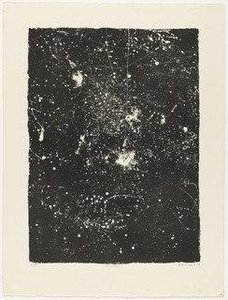
Jean Philippe Arthur Dubuffet’s “Waiting (Attente),” created in 1959, is a striking monochrome print that invites contemplation and evokes a profound sense of unease. This work exemplifies Dubuffet’s pioneering role in the development of *Art Brut*, or "raw art," a movement he himself defined as art produced outside the established academic traditions.
This print, likely created using woodcut or linocut techniques, showcases a deliberate and textured aesthetic. The composition is dominated by a large central square filled with dense clusters of small white dots against a stark black background. This interplay of light and dark creates an immediate visual tension. The technique itself is integral to the artwork’s meaning. Dubuffet intentionally embraced the imperfections inherent in printmaking—the unevenness, the slight variations in ink density—to convey a sense of immediacy and authenticity. Notice how lines are implied through the varying density of these dots, suggesting darker regions with thicker concentrations. The overall effect is not one of precise representation but rather an exploration of texture and tonal relationships.
“Waiting (Attente)” transcends mere visual appeal; it delves into deeper psychological territory. The artwork’s symbolism remains open to interpretation, which is characteristic of Dubuffet's approach. The dense black area can be seen as representing the hidden depths of the human psyche—emotions suppressed or complexities unexplored. Conversely, the scattered white dots might symbolize fleeting moments of clarity, awareness, or even hope amidst a prevailing sense of darkness and uncertainty. The title itself, "Waiting," suggests a state of anticipation, perhaps for something unknown or inevitable. This ambiguity is key to the work’s enduring power.
Dubuffet created “Waiting (Attente)” during a period of significant artistic experimentation in post-war Europe. Rejecting traditional notions of beauty and skill, he sought inspiration from sources outside the art world—children’s drawings, folk art, and even graffiti. *Art Brut* aimed to capture an unfiltered expression of human experience, free from intellectual or academic constraints. Dubuffet's work challenged the established norms of the art world, paving the way for new forms of abstract expressionism and influencing subsequent generations of artists. His embrace of unconventional materials and techniques reflected a broader cultural shift towards authenticity and raw emotion.
“Waiting (Attente)” is not an artwork that offers easy answers or comforting resolutions. Instead, it evokes a feeling of unease, contemplation, and mystery. The stark contrast between light and dark, combined with the textured surface, creates a visually arresting experience that lingers in the mind. Despite its abstract nature, this print possesses remarkable decorative potential. Its monochrome palette lends itself to a variety of interior design schemes—from minimalist modern spaces to more eclectic environments seeking a touch of dramatic intensity. A reproduction of "Waiting (Attente)" can serve as a powerful focal point, sparking conversation and adding depth to any space.


1901 - 1985 , Frankrike

Utforska de 10 mest inflytelserika verken inom abstrakt expressionism – från Rothkos färgfält till Pollocks action painting. Lär känna konstnärerna och deras teknik. Hitta museumskvalitativa tryck på WahooArt.com och förvandla ditt hem med tidlös konst!

Utforska Wassily Kandinskys 25 mest ikoniska verk – från expressionism till abstrakt konst. Lär känna historien bakom mästerverken och hitta inspiration för din heminredning med WahooArt.com. Upptäck hela samlingen online!

Utforska 10 ikoniska målningar dominerade av svart – från Rembrandts djupa skuggor till Munchs ångest. Lär känna historien bakom mästerverken och hitta inspiration för din inredning på WahooArt.se. Upptäck hela kollektionen online!

Utforska de 10 mästerverk som definierade geometrisk abstraktion! Lär känna Mondrian, Kandinsky & Malevich. Hitta inspiration och museumskvalitativa konsttryck för ditt hem på WahooArt.com. Upptäck hela samlingen online!

Explore the profound emotional depth of Lyrical Abstraction. Discover how masters like Raymond Parker used color and form to bridge Impressionism and Abstract Expressionism. Learn about this pivotal movement through our expert-led art history guide.

 Förhandsvisa
 Skicka
 Dela
Dela
 Visa detaljer

 Ladda ner
 Liknande objekt
 Röntgen
 Bildspel
 Visa mer




































 Glasalternativet är endast tillgängligt i storlekar under 110 cm.


![Abstract Composition [triptych] — Vaclav Vytlacil, Abstract Expressionism](/media/artworks/images-thumb/08/3c/083c0675045645fd42d4e6c6d63f1ced.jpg)