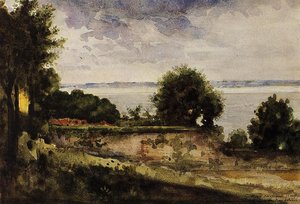
Gustave Moreau’s “Prometheus”: A Titan’s Silent Plea
Gustave Moreau’s “Prometheus” – a monumental canvas depicting the titan chained atop a desolate mountain, offering a flickering flame to humanity – is far more than a mere illustration of Greek mythology. It's a profound meditation on sacrifice, knowledge, and the enduring struggle between freedom and constraint. Completed in 1868, this painting stands as a cornerstone of Symbolism, rejecting the rigid realism of its predecessors and instead plunging headfirst into the turbulent depths of human emotion and philosophical inquiry. Moreau wasn’t interested in simply recreating a myth; he sought to distill its essence – its inherent drama and timeless themes – into a powerfully evocative visual experience.
The painting immediately commands attention with its dramatic composition. The titan, Prometheus, dominates the scene, his muscular form rendered with a deliberate roughness that speaks of both immense strength and profound suffering. He’s not depicted as a triumphant hero, but rather as a solitary figure, burdened by the weight of his actions. The landscape itself is equally arresting – a jagged, unforgiving terrain punctuated by swirling clouds and distant, ambiguous mountains. This isn't a picturesque backdrop; it’s an extension of Prometheus’s internal state, mirroring his isolation and despair. Moreau masterfully employs perspective to create a sense of vastness and scale, drawing the viewer into this desolate world alongside the titan.
The Language of Light and Shadow
Moreau's technique is characterized by a deliberate rejection of photographic realism in favor of expressive brushwork and atmospheric effects. Visible strokes define Prometheus’s form and the rough texture of the rocks, while softer lines evoke the swirling clouds and distant mountains – creating an overwhelming sense of depth and movement. The color palette is deliberately muted, dominated by browns, blues, and grays, contributing to the painting's melancholic mood. However, Moreau strategically utilizes light to draw our attention to key elements. A single, intense source illuminates Prometheus’s face and torso, casting dramatic shadows that heighten the sense of suffering and struggle. This carefully orchestrated interplay of light and shadow is not merely decorative; it serves to amplify the emotional impact of the scene.
Decoding the Symbols: Fire, Chains, and Humanity
“Prometheus” is rich in symbolism, inviting multiple interpretations. The titan himself embodies resilience, sacrifice, and the enduring human spirit – a willingness to endure hardship for the sake of others. The flame he offers isn’t simply fire; it represents knowledge, enlightenment, and progress—but also carries within it the potential for destruction and unintended consequences. The chains that bind him are a potent symbol of constraints imposed by authority, both divine and societal, representing the limitations placed upon individual freedom. Below, a shadowy figure – often interpreted as humanity – receives this gift, poised to benefit from Prometheus’s sacrifice but also burdened with the responsibility it entails. A recurring motif in Moreau's work, the bird appears here as well, suggesting freedom, spirituality, or a connection to the divine realm—a poignant counterpoint to Prometheus’s earthly imprisonment.
Moreau and His Legacy: A Bridge Between Worlds
Gustave Moreau (1826-1898) was a pivotal figure in the Symbolist movement, rejecting the prevailing artistic trends of his time to explore subjective emotions and mythological themes. Heavily influenced by literary giants like Shakespeare and Byron, he transformed familiar myths into deeply personal statements. “Prometheus” exemplifies this approach, demonstrating Moreau’s fascination with classical narratives and his ability to imbue them with a uniquely emotional charge. His work profoundly impacted later artists such as Henri Matisse and Georges Rouault, paving the way for modern art's exploration of inner worlds and symbolic language. Today, the Musée Gustave Moreau in Paris stands as a testament to his enduring legacy, preserving his studio and an extensive collection of his works. “Prometheus” is more than just a historical artwork; it’s a timeless meditation on the human condition, capable of resonating with audiences for generations to come.
An Evocative Presence in Your Space
"Prometheus" evokes a sense of awe, melancholy, and profound contemplation. Its dramatic composition and muted color palette make it a striking focal point for a study, library, or living room. The artwork pairs beautifully with dark wood furnishings, antique accents, and textured fabrics to enhance its Romantic atmosphere. A high-quality reproduction would add a touch of intellectual sophistication and artistic depth to any interior space – a constant reminder of the power of knowledge, the burden of freedom, and the enduring spirit of rebellion.

Frågor och svar
Vilket rum rekommenderas "Prometheus" av Gustave Moreau för?
En reproduktion av "Prometheus" passar bra i ett Vardagsrummet.
Vilken typ av konstverk är "Prometheus" av Gustave Moreau?
"Prometheus" är ett verk av typen Väggkonst.
Vad rekommenderas för användning av ett tryck av "Prometheus"?
En reproduktion av "Prometheus" av Gustave Moreau rekommenderas för Signaturverk. Detta förslag grundar sig på verkets motiv, stämning och färger.



 Visa i rummet
 Byt till tryckta exemplar
 Skicka
 Dela
Dela
 Detaljer
 Studentguide för konstverk

 Ladda ner
 Liknande objekt
 Röntgen
 Bildspel
 Besökstatistik

 Läs mer






































 Glasalternativet är endast tillgängligt i storlekar under 110 cm.