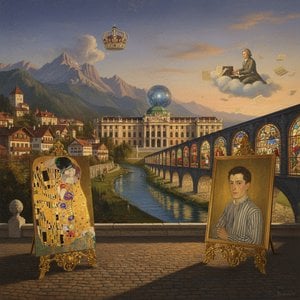
Gustav Klimts tidiga liv och konstnärliga rötter
Gustav Klimt, född den 14 juli 1862 i Baumgarten nära Wien, växte upp i en familj präglad av både konstnärlig ådra och ekonomiska svårigheter. Hans far, Ernst Klimt, var guldsmed – ett yrke som subtilt men djupt skulle påverka den unge Gustavs estetiska känslighet. Fascinationen för bladguld, de minutiösa detaljerna, den rena överflödet kom att prägla hans konstnärskap. Familjens ekonomiska situation innebar frekventa flyttar inom Wien, en rastlös uppväxt som kanske bidrog till Klimts skarpa observationsförmåga och känslighet för mänskliga erfarenheter. Redan som barn visade han anmärkningsvärda teckningstalanger, vårdade av faderns yrke och en medfödd begåvning som snabbt blev uppenbar. År 1876 antogs han till Wiens Kunstgewerbeschule (Skolan för tillämpad konst) där han inledde formell utbildning i arkitektonisk målning under Ferdinand Laufberger. Detta gav honom en solid teknisk grund, men utsatte honom också för de rådande akademiska stilarna – stilar som Klimt så småningom skulle utmana och överträffa. Det var här han också ingick ett viktigt konstnärligt partnerskap med sin bror Ernst och Franz von Matsch, ett samarbete som säkrade tidiga uppdrag för dekorativa väggmålningar och tak, vilket lade grunden för hans framtida framgångar.
Genombrottet och Wiener Secession
Under 1890-talet blev Klimt alltmer desillusionerad av det konservativa konstnärsetablissemanget i Wien. Han längtade efter större kreativ frihet, ett utrymme där innovation kunde blomstra utan traditionens begränsningar. Denna önskan kulminerade i bildandet av Wiener Secession 1897, en avgörande händelse i österrikisk konsthistoria. Klimt valdes till dess förste ordförande och blev rörelsens frontfigur, som strävade efter att bryta med de rigida akademiska normerna och omfamna nya konstnärliga strömningar som svepte över Europa – jugend, symbolism och japansk estetik. Secessionens egen utställningsbyggnad, designad av Joseph Maria Olbrich, blev en symbol för denna revolt, ett tempel tillägnat modern konst. Klimts verk var centrala för Secessions ethos, och förkroppsligade dess avvisande av konventionell estetik och dess omfamnande av dekorativa element, djärva färger och symbolisk imagery. Hans målningar började utforska teman som kärlek, död och sexualitet med en aldrig tidigare skådad öppenhet, vilket utmanade samhällsnormer och väckte både beundran och upprördhet.
Den gyllene perioden och konstnärlig mognad
Runt år 1900 inträdde Klimt i vad som nu kallas hans "gyllene period", en tid präglad av den överdådiga användningen av bladguld, inspirerad av bysantinska mosaiker och medeltida illuminerade manuskript. Denna teknik förvandlade hans målningar till skimrande, overkliga visioner, genomsyrade av en känsla av andlig djup och sensuell lockelse.
Kyssen (1907-1908), kanske hans mest ikoniska verk, exemplifierar denna stil – ett par låsta i en omfamning, höljda i en gyllene aura, deras kroppar prydda med intrikata mönster. Denna period såg också Klimt producera en serie fantastiska porträtt, inklusive *Porträtt av Adele Bloch-Bauer I* (1907), som visade hans förmåga att fånga inte bara fysisk likhet utan också sina modellers psykologiska komplexitet. Han suddade alltmer ut gränserna mellan målning och ornamentik, integrerade dekorativa element i sina kompositioner för att skapa en harmonisk fusion av form och innehåll. Påverkan från japansk konst – japonismen – var särskilt tydlig i hans plattare perspektiv, betoning på linjer och användning av dekorativa mönster.
Kontroverser, influenser och ett bestående arv
Klimts karriär var inte utan kontroverser. År 1900 fick han ett prestigefullt uppdrag att måla takmålningar för den stora salen i Wiens universitet, som representerade Filosofi, Jurisprudence och Teologi. Dessa verk – särskilt *Filosofi* – ansågs provokativa och till och med pornografiska av konservativa kritiker, vilket ledde till offentlig upprördhet och slutligen fick Klimt att vägra ytterligare offentliga uppdrag. Denna händelse markerade en vändpunkt i hans karriär, som drev honom mot mer privata beställningar och gav honom större konstnärlig frihet. Under hela sitt liv påverkades Klimt av ett mångsidigt utbud av artister och stilar – från Hans Makarts historiska målningar till den dekorativa konsten i Byzantium och Japan. Han hämtade också inspiration från symbolismen, utforskande teman som mytologi, allegori och det undermedvetna. Gustav Klimt fortsatte att måla flitigt fram till sin död den 6 februari 1918 av en stroke under spanska sjukan. Hans senare verk utforskade mer abstrakta former och landskap, vilket visade pågående konstnärlig utveckling. Han erkänns nu som en av de viktigaste figurerna i österrikisk konsthistoria, en ledande företrädare för Wiener Secession och en bestående symbol för jugendens elegans.
Hans målningar uppnår höga priser på auktion, och hans inflytande fortsätter att resonera i samtida konst och design.
Nyckelkaraktäristika & Konstnärlig stil
- Symbolism: Klimts verk är djupt symboliskt och utforskar ofta teman som kärlek, död, sexualitet och den mänskliga existensen.
- Jugend: Han var en ledande figur i jugendrörelsen, präglad av dess organiska linjer, dekorativa mönster och betoning på skönhet.
- Den gyllene perioden: Hans användning av bladguld skapade skimrande, överdådiga ytor som blev hans signaturstil.
- Dekorativa element: Klimt integrerade dekorativa element i sina kompositioner och suddade ut gränserna mellan målning och ornamentik.
- Den kvinnliga formen: Den kvinnliga kroppen var ett centralt motiv i hans verk, ofta avbildad med sensualitet och psykologiskt djup.



 Förhandsvisa
 Byt till tryck
 Skicka
 Dela
Dela
 Visa detaljer

 Ladda ner
 Liknande objekt
 Röntgen
 Bildspel
 Statistik


 Visa mer






































 Glasalternativet är endast tillgängligt i storlekar under 110 cm.