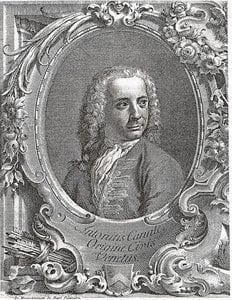
Giovanni Antonio Canal: The Master of Venetian Light
Giovanni Antonio Canal, universally known as Canaletto, was born in Venice on October 18, 1697, into a family deeply rooted in the world of visual arts. His father, Bernardo Canal, was a skilled painter specializing in theatrical scene settings – a profession that instilled in young Giovanni an early appreciation for composition, perspective, and the art of capturing fleeting moments. Artemisia Barbieri, his mother, further nurtured his artistic sensibilities, providing him with a foundation in technique and observation. Canaletto’s formative years were thus spent immersed in the vibrant atmosphere of Venetian artistry, laying the groundwork for his future success as one of the most celebrated veduta painters of the 18th century.
His early training wasn't solely within the family workshop; Canaletto sought experience beyond Venice. In 1718, he embarked on a significant journey to Rome, where he found employment assisting his father in creating backdrops for two operas staged by Alessandro Scarlatti. This period proved invaluable, exposing him to the grandeur of Roman architecture and the theatrical demands of stage design – experiences that profoundly shaped his artistic vision and honed his ability to render complex spatial relationships with remarkable accuracy.
The Rise of a Venetian Master
Upon returning to Venice in 1720, Canaletto swiftly established himself as a respected artist. Initially, he focused on producing commissioned works for wealthy patrons – portraits, interiors, and decorative panels that showcased his burgeoning talent. However, it was his fascination with the city itself—its intricate canals, bustling markets, and magnificent palaces—that truly ignited his artistic passion. He began to specialize in *vedute*, Italian term for "views," meticulously documenting Venice’s urban landscape with an unprecedented level of detail and realism.
Canaletto's approach was revolutionary. Unlike earlier artists who often idealized their subjects, Canaletto sought to capture the city as it truly existed—warts and all. He employed a systematic method, beginning with extensive preparatory drawings that captured every nuance of perspective, light, and shadow. These detailed sketches served as the foundation for his finished paintings, ensuring remarkable accuracy and a palpable sense of authenticity. He was also known to use a camera obscura – a device that projected an image of the outside world onto a surface – to aid in achieving precise topographical details, though he always prioritized compositional design above all else.
Collaborations and Artistic Influence
Canaletto’s career flourished through collaborations with other talented artists. Notably, his nephew, Bernardo Bellotto, became an accomplished landscape painter in his own right, often working alongside Canaletto and adopting a similar style. Their partnership produced numerous stunning views of Venice, showcasing the evolving cityscape and reflecting the artistic sensibilities of both men. The rivalry between them was also notable; they competed for commissions and sought to establish their individual reputations within the Venetian art world.
Canaletto’s influence extended far beyond Venice. In 1746, he traveled to England, invited by wealthy collectors eager to acquire his unique style. His paintings of London—including views of Buckingham Palace, St. Paul's Cathedral, and the Tower of London—became immensely popular, establishing him as a leading figure in European art. The British merchant Joseph “Consul” Smith played a pivotal role in this success, recognizing Canaletto’s talent and securing royal patronage for his work. King George III acquired a significant collection of Canaletto's paintings, further elevating the artist’s status and ensuring his works were widely exhibited throughout England.
Legacy and Enduring Appeal
Canaletto died in Venice on April 19, 1768, leaving behind a remarkable body of work that continues to captivate audiences today. His paintings offer an invaluable glimpse into the vibrant life of 18th-century Venice—a city teeming with commerce, culture, and artistic innovation. His meticulous attention to detail, masterful use of light and shadow, and unwavering commitment to realism have earned him a place among the greatest veduta painters in history.
Canaletto’s legacy is reflected in the numerous museums that house his works—including the National Gallery in London, where his paintings are celebrated for their beauty and historical significance. His influence can also be seen in the work of countless artists who followed in his footsteps, solidifying his position as a true master of Venetian art.



 Förhandsvisa
 Byt till tryck
 Skicka
 Dela
Dela
 Visa detaljer

 Ladda ner
 Liknande objekt
 Röntgen
 Bildspel
 Statistik


 Visa mer