

Giclée- eller canvasprint av museumskvalitet med snabb produktion och flexibla ytbehandlingsalternativ. ( Beställ handmålad reproduktion Byt till digital bild)





























Välj bland våra förinställda storlekar som motsvarar konstverkets ursprungliga proportioner.

Ange den bredd och höjd du behöver för att passa din ram eller vägg. Ett tryck kan endast beskäras, aldrig göras större än originalbilden, vilket innebär att ett format med en annan proportion leder till att en del av bilden går förlorad. Vi skickar en digital mockup för godkännande innan vi påbörjar tryckningen. Bilden som visas på denna sida visar inte den faktiska beskärningen — det är endast mockuppen som gör det.
Leverans över hela världen () på 2 veckor istället för standard 4/5 veckor. (11 november)
The Sideshowed
Storlek på reproduktion
In the quiet brilliance of Georges Seurat’s 1888 masterpiece, “Circus Sideshow,” we find ourselves transported to the heart of a Parisian spectacle, where the boundaries between reality and illusion begin to dissolve. This work is far more than a mere depiction of a circus performance; it is a profound exploration of how light interacts with the human gaze. As a cornerstone of Post-Impressionism, the painting captures a moment of suspended animation, inviting the viewer to step into a world where every flicker of movement and every shadow is meticulously calculated to evoke a sense of wonder. The scene presents a woman on stage, her presence commanding the attention of a diverse crowd, creating an atmosphere thick with both excitement and the quiet anticipation of the unknown.
The emotional resonance of the piece lies in its ability to balance the grandiosity of the spectacle with the intimate, almost voyeuristic experience of the spectators. There is a palpable tension between the performers on stage and the audience—some individuals are deeply immersed in the magic of the moment, while others remain detached, lost in their own reflections. This duality mirrors the complexity of urban life in late 19th-century France, where the public spectacle served as both a shared social ritual and a collection of isolated, individual experiences. For the collector or interior designer, this painting offers a sophisticated layer of narrative depth, making it an ideal centerpiece for spaces that value intellectual stimulation and atmospheric storytelling.
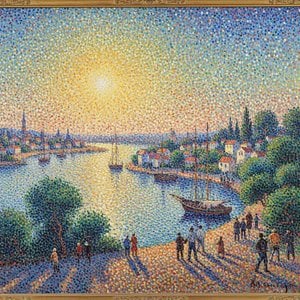
To gaze upon “Circus Sideshow” is to witness the triumph of scientific rigor applied to the canvas. Seurat, a pioneer of the Pointillist technique, rejected the spontaneous, often blurred brushstrokes of his Impressionist predecessors in favor of a method rooted in optical theory. Rather than blending pigments on a palette, he painstakingly applied tiny, unrecorded dots of pure, unmixed color—shades of yellow ochre, cadmium red, and ultramarine blue—directly onto the surface. This revolutionary approach relies on the viewer's eye to perform the work of blending; as light hits these individual points of pigment, the brain synthesizes them into a luminous, vibrating whole.
This technique creates an effect of shimmering luminosity that traditional painting methods simply cannot replicate. The texture of the piece feels alive, as if the very air within the circus tent is composed of dancing particles of light. For those seeking to incorporate fine art into a modern interior, the structural integrity and rhythmic precision of Seurat’s dots provide a unique visual texture that complements both classical and contemporary decor. It is a technique that demands slow looking, rewarding the observer with a deeper understanding of how color and light can be manipulated to create a sense of profound depth and brilliance.
Historically, “Circus Sideshow” serves as a window into the cultural zeitgeist of the Belle Époque. The circus was a symbol of the era's fascination with exoticism, social mobility, and the marvels of modern entertainment. By choosing this subject, Seurat elevated a transient moment of popular culture to the status of high art, imbuing the ephemeral nature of the sideshow with a sense of permanence and monumental importance. The painting captures the essence of a society on the brink of a new century, caught between the traditional allure of the spectacle and the scientific advancements that were reshaping human perception.
Owning a high-quality reproduction of this masterpiece allows one to bring this historical elegance into the home. Whether placed in a sunlit gallery or a moody, dimly lit study, the painting acts as a bridge between eras. It offers more than just aesthetic beauty; it provides a conversation piece that speaks to the history of science, the evolution of art movements, and the eternal human fascination with the magic of the stage. It is an investment in a legacy of light, precision, and the enduring power of the human imagination.
Statistik för "The Sideshowed" av Georges Seurat finns på verkets Besöksstatistik-sida: månatliga besök för verket, besök för konstnärens verk samt en uppdelning av nyligen anlända besökare per land och språk.
Den dominerande nyansen i "The Sideshowed" av Georges Seurat är Green to Violet Spectrum. Nyansen utgör den underliggande tonen i färgpaletten.
Ljus-mörker-kontrasten i "The Sideshowed" är registrerad som Serene. Kontrast beskriver hur starkt ljusa och mörka partier skiljer sig åt.

För att förstå det moderna måleriets bana måste man betrakta det korta och intensiva livet hos Georges Seurat. Han föddes i Paris, Frankrike, den 2 december 1859, som son till Ernestine Faivre och Antoine Chrysostome Seurat, en man som hade gått från att vara juridisk tjänsteman till fastighetsinvesterare i Champagne. Denna bakgrund gav den stabilitet som krävdes för hans snabba och disciplinerade klättring inom den parisiska konstscenen. Han målade inte bara; han konstruerade ett nytt sätt att se som utmanade sina föregångares spontana impulser.
Hans karriär var en sprint snarare än ett maraton. Han avled i Paris, Frankrike, den 29 mars 1891, vid endast 31 års ålder. Detta förtida slut lämnade efter sig ett konstnärskap som känns koncentrerat och avsiktligt, utan den utdragna och lösa utveckling som präglade många av hans samtida. Även hans sista, ofullbordade verk, såsom The Circus, avslöjar ett sinne upptaget av ljusets strukturella mekanik och den sociala ordningen. Han ersatte det flyktiga ögonblicket med en kalkylerad, permanent precision.
Inverkan av hans korta liv mäts genom den enorma tätheten i hans tekniska innovationer. Han förflyttade konsten bort från ögonblickets emotionella spontanitet mot en systematisk, nästan matematisk tillämpning av färg. Hans närvaro i 1800-talets historia definieras av detta vägran att enbart förlita sig på intuition. Han sökte en logik i duken som förblir synlig i varje pigmentprick han lämnade efter sig.
Georges Seurats livsresa tog sin början i Paris, där hans familj flyttade till Boulevard de Magenta kort efter hans födelse. Hans uppväxt präglades av den stabilitet som hans far, Antoine Chrysostome Seurat, erbjöd – en man som lämnat sin karriär som juridisk tjänsteman för att istället bli fastighetsinvesterare. Denna bakgrund gav den unge konstnären de resurser som krävdes för att få tillgång till den formella utbildning som behövdes för att utmana det sena 1800-talets etablerade normer. Han förlitade sig aldrig på enbart intuition; hans konstnärliga utveckling vilade snarare på en grund av rigorös och systematisk träning.
Hans formella utbildning inleddes vid École Municipale de Sculpture et Dessin, där han studerade under skulptören Justin Lequien. Denna tidiga exponering för skulpturkonsten bidrog sannolikt till den strukturella, nästan frisliknande kvalitet som senare skulle genomsyra hans kompositioner. Vid 1878 hade han klivit in i de högsta kretsarna av det franska konstlivet genom att skrivas in vid det prestigefyllda École des Beaux-Arts. Under sin tid där studerade han under Henri Lehmann, en period som gav honom de traditionella tekniker och den kompositionella disciplin som han senare skulle komma att dekonstruera genom vetenskaplig analys.
Seurat ersatte sina föregångares spontana och intuitiva penseldrag med ett kalkylerat och systematiskt förhållningssätt till ljuset. Han utvecklade punktillismen, en metod som definieras av appliceringen av små, distinkta prickar av ren färg på en duk. Detta var inte ett dekorativt val utan ett funktionellt sådant. Genom att använda divisionism separerade han lokal färg i enskilda punkter och förlitade sig på betraktarens öga för att uppnå en optisk blandning. Denna process, som han kallade kromoluminarism, behandlade färg som en vetenskap snarare än bara en känsla. Han strävade efter att rekonstruera synens fysik genom den exakta placeringen av pigment.
Hans precision sträckte sig ända in i det förberedande arbetet. Han använde ofta kontékritor på papper med sträv yta för att skissa upp sina kompositioner. Denna disciplinerade metod säkerställde att varje prick i hans slutgiltiga storskaliga verk var en del av en större, matematiskt orkestrerad struktur. De resulterande ytorna besitter en rytmisk, vibrerande kvalitet som härstammar från spänningen mellan de enskilda färgpunkterna och den enhetliga bild de bildar på näthinnan. Hans arbete förblir en studie i hur teknisk stringens kan diktera den visuella perceptionen.
Georges Seurats vision vilade på ett strikt och matematiskt förhållningssätt till ljuset. Han förkastade sina föregångares spontana och emotionella penseldrag till förmån för en systematisk rekonstruktion av seendet. Denna metod förvandlade duken till en plats för optisk beräkning snarare än enbart observation. Hans verk strävade efter att fånga en scenes väsentliga och oföränderliga struktur genom en exakt tillämpning av färglära. Han målade inte bara ett landskap; han konstruerade en visuell upplevelse baserad på hur det mänskliga ögat bearbetar ljus och pigment.
Hans storskaliga kompositioner vittnar om denna hängivelse till ordning. A Sunday Afternoon on the Island of La Grande Jatte (1884–1886) använder en monumental skala för att presentera en scen av parisiskt fritidsliv genom en tät mosaik av prickar. Detta verk fungerar som ett manifest för neoimpressionismen, där flytande rörelse ersätts av en känsla av permanent, skulptural stillhet. På liknande sätt visar Bathers at Asnières (1884) hans tidiga förmåga att förena klassiska, frisläppta figurtyper med den moderna, industriella verkligheten vid Seine. Dessa målningar bevisar att hans intresse låg i skärningspunkten mellan vetenskaplig precision och det samtida livet.
Även hans sista, ofullbordade strävanden avslöjar en besatthet av spänningen mellan rörelse och struktur. The Circus (1890–91) använder en neoimpressionistisk stil för att skildra energin i ett offentligt skådespel, men förblir ändå förankrad i hans karakteristiska formkontroll. I Young Woman Powdering Herself (1889–1890) applicerade han sin teknik på ett enskilt motiv och utforskade den mänskliga fåfängans konstladhet genom en högst konstruerad miljö. Hans konstnärskap var en ständig strävan efter att finna en logik i ljuset som impressionismens flyktiga blick inte kunde erbjuda.
Georges Seurats inverkan på den moderna konstens bana kan mätas genom de radikala skiften som hans metoder påtvingade efterföljande rörelser. Genom att ersätta sina föregångares intuitiva penseldrag med ett systematiskt och vetenskapligt förhållningssätt till färg och ljus, vidgade han gränserna för vad en målning kunde uppnå. Denna intellektuella stringens förflyttade konsten från ren representation mot en strukturerad analys av perceptionen. Hans envisa fokus på pigmentens optiska blandning förändrade i grunden mekanismerna för hur en betraktare interagerar med en duk.
Ringarna på vattnet från hans tekniska innovationer sträckte sig långt utanför den neoimpressionistiska kretsen. Fauvisterna lånade hans betoning på djärv, icke-naturalistisk färg, medan kubisterna hämtade inspiration från hans förmåga att dekonstruera former till geometriska komponenter. Även de abstrakta expressionisterna, med sitt fokus på gestens råa energi, står i tacksamhetsskuld till det sätt på vilket han befriade färgen från de traditionella blandningsteknikernas begränsningar. Han bevisade att konsten kunde vara både en rigorös intellektuell strävan och en metod för att fånga det moderna livets essens.

1859 - 1891 , Frankrike

Discover the mesmerizing world of Pointillism. Explore the revolutionary techniques of Georges Seurat, the science of optical color mixing, and the enduring legacy of Neo-Impressionism in this expert guide for classical art enthusiasts.

Explore the scientific brilliance of Seurat and Signac. Discover how Pointillism revolutionized color through optical mixing and light, offering a profound look into the Neo-Impressionist movement for true art connoisseurs and collectors.

Explore the vibrant evolution of Post-Impressionism. From Seurat's revolutionary Pointillism to the emotional depth of masters, discover how this movement redefined modern art history through color, structure, and unparalleled creative expression.
Embark on a sophisticated journey into the luminous world of Neo-Impressionism. Uncover the scientific brilliance of Pointillism, from Georges Seurat’s revolutionary color theory to the mesmerizing magic of the dot. An expert exploration for true art history enthusiasts.
 Förhandsvisa
 Skicka
 Dela
Dela
 Visa detaljer
 Guide
Guide

 Ladda ner
 Liknande objekt
 Röntgen
 Bildspel
 Frågor och svar
 Statistik

 Visa mer









 Glasalternativet är endast tillgängligt i storlekar under 110 cm.


