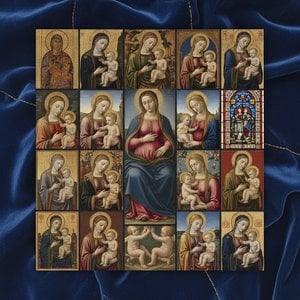
En lysande stjärna inom den internationella gotiken: Gentile da Fabrianos liv och konst
Gentile da Fabriano, ett namn synonymt med den internationella gotikens överdådiga elegans, framträdde ur det konstnärliga landskapet i 1300-talets sena Italien. Han föddes omkring år 1370 i den pittoreska staden Fabriande, belägen i regionen Marche, men hans tidiga liv förblir höljt i mystik. Vi vet att hans mor gick bort före 1380 och att hans far, Niccolò di Giovanni Massi, sökte tröst i ett kloster senast 1385 – händelser som sannolikt formade den unge Gentiles formativa år. Även om detaljerna kring hans första utbildning är knappa, framgår det av hans tidigaste kända verk,
Madonna med barnet (ca 1395-1400), som nu finns i Berlin, att han absorberade den förfinade estetik som präglade den sengotiska målarkonsten i norra Italien. Detta tidiga verk anar redan den delikata precision och de eleganta former som senare skulle komma att definiera hans mogna stil.
Venetianska blomstringar och ett stigande rykte
Vid ungefär år 1405 hade Gentile etablerat sig som verksam konstnär i Venedig, en livlig knutpunkt för handel och kulturellt utbyte. Här åtog han sig uppdrag såsom en panel till kyrkan Santa Sofia – tyvärr förlorad genom tidens tand – och samarbetade med framstående konstnärer som Jacopo Bellini. Hans venetianska period förde honom i kontakt med andra inflytelserika gestalter, däribland Pisanello och Michelino da Besozzo, vilket främjade en konstnärlig dialog som berikade hans utvecklande stil. Det var under denna tid han började bygga upp ett rykte för sin noggranna detaljrikedom och sin sofistikerade användning av färg, egenskaper som skulle bli kännetecken för hans arbete. Freskerna som beställdes till Dogepalatset, föreställande en sjöslag, är också förlorade men vittnar om hans förmåga att hantera storslagna narrativa kompositioner. Hans resor och samarbeten vidgade hans konstnärliga horisonter och förberedde honom för ännu större bedrifter under de kommande åren.
Mästerverk av tro och form: Florens och bortom
Perioden mellan 1410 och 1412 såg Gentile skapa ett av sina mest hyllade verk,
Valle Romita-polyptyket, som nu finns i Pinacoteca di Brera. Detta komplexa altarskåp uppvisar hans mästerskap inom komposition, färgharmoni och intrikata detaljer. Det var dock hans flytt till Florens år 1020 som verkligen cementerade hans eftermäle. På uppdrag av den förmögne köpmannen Palla Strozzi påbörjade Gentile vad som utan tvekan är hans mest ikoniska skapelse:
De tre kungars tillbedjan (1423), som nu pryder väggarna i Uffizigalleriet. Detta mästerverk exemplifierar den internationella gotiken vid dess zenit – en bländande uppvisning av praktfulla tyger, utsökta juveler och gracila figurer arrangerade i en minutiöst utformad scen. Målningen är inte enbart en religiös skildring; det är en hyllning till rikedom, makt och konstnärlig skicklighet. Gentiles användning av bladguld och vibrerande färger skapar en överjordisk lyster som drar betraktaren in i det heliga narrativet. Hans florentinska period gav även andra betydelsefulla verk, däribland
Intercessionsaltarskåpet och
Quaratesi-polyptyket, där varje verk demonstrerar hans fortsatta förfining av teknik och konstnärlig vision.
Ett bestående inflytande: Arv och historisk betydelse
Gentile da Fabrianos liv fick en tragisk förtida slut; han dog före den 14 oktober 1427 och begravdes antingen i Rom eller Florens – den exakta platsen för hans sista viloplats är fortfarande osäker. Trots sin relativt korta karriär var hans inverkan på den italienska konsten djupgående. Han överbryggade gapet mellan den sengotiska traditionen och den framväxande renässansestetiken, och påverkade en hel generation konstnärer med sin förfinade teknik och eleganta stil. Hans betoning på detaljerad observation, naturalistisk representation och sofistikerade färgpaletter banade väg för innovationerna hos konstnärer som Masaccio och Fra Angelico. Gentiles verk står som ett vittnesbörd om skönhetens, hantverkets och den konstnärliga visionens bestående kraft – ett lysande exempel på den internationella gotiken i dess mest gloriösa form.
- Utforska ytterligare insikter i den internationella gotiska stilen genom resurser tillgängliga på WahooArt.com.
- Fördjupa dig i hans liv och verk med information från Wikipedia.



 Förhandsvisa
 Beställ handmålad reproduktion
 Skicka
 Dela
Dela
 Visa detaljer

 Ladda ner
 Liknande objekt
 Röntgen
 Bildspel
 Statistik


 Visa mer






































 Glasalternativet är endast tillgängligt i storlekar under 110 cm.