A Chronicler of the Vanishing West: The Life and Art of Frederic Remington
Frederic Sackrider Remington, född i Canton, New York, den 4 oktober 1861, var ingen produkt av det västernland han så levande målade. Han var snarare en österlänning som skapade sin konstnärliga identitet genom fascination och en dedikerad studie av ett landskap som i stort sett hade försvunnit. Hans bakgrund antydde ett liv långt borta från dammiga stigar och kavalleriattacker – franska basiska arv blandat med starkt republikanska nya englandsrötter, en far som var krigskolonnell och tidningsredaktör, samt kopplingar till det kända Remington Arms-imperiet genom avlägsna släktingar. Trots detta var det en tidig exponering för militära teman, kombinerat med en rastlös anda och ett skarpt öga för berättande, som ledde honom på vägen mot att bli kanske den mest igenkännliga konstnären av den amerikanska västern. Hans barndom flyttades till Bloomington, Illinois, sedan tillbaka till Canton och slutligen till Ogdensburg, New York, men hans fantasi fanns fångad av berättelser om friluftsliv. Även om han initialt pekades i en militär utbildning vid Vermont Episcopal Institute, låg Remingtons sanna talang inte i att följa order, utan i att observera och tolka världen omkring honom genom konst. En kort vistelse vid Yale University bekräftade detta; fotboll och skissande hade mycket större attraktion än formell akademisk sysslor.
Från Illustratör till Målare: Skapandet av en Konstnärlig Vision
Remingtons konstnärliga resa började inte med storslagna dukar, utan med bläck och papper. Hans första publicerade verk, en teckning för *Yale Courant*, signalerade tidigt ett begåvningsfullt sinne för att fånga handling och berättelse. En avgörande resa till Montana 1881 tände hans livslånga besatthet av västern. Detta var inte bara en turists blick; Remington sökte att fördjupa sig i kulturen, observerade cowboys, indianer och landskapet självt. I början försökte han ranching och gruvdrift, men dessa visade sig vara misslyckade, vilket frigjorde honom att helt ägna sig åt konst. Återvändande till öst etablerade han snabbt sig själv som en illustratör för tidningar som *Harper’s Weekly* och *Collier’s*, hans dynamiska skildringar av västernscener fångade en nationell publik som längtade efter berättelser om gränslandet. Dessa illustrationer var inte bara rapportering; de var fyllda med drama, energi och en romantiserad syn på västern som resonerade djupt hos allmänheten. Genom detta arbete finslipade Remington sina färdigheter i komposition, fångande rörelse och förmedlande av känslor – kvaliteter som senare skulle definiera hans målningar. Han fick minimal formell utbildning bortsett från några skissklasser vid Yale och en kort period på Art Students League, utvecklade istället ett distinkt stil som karaktäriserades av energiska penseldrag, djärva färger och fokus på realism blandat med dramatiskt uttryck.
Att fånga en Försvinnande Värld: Teman och Stil
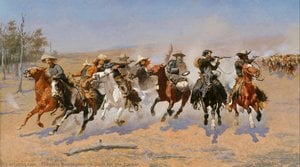
Remingtons konst är oåtskild från en specifik tidpunkt i amerikansk historia – den sista tiden av det gamla västern. Hans målningar bebos av ikoniska figurer: robusta cowboys som driver boskap, stoiska indianer som står inför förflyttning och U.S. Cavalry-soldater engagerade i både hjältemodiga strider och tragiska konflikter. Han tvekade inte att skildra de hårda realiteterna i gränslandets liv, men hans konst tenderar ofta till en romantiserad framställning, som betonar mod, äventyr och kollisionen av kulturer.
Hans målningar är inte bara historiska dokument; de är suggestiva berättelser som utforskar teman om heroism, förlust och den oundvikliga frammarschen av utveckling. Remingtons stil utvecklades över tid, från mer täta, akademiskt influerade skildringar till mer lösa, uttrycksfulla penseldrag. Han var en mästare på att fånga rörelse – hästar som galopperar över slätter, cowboys som kämpar med boskap och soldater som stormar in i strid.
Han använde ofta snabba skisser och fotografier som referensmaterial, men hans konst överskred alltid ren imitation, fylld med sin egen unika vision och emotionella intensitet. Kända verk som *My Ranch*, *Waiting in the Moonlight*, *Ridden Down* (1905) och *The Long-Horn Cattle Sign* (1908) exemplifierar hans förmåga att fånga både den stora och den sårbara aspekten av det amerikanska västern.
Arv och Bestående Inverkan
Frederic Remington dog oväntat 1909 i ålder av 48 år, lämnade efter sig en enorm verktygslåda som fortfarande fångar publikens uppmärksamhet idag. Hans inflytande på västernkonst är obestridligt; han målade inte bara västern, han *definierade* den för generationer av amerikaner. Han etablerade ett visuellt språk för gränslandet – en ikonografi av cowboys, indianer och kavalleri som blev djupt rotad i allmänhetens fantasi.
- Hans verk inspirerade otaliga andra konstnärer, inklusive N.C. Wyeth och Zane Grey.
- Frederic Remington Art Museum i Ogdensburg, New York, står som ett testamente till hans bestående arv, bevarar en omfattande samling av hans målningar, skulpturer och arkivmaterial.
- Hans konst visas fortfarande i stora museer över hela landet, inklusive Metropolitan Museum of Art och Amon Carter Museum of American Art.
Remingtons skildringar, även om de ibland kritiseras för deras romantiserade framställning av västern, ger en värdefull inblick i en avgörande tid i amerikansk historia. Han fångade inte bara vad *var*, utan också vad människor *trodde* om västern – dess myter, dess legender och dess bestående attraktion. Han är ett kraftfullt symbol för den amerikanska andan – en skildrare av en försvinnande värld som förvandlade den till ett bestående konstnärligt arv.



 Visa i rummet
 Byt till tryckta exemplar
 Skicka
 Dela
Dela
 Detaljer
 Guide
Guide

 Ladda ner
 Liknande objekt
 Röntgen
 Bildspel
 Besökstatistik


 Läs mer