x
Giclée- eller canvasprint av museumskvalitet med snabb produktion och flexibla ytbehandlingsalternativ.
Välj bland våra förinställda storlekar som motsvarar konstverkets ursprungliga proportioner.
Du kan ange egna mått för att passa en specifik ram eller yta. Om det valda måttet inte överensstämmer med originalbildens proportioner kommer vi antingen att beskära konstverket eller utöka bilden med en speglad eller enfärgad kant. En digital mockup skickas för ditt godkännande innan produktionen påbörjas.

Vänligen notera att förhandsvisningen på skärmen inte återspeglar den faktiska beskärningen eller utökningen. Endast mockuppen visar den slutgiltiga kompositionen korrekt.
Även om anpassade storlekar är möjliga, rekommenderar vi att du väljer ett mått från den fördefinierade listan för att bevara de ursprungliga proportionerna.
Leverans över hela världen () på 2 veckor istället för standard 4/5 veckor. (2 juli)
Clock
Storlek på reproduktion
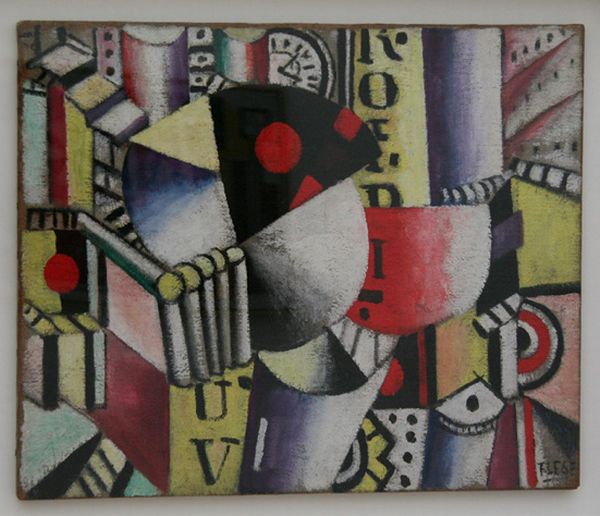
Fernand Léger's Clock is a pivotal work exemplifying his signature “Tubism” – a dynamic offshoot of Cubism that celebrates the machine age. More than a mere depiction, this painting constructs a visual vocabulary reflecting modernity’s energy and inherent contradictions.
The composition immediately intrigues with its playful yet enigmatic arrangement. At its heart is a bird, rendered not through naturalistic detail but as an assemblage of geometric forms. Dominating the bird’s chest is a prominent clock – a potent symbol representing time's relentless march, industrial progress, and perhaps even the constraints imposed by modern life. Adding to this fascinating juxtaposition, the bird clutches a baseball bat within its beak, hinting at leisure, American cultural influences, and a distinctly sporty spirit filtering into Léger’s artistic vision. Surrounding these central motifs are fragmented representations of everyday objects – a cup, bowl, and vase – all broken down into their essential geometric components.
Léger masterfully employs a limited yet impactful palette, primarily utilizing bold reds and stark blacks. This high-contrast color scheme amplifies the painting’s visual impact and reinforces its sense of mechanical precision. The application of paint is notably flat, deliberately eschewing traditional modeling techniques in favor of clearly defined planes and shapes. This flatness contributes to the artwork's overall feeling of being a constructed image rather than a mimetic representation of reality. The deliberate simplification of forms and rejection of conventional perspective are hallmarks of Léger’s unique Cubist approach.
Born in 1881, Fernand Léger lived through – and actively engaged with – the rapid industrialization and technological advancements of the early 20th century. He diverged from purely analytical Cubism (as pioneered by Picasso and Braque) towards a more accessible style that embraced the beauty and dynamism of machines and modern life. Clock, likely created between 1920-1930, embodies this aesthetic perfectly. It reflects Léger’s fascination with the energy and rhythm of the machine age, elevating commonplace objects to heroic forms.
Clock evokes a complex emotional response – a blend of optimism and underlying tension. The bold colors and dynamic composition convey vitality and progress. However, the fragmented nature of the imagery and the prominent presence of the clock can also be interpreted as representing the alienation and fragmentation experienced in modern society. The baseball bat introduces an element of human activity and leisure, perhaps suggesting a desire to escape or find joy within this mechanized world. The painting invites viewers to contemplate the intricate relationship between humanity, technology, and the passage of time.
Clock would make a striking statement in various settings:
To best showcase the artwork, consider framing it with a simple black frame that doesn’t compete with its strong visual elements. Placement should allow for ample viewing distance and appropriate lighting to highlight the richness of the colors and textures. Clock is not merely a decorative piece; it's an intellectual statement – a window into the heart of modernity.
1881 - 1955 , Frankrike
Berätta om ditt projekt så kommer våra konstexperter att ge dig 3 personliga konstförslag.
Vi skapar ett urval av 3 alternativ helt anpassat för dig – gratis!