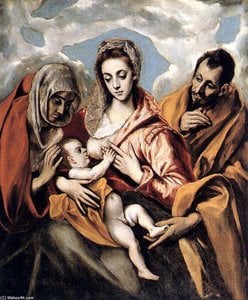
Giclée- eller canvasprint av museumskvalitet med snabb produktion och flexibla ytbehandlingsalternativ. ( Beställ handmålad reproduktion Byt till digital bild)





























Välj bland våra förinställda storlekar som motsvarar konstverkets ursprungliga proportioner.

Ange den bredd och höjd du behöver för att passa din ram eller vägg. Ett tryck kan endast beskäras, aldrig göras större än originalbilden, vilket innebär att ett format med en annan proportion leder till att en del av bilden går förlorad. Vi skickar en digital mockup för godkännande innan vi påbörjar tryckningen. Bilden som visas på denna sida visar inte den faktiska beskärningen — det är endast mockuppen som gör det.
Leverans över hela världen () på 2 veckor istället för standard 4/5 veckor. (10 november)
Retable and side altars
Storlek på reproduktion
El Greco’s “Retable and Side Altars,” painted in 1577 for the Cistercian convent of Santo Domingo el Antiguo in Toledo, Spain, isn't merely a religious depiction; it’s a profound exploration of faith, emotion, and the burgeoning artistic spirit of the late Renaissance. Commissioned during a pivotal moment in El Greco’s career – his arrival in Spain after years spent honing his craft in Italy and Greece – this monumental altarpiece reveals a synthesis of influences, forging a uniquely powerful style that would resonate through art history. The work stands as a testament to El Greco's ability to imbue religious iconography with an intensely personal and dramatic sensibility, pushing beyond the established conventions of the time.
The core of the altarpiece centers around “The Assumption of the Virgin,” a breathtaking vision of Mary ascending into heaven. El Greco masterfully employs a dynamic composition, eschewing the static serenity often associated with religious art. Figures are elongated and distorted, their bodies contorted in expressions of anguish and ecstasy. The use of color is equally arresting – deep reds, blues, and ochres dominate, creating an atmosphere of heightened drama and spiritual intensity. The architectural setting, rendered with a subtle yet effective perspective, anchors the scene within the confines of Toledo’s Santo Domingo convent, grounding the divine in the earthly realm.
El Greco's artistic journey is crucial to understanding this masterpiece. His early training in Crete exposed him to Byzantine iconography, characterized by its stylized figures and rich symbolism. However, his time in Italy, particularly Venice, introduced him to the innovations of the Renaissance – a fascination with perspective, naturalism, and the use of oil paint. Crucially, he was deeply influenced by Flemish artists like Jan van Eyck and Dirk Bouts, whose meticulous detail, dramatic lighting, and emotional intensity found their way into his work. This confluence of influences is most evident in the altarpiece’s composition, its use of chiaroscuro (the contrast between light and dark), and the expressive faces of its figures.
Yet, El Greco didn't simply mimic these styles; he transformed them, imbuing them with his own distinctive vision. The elongated figures, the heightened emotionalism, and the unsettling use of color are distinctly *El Greco*. He wasn’t interested in creating a purely realistic representation of religious subjects; instead, he sought to convey their spiritual essence through powerful visual metaphors.
The “Retable and Side Altars” is rich with symbolic detail. The figures themselves are not merely portraits but embodiments of theological concepts. The placement of saints, the gestures they make, and their expressions all contribute to a complex narrative that speaks to themes of faith, devotion, and salvation. Note, for example, the prominent role of Saint John the Evangelist in one of the side panels – a figure often associated with divine revelation and prophecy. The inclusion of classical elements, such as the architectural framework and the references to Roman mythology, further enriches the work’s symbolic landscape.
The choice of Toledo itself is significant. As a city steeped in religious history and a center of Spanish culture, it provided El Greco with a fertile ground for his artistic explorations. The depiction of the city's skyline, subtly integrated into the background, connects the divine realm to the everyday world.
Ultimately, “Retable and Side Altars” is a profoundly moving work of art. It’s not simply a depiction of religious events; it's an exploration of human emotion – faith, doubt, joy, sorrow, and ultimately, hope. The elongated figures, the dramatic lighting, and the intense colors all contribute to a sense of heightened emotional intensity. The viewer is drawn into the scene, invited to contemplate the mysteries of faith and the complexities of the human experience. It’s a testament to El Greco's ability to transform religious iconography into a powerful expression of the soul—a legacy that continues to captivate audiences centuries later.
Consider commissioning a high-quality reproduction to bring this extraordinary artwork into your home or office, allowing its evocative power and spiritual depth to enrich your surroundings.
Storlek Large, Portrait-orientering: detta är den rekommenderade tryckinställningen för "Retable and side altars" av El Greco.
"Retable and side altars" av El Greco förmedlar en Spiritual känsla inom en övergripande Elegant stämning.
"Retable and side altars" tillhör El Grecos Mature Period i konstnärskarriären. Denna klassificering relaterar verket till konstnärens utveckling.

Doménikos Theotokópoulos, av historien känd som El Greco, tog sina första steg i livet 1541 på ön Kreta. Vid denna tid var ön under venetianskt styre, ett faktum som senare skulle tillåta honom att överbrygga klyftan mellan östliga och västliga traditioner. Han utbildades som ikonmålare inom den bysantinska traditionen, en disciplin som krävde en noggrann uppmärksamhet på detaljer och ett fokus på motivets andliga essens snarare än enbart fysisk likhet. Denna tidiga fördjupning i den kretsiska skolan gav honom en känsla för symbolisk precision som skulle förbli en konstant, även när hans stil genomgick radikala transformationer.
Vid tjugosex års ålder flyttade han till Venedig för att utvidga sin förståelse av den naturliga världen. I den venetianska republiken kom han i kontakt med verken av Tizian och Tintoretto, och han sög åt sig deras mästerskap i färg och användningen av ljus för att definiera form. Han lärde sig att röra sig bort från ungdomens stela linjer och omfamnade ett mer flytande penseldrag och en känsla av dynamik. Denna period var inte ett avvisande av hans rötter utan snarare en expansion av dem, då han började sammanväva den disciplinerade ikonografin från sitt grekiska arv med den atmosfäriska sensualiteten från den italienska renässansen.
Efter en period i Rom, där han mötte manierismens förlängda former och sofistikerade kompositioner, slog El Greco sig ner i Toledo, Spanien, år 1577. Detta flytt visade sig vara avgörande. Toledo var ett centrum för intensiv religiös glöd under motreformationen, vilket erbjöd ett landskap som var perfekt anpassat för hans alltmer mystiska vision. Det var här som hans stil nådde sin mest särpräglade fas, kännetecknad av figurer som verkade utsträckta och förvridna, som om de drogs av en osynlig andlig kraft. Han använde färg inte för att efterlikna verkligheten, utan för att förstärka den emotionella effekten, ofta genom att använda onaturliga nyanser för att skildra det gudomliga.
Hans arbete i Spanien präglades av en spänning mellan det jordiska och det eteriska. I Begravningen av greve Orgaz (1586-1588) sammanställde han den realistiska skildringen av samtida figurer med utdragna, himmelska former, vilket skapade en visuell bro mellan det dödliga och det gudomliga. Hans förmåga att manipulera ljus och skugga gjorde det möjligt för honom att skapa en känsla av drama som kändes både teatralisk och djupt personlig. Han målade inte bara scener; han försökte gestalta de emotionella och andliga realiteter som existerar bortom den fysiska världens yta.
De senare åren av hans liv präglades av en rörelse mot ännu större abstraktion och mysticism. Hans kompositioner blev mer komplexa och hans figurer mer förvridna, vilket speglade en växande distans till konventionella konstnärliga normer. Trots att han nådde framgång och fick betydande uppdrag från kyrkor och kloster i Toledo, kändes hans inflytande inte omedelbart av den bredare konstvärlden efter hans död 1614. Under en lång period betraktades han som en excentriker, och hans verk förblev i stort sett förbisedda av konsthistoriens mainstream.
Det var inte förrän under 1900-talet som hans betydelse fullt ut erkändes. Modernisterna fann i hans verk en föregångare till framtidens expressiva och fragmenterade stilar. Hans förmåga att förvränga proportioner och använda djärva, emotionella färger resonerade med dem som sökte uttrycka inre psykologiska tillstånd. Idag betraktas hans målningar som fönster in i den mänskliga själen, hyllade för sin unika förmåga att fånga trons intensitet och kampen för transcendens.
Några framstående verk inkluderar:

1541 - 1614 , Grekland

Explore the profound drama of Spanish Baroque art. Delve into the mastery of light, shadow, and realism through the legendary works of Diego Velázquez and the Spanish Golden Age.
 Förhandsvisa
 Skicka
 Dela
Dela
 Visa detaljer
 Guide
Guide

 Ladda ner
 Liknande objekt
 Röntgen
 Bildspel
 Frågor och svar
 Statistik


 Visa mer









 Glasalternativet är endast tillgängligt i storlekar under 110 cm.