Olja på dukVäggkonstMannerist Landscape
 1597Renässansen
 121.0 x 109.0 cm
 Metropolitan Museum of Art
Giclée- eller canvasprint av museumskvalitet med snabb produktion och flexibla ytbehandlingsalternativ. ( Beställ handmålad reproduktion Köp högupplöst bild)





























Välj bland våra förinställda storlekar som motsvarar konstverkets ursprungliga proportioner.

Du kan ange egna mått för att passa en specifik ram eller yta. Om det valda måttet inte överensstämmer med originalbildens proportioner kommer vi antingen att beskära konstverket eller utöka bilden med en speglad eller enfärgad kant. En digital mockup skickas för ditt godkännande innan produktionen påbörjas.
Vänligen notera att förhandsvisningen på skärmen inte återspeglar den faktiska beskärningen eller utökningen. Endast mockuppen visar den slutgiltiga kompositionen korrekt.
Även om anpassade storlekar är möjliga, rekommenderar vi att du väljer ett mått från den fördefinierade listan för att bevara de ursprungliga proportionerna.
Leverans över hela världen () på 2 veckor istället för standard 4/5 veckor. (7 september)


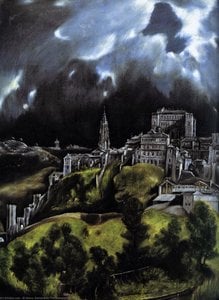
En vy av Toledo
Storlek på reproduktion
El Greco’s “A View of Toledo,” painted in 1597 and now residing within the Metropolitan Museum of Art, is far more than just a depiction of a Spanish city; it's an immersive journey into a profoundly psychological landscape. This oil on canvas transcends the boundaries of simple observation, transforming into a visceral expression of spiritual tension and impending drama. Born Domenikos Theotokopoulos in Crete, El Greco’s artistic life was shaped by a remarkable synthesis – a potent blend of Byzantine tradition, Italian Mannerism, and Venetian Renaissance influences. This confluence culminated in his uniquely personal and dramatically charged style, and “A View of Toledo” stands as its most powerful testament. It's not merely a landscape; it’s a carefully constructed mood, a premonition rendered in color and form.
The painting immediately commands attention with an overwhelming sense of foreboding. The dominant feature is a colossal hill crowned by a formidable castle, anchoring the scene within a valley bisected by two surging rivers. These waterways aren’t serene; they possess an almost violent energy, mirroring the turmoil brewing above. Scattered throughout the image are figures – not idyllic inhabitants enjoying the vista, but individuals engaged in everyday activities, seemingly oblivious to the impending storm. This deliberate juxtaposition of human activity and atmospheric drama creates a potent sense of unease, suggesting that even amidst routine, a deeper, more unsettling reality lies beneath the surface. It’s as if El Greco is reminding us that life continues regardless of looming threats.
El Greco's distinctive style in “A View of Toledo” is a direct result of his diverse artistic training. The painting’s foundation rests firmly within the Byzantine tradition – evident in the meticulous detail, the rich, layered colors, and the stylized rendering of figures. However, he skillfully integrates elements from Italian Mannerism, particularly in the elongated forms and dramatic perspective, alongside Venetian Renaissance influences, most notably in the use of color and light. The result is a style that anticipates the emotional intensity of Expressionism and the fragmented forms of Cubism – movements centuries later. The painting’s scale itself contributes to this effect; it feels both monumental and intensely personal.
Notice particularly how El Greco employs color. He doesn't shy away from dark, brooding tones—deep blues, blacks, and purples dominate the sky—creating a sense of claustrophobia and impending doom. Yet, these somber hues are punctuated by vibrant greens and yellows in the landscape below, offering a fleeting glimpse of hope or perhaps simply highlighting the contrast between earthly existence and spiritual turmoil. The figures themselves are rendered with an almost ethereal quality, their forms elongated and distorted, further emphasizing the painting’s psychological depth.
“A View of Toledo” is inextricably linked to the city it depicts – a strategically important stronghold that has witnessed centuries of conflict and religious upheaval. Founded by Julius Caesar, Toledo became a center of Christian power during the Middle Ages, enduring sieges and reconquests before finally falling under Moorish control in the 10th century. The painting captures this complex history, reflecting both the city’s physical strength (represented by the castle) and its spiritual significance. The two rivers, the Tagus and Tajo, are not merely geographical features; they symbolize the flow of time and the passage of fate.
Interestingly, El Greco painted this view from a specific vantage point – overlooking the city from the hills surrounding it. This choice is significant because it allows him to capture both the grandeur of Toledo’s architecture and the vulnerability of its position. The castle, perched atop the hill, represents power and defense, while the rivers suggest the constant threat of invasion and destruction. The inclusion of everyday figures adds a layer of human drama to this symbolic landscape, reminding us that even in times of conflict, life continues on.
“A View of Toledo” is not simply a beautiful landscape; it’s a profoundly moving work of art. El Greco masterfully evokes a sense of unease, anticipation, and perhaps even despair. The painting's dramatic composition, coupled with its rich color palette and stylized figures, creates an atmosphere that lingers long after the viewer has turned away. It is this ability to tap into fundamental human emotions that has secured El Greco’s place as one of the most influential artists in Western history.
Today, reproductions of “A View of Toledo” continue to captivate audiences worldwide. WahooArt offers meticulously crafted hand-painted reproductions that faithfully capture the painting's original beauty and emotional power. Owning a reproduction is not just acquiring an image; it’s bringing home a piece of art history – a window into the soul of a city and the visionary mind of El Greco.


1541 - 1614 , Griechenland

Discover the profound allure of oil on canvas. Explore the mastery of impasto textures, the science of pigment longevity, and expert guides to selecting museum-quality reproductions that elevate your collection with timeless elegance and tactile depth.

Embark on a sophisticated exploration of Spanish art history, from the chiaroscuro mastery of Velázquez to the profound shadows of Goya. Discover how the dramatic light and emotional depth of Spain's greatest masters continue to inspire collectors and connoisseurs today.

Discover the enduring allure of oil on canvas. Explore how master techniques like impasto and glazing create the depth, texture, and emotional resonance found in the world's greatest masterpieces. An essential guide for fine art enthusiasts and discerning collectors.

Discover the enduring legacy of oil on board painting. Explore how historical techniques, rich impasto textures, and structural durability create timeless masterpieces that bridge Renaissance grandeur with modern art collecting excellence.

 Förhandsvisa
 Skicka
 Dela
Dela
 Visa detaljer

 Ladda ner
 Liknande objekt
 Röntgen
 Bildspel
 Visa mer







 Glasalternativet är endast tillgängligt i storlekar under 110 cm.