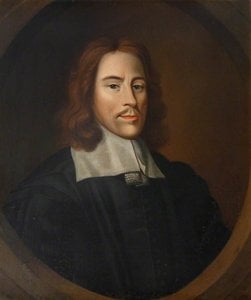
The Shadowed Master of Scottish Portraiture
In the turbulent landscape of seventeenth-century Scotland, where political upheaval and the Restoration of the monarchy reshaped the social fabric, the name David Scougall emerges as a vital, if somewhat enigmatic, presence. Though much of his personal history remains veiled by the passage of centuries, his brushstrokes offer a window into an era of profound transition. Born around 1625, likely in Edinburgh, Scougall navigated a world where art served as both a mirror to power and a testament to lineage. While he may have been partially obscured by the more prolific shadows of contemporaries like John Michael Wright, Scougall established himself as a premier chronicler of the Scottish nobility, capturing the very essence of an aristocracy seeking to assert its permanence through the medium of oil and canvas.
The foundations of his artistry were likely laid in the rigorous traditions of apprenticeship, with evidence suggesting he studied under the celebrated Flemish painter John Michael Wright. This connection was transformative; it infused Scougall’s work with a sophisticated understanding of anatomical precision and the burgeoning Renaissance ideals that were sweeping across Europe. From this lineage, he inherited a commitment to expressive realism—a technique that allowed him to move beyond mere likeness to capture the psychological weight of his subjects. His style was not merely an imitation of others but a synthesis of meticulous observation and a humanist sensibility, creating portraits that breathed with a quiet, dignified intensity.
A Legacy of Nobility and Lineage
Scougall’s career was defined by his ability to command the attention of Scotland's most influential families. His studio became a destination for those seeking to immortalize their status during the period following the Restoration of Charles II. One of his most notable achievements lies in his mastery of light and shadow, a skill famously demonstrated in his 1654 portrait of the daughter of Archibald Campbell, Marquis of Argylant. In such works, one observes a remarkable ability to manipulate luminosity, drawing the viewer's eye to the subtle textures of silk, the glint of jewelry, and the piercing depth of a sitter’s gaze. His repertoire included much more than simple likenesses; he provided the visual vocabulary for the new Parliament and the landed gentry, documenting the faces of power with an authority that commanded respect.
The artistry of Scougall was not a solitary endeavor but the beginning of a significant familial tradition. He was the progenitor of a dynasty of painters, most notably his son, John Scougall, who continued to refine and expand the family’s reputation for excellence. This lineage ensured that the Scougall name remained synonymous with Scottish portraiture for decades. Beyond the canvas, recent historical inquiries have even suggested a fascinating duality in David's life, hinting that he may have balanced his creative pursuits with a career as a solicitor, deeply embedded within the legal and social networks of Leith and Edinburgh. This intersection of law and art underscores the sophisticated, multi-faceted nature of the intellectual class he so frequently depicted.
Artistic Influence and Historical Resonance
To study the work of David Scougall is to witness the evolution of a national identity through portraiture. While his style was often noted for its resemblance to the great Sir Peter Lely, Scougall maintained a distinct character rooted in the traditions of Scotland's first great painter, George Jamesone. His ability to blend Dutch realism with a more formal, courtly elegance allowed him to dominate the Scottish portrait market during a period of immense political flux. His portraits, such as those of Sir James Steuart of Coltness or Lady Mary Seton, serve as historical anchors, preserving the dignity and social hierarchy of a bygone age.
Ultimately, Scougall’s significance transcends the mere documentation of faces. He was an architect of memory, using his brush to solidify the legacies of the Scottish elite. His work stands as a testament to a period when art was a vital instrument of political and social continuity. Through his commitment to detail and his profound understanding of human character, David Scougall ensured that even as the political tides of Scotland shifted, the spirit and stature of its people would remain eternally captured in the amber of his masterful paintings.



 Förhandsvisa
 Byt till tryck
 Skicka
 Dela
Dela
 Visa detaljer

 Ladda ner
 Liknande objekt
 Röntgen
 Bildspel
 Statistik
 Visa mer