Handmålad olja på duk i din valda storlek och ram, tillverkad efter beställning av våra konstnärer. ( Byt till tryckta exemplar
Byt till digital bildförsäljning)
Välj bland våra förinställda storlekar som motsvarar konstverkets ursprungliga proportioner.
Du kan ange egna mått för att passa en specifik ram eller yta. Om den valda storleken inte matchar originalbildens proportioner kommer vi antingen att beskära konstverket eller utöka målningen med ytterligare handmålade element. En digital skiss skickas till dig för godkännande innan produktionen påbörjas.
Observera att förhandsvisningen på skärmen inte återspeglar den faktiska beskärningen eller utökningen. Endast skissen visar den slutgiltiga kompositionen korrekt.
Även om anpassade storlekar är möjliga, rekommenderar vi att du väljer en dimension från den fördefinierade listan för att bevara originalproportionerna.
Leverans över hela världen () på 3–4 veckor istället för standard 5 veckor. (25 september). Inga kompromisser med kvaliteten.
Proserpine
Reproduktionsstorlek
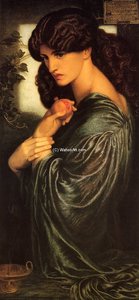
Dante Gabriel Rossetti's "Proserpine," painted in 1874, is more than simply a portrait; it’s a poignant meditation on loss, longing, and the bittersweet nature of eternal beauty. The canvas, measuring a modest 6 x 125 cm, holds within its depths a scene both arresting and profoundly melancholic. Jane Morris, Rossetti's muse and wife, embodies Proserpine herself – a figure tragically caught between two worlds, forever bound to the shadowy realm of Pluto while yearning for the sunlit joys of Earth.
Rossetti’s style is undeniably rooted in Pre-Raphaelite aesthetics, a movement he helped pioneer. The painting revels in rich, saturated colors—deep blues and purples dominate the background, evoking the oppressive atmosphere of the underworld, contrasted sharply with the vibrant red of the pomegranate fruit held delicately in Proserpine's hand. The brushwork is meticulous yet fluid, creating an almost tactile quality to the fabrics and skin tones. Notice how Rossetti masterfully employs sfumato – a subtle blurring of lines and colors – to soften the edges of Morris’s features, lending her an ethereal, dreamlike appearance.
The central image—Proserpine consuming a pomegranate—is laden with symbolic weight. The pomegranate, a fruit associated with both fertility and death, represents Proserpine's forced captivity. Each seed symbolizes a year spent in the underworld, a constant reminder of her separation from her beloved husband, Zephyr. The red color itself is significant; it’s the hue of blood, hinting at the pain and sacrifice inherent in her fate. The apple, held aloft, further emphasizes this theme of temptation and consequence – a symbol of the forbidden fruit that led to her downfall.
Furthermore, the setting—a shadowy, undefined space—is deliberately ambiguous. It’s not a specific location but rather a representation of the underworld itself: a realm of perpetual twilight and muted colors. This reinforces the feeling of isolation and despair that permeates the painting. The careful arrangement of objects – the pomegranate, the apple, even the folds of Morris's dress – all contribute to a complex visual narrative.
"Proserpine" offers a rare glimpse into the emotional landscape of Victorian England, a period grappling with themes of mortality, beauty, and the constraints placed upon women. Rossetti’s choice of Jane Morris as Proserpine is particularly revealing; she herself was deeply connected to the Pre-Raphaelite movement and possessed an innate understanding of its aesthetic principles. Morris's pose—looking directly at the viewer—creates a powerful sense of intimacy, drawing us into Proserpine’s sorrowful gaze.
The painting’s enduring appeal lies in its ability to evoke a profound emotional response. It is not merely a depiction of a mythological figure but rather an exploration of universal themes – love, loss, and the yearning for connection. It's a testament to Rossetti’s skill as a painter and his capacity to imbue his work with layers of meaning and feeling. A reproduction captures this exquisite detail and emotional depth, offering a beautiful addition to any collection or interior space.
WahooArt offers meticulously crafted hand-painted reproductions of "Proserpine," ensuring that the painting’s original beauty and nuance are faithfully preserved. Our artists utilize traditional oil painting techniques, replicating Rossetti's rich color palette and delicate brushwork with exceptional precision. We offer a range of sizes to suit your individual needs and preferences, from smaller pieces suitable for intimate settings to larger formats ideal for grand spaces.
Explore our collection today and bring the haunting beauty of “Proserpine” into your home or studio. A WahooArt reproduction is more than just a print; it's a tangible connection to one of the most evocative works of Victorian art.
1828 - 1882 , Storbritannien