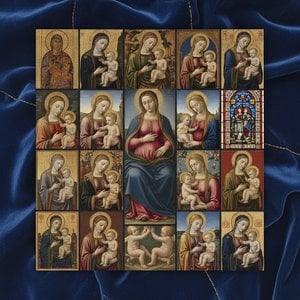
A Throne of Faith: Carlo Crivelli’s “Enthroned Madonna”
The year is 1473, and within the bustling workshops of Venice, Carlo Crivelli was meticulously crafting an image destined to resonate through centuries – the “Enthroned Madonna.” This isn't merely a portrait; it’s a profound meditation on faith, royalty, and divine motherhood, rendered with the meticulous detail characteristic of the early Renaissance. The panel painting, measuring an unknown size but radiating an undeniable presence, immediately draws the viewer into its richly layered composition, a testament to Crivelli’s skill in blending Venetian influences with his own developing artistic voice.
Crivelli's journey began in Venice, absorbing the linear elegance of Jacopo Bellini and the vibrant color palettes of Giovanni Bellini. However, he soon sought his own path, establishing a base in the March of Ancona, where he cultivated a style that prioritized clarity, decorative elements, and a subtly restrained emotionality. This piece exemplifies that approach perfectly – it’s not an explosion of feeling, but rather a carefully constructed tableau of piety and reverence.
A Symphony of Figures: Composition and Technique
The painting centers on the Virgin Mary, seated upon a magnificent throne adorned with intricate gold leaf and geometric patterns. She holds the Christ Child in her lap, his gaze serene and accepting. Surrounding them is a carefully orchestrated procession of saints and biblical figures – St. John the Baptist, St. Peter, and various other prophets and martyrs – each rendered with remarkable precision. The arrangement follows a clear hierarchical structure, reflecting the importance of Mary and Christ within Christian theology. Crivelli masterfully employs perspective, creating a sense of depth through overlapping forms and subtle shading, though it’s characteristic of the period's panel painting techniques rather than a fully developed Renaissance approach.
The technique itself is rooted in tempera on wood panel, a medium favored for its durability and ability to achieve luminous colors. The surface has a slightly textured quality, indicative of multiple layers of paint applied over time. Close examination reveals the artist’s deliberate attention to detail – the folds of the drapery, the intricate patterns on the throne, and the delicate rendering of each figure's facial features all speak to Crivelli’s dedication to his craft.
Symbolism Woven into the Fabric
Beyond its formal composition, the “Enthroned Madonna” is laden with symbolic meaning. The throne itself represents Mary’s divine status and her role as Queen of Heaven. The gold leaf symbolizes wealth, glory, and the sacredness of the subject matter. The lilies held by Mary are a traditional symbol of purity and innocence. Christ's presence signifies his divinity and humanity, while his gestures suggest acceptance and grace. Even the positioning of the figures – Mary seated centrally, with Christ nestled in her lap – reinforces their central importance within the Christian narrative.
The inclusion of various saints serves to underscore the universality of faith and the interconnectedness of the heavenly court. Each figure is carefully chosen to represent a specific virtue or aspect of Christian belief, contributing to the painting’s overall message of spiritual authority and devotion. The use of halos, a common feature in Renaissance art, further emphasizes the holiness of these figures.
A Legacy of Devotion
Carlo Crivelli's “Enthroned Madonna” is more than just a beautiful artwork; it’s a window into the religious and artistic sensibilities of 15th-century Italy. Its enduring appeal lies in its masterful composition, meticulous technique, and profound symbolism – a testament to the power of art to convey complex theological ideas with grace and elegance. Reproductions of this piece offer a captivating glimpse into a world where faith, royalty, and beauty converged, continuing to inspire contemplation and reverence today.
Frågor och svar
Hur beskrivs stämningen i "Enthroned Madonna" av Carlo Crivelli?
"Enthroned Madonna" av Carlo Crivelli beskrivs ha en Elegant stämning. Denna klassificering kan hjälpa till att matcha verket med en miljö.
Använder "Enthroned Madonna" av Carlo Crivelli starka kontraster eller mjuka harmonier?
I "Enthroned Madonna" förenas en Statement kontrast med en Strong Color Unity harmoni.
Var i Carlo Crivellis karriär placeras "Enthroned Madonna", med tanke på dess datum?
Med tanke på sitt datum från 1473, tillhör "Enthroned Madonna" Carlo Crivellis Mature Period.



 Förhandsvisa
 Beställ handmålad reproduktion
 Skicka
 Dela
Dela
 Visa detaljer
 Guide
Guide

 Ladda ner
 Liknande objekt
 Röntgen
 Bildspel
 Q&A
Q&A Statistik


 Visa mer






































 Glasalternativet är endast tillgängligt i storlekar under 110 cm.