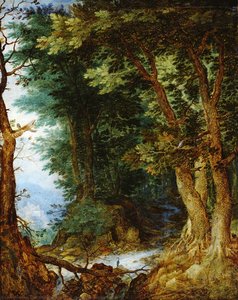
Alexander Keirincx: Bridging Flanders and England – A Landscape Revolutionary
Alexander Keirincx, a name often obscured by historical misinterpretations and the passage of time, stands as a pivotal figure in 17th-century European art. Born in Antwerp in 1600 and tragically dying in Amsterdam in 1652, his journey spanned multiple artistic landscapes – from the meticulous forest scenes of his early training to the groundbreaking ‘house portraits’ that foreshadowed a significant shift in British painting. Keirincx's legacy isn’t simply one of skilled landscape rendering; it represents a crucial bridge between Flemish Baroque tradition and the burgeoning naturalism of the Dutch Golden Age, culminating in an unprecedented commission that profoundly impacted the development of English art.
Keirincx’s artistic education firmly rooted him within the established traditions of Antwerp. Trained as a Flemish Baroque painter, he initially specialized alongside his teacher, Abraham Govaerts, producing small-scale cabinet landscapes reminiscent of Jan Brueghel the Elder and Gillis van Coninxloo. These early works were characterized by a Mannerist style – three distinct colors dominating the palette, schematic compositions, and the strategic placement of ‘repoussoir’ trees to create depth. These scenes frequently incorporated historical, mythological, or biblical narratives within this carefully constructed framework. However, a subtle yet significant transformation began to occur in the 1620s and 30s, mirroring the influence of Dutch tonalism championed by artists like Pieter de Molyn and Jan van Goyen. This shift moved away from rigid formality towards a more atmospheric and nuanced approach to landscape depiction – a key element that would define his later work.
The English Sojourn: A Royal Commission and Lasting Impact
The most remarkable chapter in Keirincx’s career unfolded during his sojourn in England, commissioned by King Charles I. Between May 1639 and mid-1640, he embarked on a project of immense significance – the creation of ten landscape paintings showcasing royal castles and residences across Northern England and Scotland. This wasn't merely a decorative undertaking; it was deeply intertwined with political maneuvering. Initially intended as a celebration of Charles’s victory over the Scots during the First Bishops’ War, the campaign ultimately failed to materialize in the way anticipated. Consequently, the commission served as a strategic face-saving measure following the return of Scottish territories. The resulting series stands as a testament to Keirincx's versatility and ambition.
A particularly compelling example of this period is “Distant View of York,” currently housed at Tate Britain. This painting exemplifies the convergence of several key artistic elements: the atmospheric perspective characteristic of Dutch landscape painters, a serene depiction of the English countryside, and a detailed topographical representation that reflects the tastes of Caroline culture – the refined aesthetic sensibilities of Charles I’s court. Crucially, Keirincx's work marked an important transition; these landscapes weren’t simply scenic views but represented ‘house portraits,’ a nascent trend in British painting that would soon become firmly established by artists like Jan Siberechts and Jan Griffier the Elder. This innovation demonstrated a shift towards incorporating architectural elements into landscape compositions, reflecting a growing interest in documenting and celebrating the grandeur of English estates.
Technique and Influences
Keirincx’s artistic style evolved significantly throughout his career, demonstrating an impressive ability to absorb and adapt influences. His early works are characterized by meticulous detail, vibrant colors, and a reliance on established compositional techniques. However, the impact of Dutch tonalism is evident in his later landscapes – a softening of edges, a greater emphasis on light and shadow, and a more subtle use of color. He skillfully employed atmospheric perspective to create a sense of depth and distance, mimicking the effects achieved by masters like Jan van Goyen. Furthermore, Keirincx’s work reveals a keen understanding of drawing and composition, elements inherited from his Flemish training but refined through observation and experimentation during his time in England.
A Forgotten Legacy – Rediscovering Alexander Keirincx
Despite his undeniable contributions to art history, particularly within the context of British painting, Alexander Keirincx’s legacy has been tragically obscured by historical inaccuracies, a lack of comprehensive documentation, and persistent misidentification. For many years, he was mistakenly associated with Jacob or Johann Carings, an English painter from a similar period. Recent scholarship, bolstered by archival research and careful analysis of his works, is finally shedding light on Keirincx’s true identity and significance. His impact on the development of landscape painting in England cannot be overstated; his royal commission provided a crucial precedent for future generations of artists and helped to establish a new genre – the ‘house portrait’ – that would profoundly shape the visual culture of the 17th century.



 Förhandsvisa
 Byt till tryck
 Skicka
 Dela
Dela
 Visa detaljer

 Ladda ner
 Liknande objekt
 Röntgen
 Bildspel
 Statistik


 Visa mer