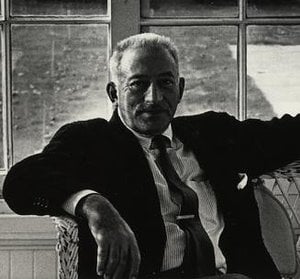
Om konstnären
A Pioneer of Abstract Expressionism: The Life and Art of Adolph Gottlieb
Adolph Gottlieb, born in New York City on March 14, 1903, emerged as a pivotal figure in the burgeoning landscape of American Abstract Expressionism. His journey was one of constant exploration—a relentless pursuit to distill universal human experiences into a visual language that resonated with both ancient symbolism and modern anxieties. Growing up as the son of Jewish immigrants, Gottlieb’s early life instilled within him a sensitivity to cultural displacement and the search for meaning in a rapidly changing world, themes that would profoundly shape his artistic vision. He received foundational training at the Art Students League and Parsons The New School for Design, but it was his subsequent travels through Europe during the 1920s that truly ignited his aesthetic sensibilities. Immersing himself in the art and philosophies of Germany and France, he absorbed influences from Constructivism and Surrealism, laying the groundwork for his future innovations.
Early Influences and Artistic Formation
Gottlieb’s initial artistic inclinations leaned toward representational painting, particularly landscapes inspired by the American Southwest. However, he quickly recognized the limitations of depicting reality faithfully and sought a more expressive approach. His exposure to European avant-garde movements—particularly Surrealism—challenged his preconceptions about artmaking and encouraged him to embrace experimentation. Artists like Giorgio Morandi and Fernand Léger served as important models during this formative period, demonstrating the power of simplification and abstraction to convey emotion and psychological depth. He honed his skills through meticulous observation of nature and diligently studied the techniques of Old Masters, absorbing lessons in composition and color theory that would inform his later work.
The Founding of “The Ten” and Collaborative Exploration
A crucial turning point arrived in 1935 when Gottlieb joined forces with fellow artists Mark Rothko, John D. Graham, Franz Kline, Barnett Newman, Philip Guston, Lester Thomson, William Lehrer, Ivan Zakish, Robert Delaunay, and George Porter to form “The Ten,” later known as the New York Artists Painters group. This collective was instrumental in establishing a distinctly American voice within the international art scene, challenging European dominance and fostering a spirit of collaboration. They actively debated artistic ideas and pushed each other to explore new frontiers—a dynamic that fueled their creative breakthroughs. The group’s discussions centered on questions of form, content, and technique, prompting them to reconsider established conventions and forge their own unique visual languages.
The Pictographs Series: Symbolism and Ancient Roots
Gottlieb's artistic development wasn't immediate; it was a gradual evolution away from representational forms toward abstraction. Initially grappling with traditional techniques, he began to experiment with fragmented imagery and symbolic motifs, hinting at the deeper psychological currents that would define his mature style. A breakthrough occurred in 1940 when Gottlieb embarked on his iconic *Pictographs* series—a monumental undertaking that cemented his reputation as a visionary artist. These paintings feature biomorphic shapes arranged within rectangular fields, resembling ancient hieroglyphs or tribal markings. He deliberately drew inspiration from diverse sources—classical mythology, Amerindian art, African motifs—creating a compelling dialogue between modernity and ancient traditions. The *Pictographs* weren’t merely abstract compositions; they were attempts to tap into universal archetypes, exploring themes of myth, ritual, and the human condition. Gottlieb meticulously crafted each painting with painstaking attention to detail, utilizing a limited palette of colors to heighten their expressive impact.
Legacy and Recognition
Throughout his prolific career, Gottlieb exhibited extensively in galleries and museums across the United States and Europe, garnering critical acclaim for his distinctive style and profound artistic vision. He received numerous awards and accolades—including the Guggenheim Fellowship and the National Medal of Arts—recognizing his contribution to American art history. His work is now housed in prestigious collections worldwide, including MoMA and Tate Modern, ensuring that his legacy continues to inspire artists and scholars alike. Adolph Gottlieb’s unwavering commitment to exploring universal themes through abstraction solidified his place as one of the most influential figures in Abstract Expressionism—a movement that irrevocably transformed the course of 20th-century art. His enduring influence can be seen in subsequent generations of artists who embraced similar stylistic approaches and thematic concerns, demonstrating the lasting power of Gottlieb’s pioneering vision.



 Visa i rummet
 Köp handmålat konstverk
 Skicka
 Dela
Dela
 Detaljer
 Studentguide för konstverk

 Ladda ner
 Liknande objekt
 Röntgen
 Bildspel
 Besökstatistik


 Läs mer






































 Glasalternativet är endast tillgängligt i storlekar under 110 cm.