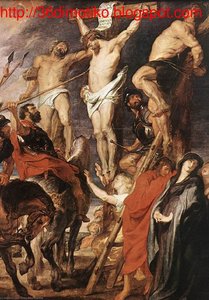
The Radiant Legacy of Abraham van Diepenbeeck
In the golden age of the Flemish Baroque, few names evoke the same sense of multifaceted brilliance as Abraham van Diepenbeeck. Born in 1596 in ’s-Hertogenbosch, Netherlands, his life was a tapestry woven from the diverse threads of many disciplines—painter, draftsman, glass artist, printmaker, and tapestry designer. While often remembered for his monumental oil paintings, his artistic soul was deeply rooted in the luminous medium of glass. As the son of the glass painter Jan Roelofsz. van Diepenbeeck, he inherited a profound understanding of how light interacts with color, a skill that would later define his ability to breathe life into religious and mythological narratives.
The trajectory of van Diepenbeeck’s career was irrevocably altered by his association with the titan of Flemish art, Peter Paul Rubens. Entering the orbit of Rubens' workshop, he did more than merely learn technique; he absorbed a philosophy of movement, drama, and opulent color. This apprenticeship allowed him to participate in some of the era's most prestigious commissions, including assisting with the intricate cartoons for tapestry series such as The Adoration of the Eucharist. His work during this period reflects the grand, sweeping gestures of the Rubensian style, yet it possesses a unique delicacy born from his early mastery of glass and light.
A Master of Light and Narrative
Van Diepen beeck’s artistic evolution was marked by a transition from the delicate transparency of stained glass to the rich, tactile depth of oil on canvas. His early renown in Antwerp was cemented through his breathtaking window designs for various churches and monasteries, where he translated biblical tales into vibrant visual spectacles. These works, such as his celebrated The Acts of Mercy, demonstrated an unparalleled ability to convey divine emotion through the interplay of light and pigment. As he moved into the realm of larger-scale oil paintings in the 1630s, this mastery of luminosity continued to permeate his compositions, lending a celestial quality to even his most terrestrial subjects.
Beyond the church windows, van Diepenbeeck became a sought-after illustrator for grand intellectual projects. His collaboration with renowned engravers like Cornelis Bloemaert resulted in works of immense cultural significance, most notably the Tableaux du Temple des Muses. This endeavor showcased his ability to marry classical mythology with the sophisticated aesthetic demands of the high Baroque. Whether capturing the solemnity of a religious scene like The Last Communion of St Francis of Assisi or the psychological depth of a portrait such as Thomas Wentworth, Earl of Strafford, his hand was always guided by a commitment to narrative clarity and emotional resonance.
Leadership and Enduring Influence
As his reputation grew, so too did his influence over the artistic community of Antwerp. His dedication to the craft led to his admission into the prestigious Antwerp Guild of Saint Luke in 1638, and by 1641, he had ascended to the role of Director of the Academy. In this capacity, van Diepenbeeck became a guardian of artistic standards, shaping the education and stylistic direction of the next generation of Flemish masters. His leadership ensured that the traditions of Rubens and the burgeoning Baroque innovations were preserved and passed forward.
The historical significance of Abraham van Diepenbeeck lies in his role as a bridge between disciplines and eras. He was an artist who could navigate the ethereal world of glass painting and the robust, fleshy reality of Baroque oil portraiture with equal grace. His life, spanning from the late Renaissance influences to the height of the Baroque, serves as a testament to the versatility required of a true master. Today, his works remain vital windows into the 17th century, offering a glimpse into a world where art was not merely decoration, but a profound medium for exploring the divine, the heroic, and the human condition.



 Förhandsvisa
 Beställ tryck
 Skicka
 Dela
Dela
 Visa detaljer

 Ladda ner
 Liknande objekt
 Röntgen
 Bildspel
 Visa mer






































 Glasalternativet är endast tillgängligt i storlekar under 110 cm.