A Renaissance Ode to Inspiration: Unveiling Raphael’s “Poetry”
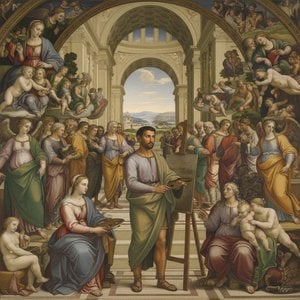
Raphael (Raffaello Sanzio da Urbino), a titan of the High Renaissance, gifted the world with an enduring legacy of beauty and intellectual depth. His fresco, “Poetry,” created between 1509-1511 as part of the *Stanze di Raffaello* within the Vatican Museums, is not merely a painting; it’s a visual manifesto of humanist ideals and artistic mastery. This work encapsulates the spirit of the Renaissance—a fervent rediscovery of classical learning and an elevation of human potential.
Decoding the Composition: A Gathering of Muses
“Poetry” depicts an idealized gathering of ancient poets, philosophers, and theologians, all reverently surrounding *Apollo*, the Greek god of poetry and music, who occupies the central position. The nine muses—Calliope, Clio, Erato, Euterpe, Melpomene, Polyhymnia, Terpsichore, Thalia, and Urania—are gracefully arranged around him, each embodying a distinct facet of artistic expression. Figures like Homer, Virgil, Sappho, and Pindar are identifiable amongst the throng, representing the pinnacle of poetic achievement. The composition is deliberately harmonious, reflecting Raphael’s profound understanding of classical principles of balance and proportion. It's an imagined symposium, a celebration of intellectual and creative pursuits.
Artistic Technique & Renaissance Style
Executed in *oil painting* on plaster (fresco), “Poetry” showcases Raphael’s exceptional technical skill. The use of vibrant hues—rich blues, warm golds, and delicate pinks—creates a sense of luminosity and serenity.
Chiaroscuro, the dramatic interplay of light and shadow, lends depth and volume to the figures, enhancing their three-dimensionality. Raphael’s mastery is evident in the fluid lines, graceful poses, and realistic depiction of anatomy. The fresco exemplifies High Renaissance characteristics: a focus on idealized beauty, harmonious composition, and a profound understanding of perspective and spatial relationships.
The overall effect is one of serene grandeur and intellectual stimulation.
Symbolism & Historical Context
“Poetry” isn’t simply a beautiful scene; it's laden with symbolism. Apollo represents the divine source of inspiration, while the muses embody its various manifestations. The inclusion of both pagan poets and Christian theologians underscores the Renaissance belief in the compatibility of classical learning and Christian faith. Commissioned by Pope Julius II, the *Stanze di Raffaello* were intended to visually represent the four branches of human knowledge: Theology, Philosophy, Poetry, and Law. “Poetry” thus served as a powerful statement about the importance of artistic and intellectual pursuits within the context of papal authority. The work reflects the humanist movement’s emphasis on human achievement and its celebration of classical antiquity.
Emotional Resonance & Lasting Impact
“Poetry” evokes a sense of reverence, inspiration, and intellectual curiosity. It invites viewers to contemplate the power of art, the pursuit of knowledge, and the enduring legacy of classical thought. The harmonious composition and idealized figures create an atmosphere of tranquility and beauty. The painting’s lasting impact lies in its ability to transcend time and continue to inspire artists, scholars, and art lovers alike. It remains a testament to Raphael's genius and a cornerstone of Western artistic heritage.
- A prime example of High Renaissance artistry.
- Rich in classical symbolism and humanist ideals.
- Demonstrates Raphael’s mastery of composition, color, and technique.
Pitanja i odgovori
Da li je "Poetry" dostupan kao umetnička štampa?
„Poetry“ je dostupno kao umetnička štampa na pamučnom platnu ili arhivskom kanvas papiru. Porudžbine se vrše na stranici Umetski print, u dimenziji po vašem izboru.
Da li je "Poetry" dobra ideja za poklon?
„Poetry“ se predlaže kao poklon za Godišnjica.
Da li je Rafael, autor dela "Poetry", poznat/a i pod drugim imenima?
Rafael je poznat/a i pod imenom Rafaello Sanzio, Rafaele Sanzio Da Urbino, Rafaello Santi.



 Naručite ručno oslikano reprodukciju
 Podeli
 Podeli
 Detalji
 Vodič
Vodič

 Preuzmi sliku
 Slični predmeti
 Automatska prezentacija
 Statistika

 Pročitaj više






































 Opcija sa staklom dostupna je samo za dimenzije manje od 110 cm


![Stanze Vaticane - The Parnassus (detail) [07] — Rafael, High Renaissance](/media/artworks/images-thumb/3c/a1/3ca1620e84d3f2fe4e94d9bb954e0eca.jpg)




![Vaticanske stanice - Proterivanje Heliodora iz hrama (detalj) [02]](/media/artworks/images-thumb/3a/23/3a2308b63b60b5cb105575e135028d92.jpg)


