Philosophy by Raphael: A Renaissance Masterpiece
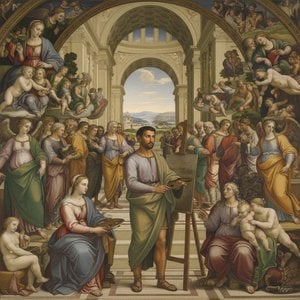
Philosophy is a monumental oil on canvas painting created by the Italian High Renaissance master, Raphael (Raffaello Sanzio Da Urbino), in 1509. Measuring an impressive 500 x 370 cm, this artwork resides within the Vatican Palace, as a cornerstone of the renowned 'Stanza della Segnatura.' Alongside Theology, Jurisprudence, and Poetry, it forms a quartet representing the four fundamental branches of knowledge during the Renaissance.
Historical Context & Intellectual Significance
Painted during the High Renaissance, a period characterized by a fervent revival of classical Greek and Roman culture and an emphasis on humanism, Philosophy embodies these ideals. The painting serves as an allegorical representation of philosophical thought itself, populated with iconic figures from ancient Greece: Plato, Aristotle, and Socrates are prominently featured, alongside other luminaries who shaped Western intellectual history. Commissioned by Pope Julius II, the frescoes in the Stanza della Segnatura were intended to visually articulate the foundations of papal authority – drawing upon theology, law, poetry, and philosophy—to legitimize his reign and demonstrate the Church’s engagement with all aspects of human knowledge.
Artistic Style & Compositional Brilliance
Raphael’s mastery shines through in Philosophy. He is celebrated for his clarity of form, harmonious compositions, and the visual realization of the Neoplatonic ideal of human grandeur. The painting demonstrates a sophisticated understanding of linear perspective, creating a convincing sense of depth and spatial harmony that draws the viewer into the scene. Raphael’s skillful use of color—warm tones contrasting with cooler shades—and light enhances the overall beauty and balance, guiding the eye through the complex arrangement of figures. The composition is carefully structured to convey a sense of order and intellectual pursuit; the central group of philosophers are arranged in a dynamic yet balanced manner, fostering a feeling of serene contemplation.
Symbolism & Emotional Resonance
Beyond its technical brilliance, Philosophy is rich in symbolism. The figures represent not just individuals but also philosophical schools of thought. Plato, gesturing towards the heavens, embodies abstract reasoning and idealism, while Aristotle, with his hand extended toward the earth, represents empirical observation and logic. The presence of Socrates, often depicted in thoughtful contemplation, underscores the importance of questioning and self-examination. The overall emotional impact is one of profound intellectual curiosity and a reverence for knowledge. The painting evokes a sense of timeless wisdom and invites viewers to contemplate the enduring power of philosophical inquiry. It’s a visual testament to the Renaissance belief in human potential and the pursuit of truth.
Acquiring a Hand-Made Reproduction
WahooArt.com offers meticulously crafted, hand-made oil painting reproductions of Philosophy and other masterpieces by Raphael (Raffaello Sanzio Da Urbino). Our skilled artists painstakingly recreate every detail, ensuring you receive a stunning work of art that will become a treasured addition to your collection.
The
Vatican Palace and its renowned artworks, including those by
Raphael (Raffaello Sanzio Da Urbino), can be explored further on
Wikipedia.
movement: High Renaissance
topics: Philosophy, Allegory, Renaissance, Plato, Aristotle, Vatican, Knowledge, Classical
creative_period: Mature Period
corpus_context: Classical Greek & Roman culture, Neoplatonic ideals, Linear perspective techniques, Part of the Stanza della Segnatura frescoes, Represents one of four branches of knowledge, Demonstrates Raphael’s mastery of composition, Humanism and intellectual pursuit, Allegory of philosophy and knowledge
Pitanja i odgovori
U kom delu doma bi se reprodukcija dela "Филозофија" lepo uklopila?
„Филозофија”, Rafael se preporučuje za Dnevna soba. Ovaj predlog je zasnovan na temi, bojama i raspoloženju dela.
Da li su boje dela „Филозофија”, Rafael živopisne ili prigušene?
Boje dela „Филозофија”, Rafael pokazuju Umereno nežna zasićenost uz Uravnoteženo intenzitet.
Ko je autor dela "Филозофија" i u kom umetničkom pravcu?
Delo "Филозофија" delo je Rafael u stilu Високосредњевјековна уметност. Umetnik i pravac definišu tradiciju ovog dela.



 Pregledaj u prostoru
 Pređi na prodaju štampanih primeraka
 Podeli
 Podeli
 Detalji
 Vodič
Vodič

 Preuzmi sliku
 Slični predmeti
 Rendgenski snimak
 Automatska prezentacija
 Statistika

 Pročitaj više






































 Opcija sa staklom dostupna je samo za dimenzije manje od 110 cm


![Stanze Vaticane - The Liberation Of St Peter (detail) [02] — Rafael, Renaissance](/media/artworks/images-thumb/37/67/376727508005fdf6aba941d2691713fd.jpg)


![Stanze Vaticane - The School Of Athens (detail) [02] — Rafael, High Renaissance](/media/artworks/images-thumb/ff/73/ff7321cc7f1d85f7343079c25e188bce.jpg)
![Stanze Vaticane - The School Of Athens (detail) [03] — Rafael, High Renaissance](/media/artworks/images-thumb/30/f3/30f39c600ce9f8eb336752926431690e.jpg)

![Stanze Vaticane - The School Of Athens (detail) [05] — Rafael, Renaissance](/media/artworks/images-thumb/ca/a9/caa9f9be8f76fbc617e906bfcb543fad.jpg)

![Stanze Vaticane - The School Of Athens (detail) [06] — Rafael, High Renaissance](/media/artworks/images-thumb/a5/aa/a5aa2b9acdb9dbd4f6ab64748f4cc597.jpg)




![Vaticanske stanice - Proterivanje Heliodora iz hrama (detalj) [02]](/media/artworks/images-thumb/3a/23/3a2308b63b60b5cb105575e135028d92.jpg)


