Umelecké dielo zobrazené na tejto stránke je chránené autorským zákonom, čo znamená, že nemôžeme legálne vytvárať ani predávať jeho identickú reprodukciu. Táto ochrana je vymáhaná na základe medzinárodných dohôd, ako napríklad Bernská konvencia a národnými zákonmi, vrátane tých, ktoré sú stanovené v Autorské právo USA – Title 17. Všetky práva vyhradené.
Táto metóda plne dodržiava autorské práva, pretože nezahŕňa kopírovanie ani duplikovanie chráneného diela. Ide skôr o kreatívnu reinterpretáciu – nový obraz, ktorý je ovplybnený originálom, no nie je s ním identický.
Giclée tlač alebo plátno múzeálnej kvality s rýchlou výrobou a rôznymi možnosťami povrchovej úpravy. ( Kúpiť ručne maľovaný obraz Prepnúť na digitálny obraz)





























Vyberte si z našich preddefinovaných rozmerov, ktoré zodpovedajú pôvodným pomeroḿ diela.

Zadajte šírku a výšku, ktoré potrebujete, aby sa reprodukcia hodila k vášmu rámu alebo stene. Print možno len orezávať, nikdy však nemennú veľkosť zvětšiť oproti pôvodnému obrázku, preto pri inom formáte stráca časť obrazu. Pred samotným vytlačiacím procesom vám pošleme digitálny náhľad na schválenie. Obrázok zobrazený na tejto stránke nezobrazuje reálny rez — len digitálny náhľad ukazuje presný výsledok.
Celosvetová doprava () do 2 týždňov namiesto štandardných 4 až 5 týždňov. (1 november)
Maamor va
Veľkosť reprodukcie
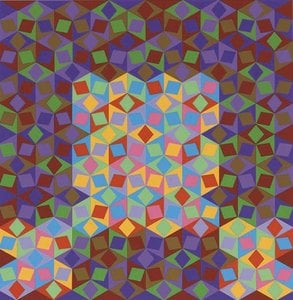
Victor Vasarely's "Maamor va" is more than just a painting; it’s an invitation to deconstruct reality, a visual meditation on perception itself. This captivating work, dominated by a vibrant interplay of blue and yellow geometric forms, embodies the core tenets of Op Art – Optical Art – a movement that emerged in the mid-20th century and profoundly impacted the course of modern art. The piece’s immediate impact lies in its dynamic surface; a mesmerizing mosaic of squares and triangles seemingly floating within a carefully orchestrated space. It's a testament to Vasarely’s meticulous approach, born from his early studies in medicine – an unexpected foundation for a revolutionary artist who sought to manipulate the viewer’s visual experience.
Vasarely's artistic journey began with a formal education in medicine, a path he ultimately abandoned to pursue his passion for visual expression. This pivotal shift occurred during his time at the Podolini-Volkmann Academy and, crucially, within Sándor Bortnyik’s “Műhely” workshop – a space deeply influenced by the Bauhaus movement. The Bauhaus, with its emphasis on functional design, geometric abstraction, and the exploration of industrial materials, provided Vasarely with the theoretical framework for his groundbreaking work. He absorbed the principles of reducing form to its essential elements – lines, planes, and colors – believing that these could be used to create optical illusions and manipulate perception in a controlled manner. This influence is clearly visible in “Maamor va,” where the precise arrangement of shapes generates a dynamic visual effect.
The beauty of "Maamor va" lies not just in its aesthetic appeal but also in its technical sophistication. Vasarely was fascinated by the way our eyes and brains interpret visual information, particularly how they perceive movement and depth. The seemingly random arrangement of squares and triangles is, in fact, a carefully calculated system designed to trick the eye. By manipulating color, size, and spacing, he created an optical illusion that generates a sense of dynamism and movement – a key characteristic of Op Art. The subtle variations in hue and tone within each shape contribute to this effect, further enhancing the painting’s visual complexity.
While abstract in its execution, “Maamor va” resonates with deeper symbolic meanings. The geometric forms can be interpreted as representing fundamental building blocks of reality – the elements that constitute our perception of the world. The vibrant colors evoke a sense of energy and excitement, reflecting Vasarely’s belief in the power of art to transform our experience of space and time. Ultimately, this artwork invites contemplation on the nature of visual perception and the relationship between the artist's intention and the viewer's interpretation. It is a powerful reminder that reality itself can be a construct, shaped by our own sensory experiences.
Farby diela „Maamor va“ od Victor Vasarely vykazujú Balanced Soft saturáciu s intenzitou Balanced.
Vďaka svojej Calm emotívnej nálade je dielo „Maamor va“ od Victor Vasarely odporúčané ako darček pre Wedding.
Stránka Náhľad v AR diela „Maamor va“ od Victor Vasarely využíva rozšírenú realitu na zobrazenie umelleckého diela vo vašom vlastnom priestore pomocou kompatibilného zariadenia.

1906 - 1997 , Kroatia

Explore the profound spiritual depth of geometric abstraction. From Malevich's Suprematism to modern masters, our expert guide reveals how pure form and color command presence in fine art collections.
 Náhľad v interiéri
 Odoslať ako digitálnu kartu
 Zdieľať
 Podrobnosti o dielo
 Príručka

 Stiahnuť obraz
 Podobné položky
 RTG skúška
 Prehliadanie diapozoje
 Q&A
Q&A Štatistiky

 Zobraziť viac









 Možnosť skla je dostupná len pri rozmeroch pod 110 cm