Ručne maľovaný olej na plátne vo vašej zvolenej veľkosti a v ráme, vyrobený na mieru našimi umelcami. ( Kúpiť tlač Kúpiť obrázok)





























Vyberte si z našich preddefinovaných rozmerov, ktoré zodpovedajú pôvodným pomeroḿ diela.

Môžete zadať vlastné rozmery tak, aby sa hodili do konkrétneho rámu alebo priestoru. Ak sa váš zvolený rozmer nezhoduje s pôvodnými proporciami obrazu, dielo buď orezáme, alebo ho doplníme ručne maľovanými prvkami. Pred začiatkom výroby vám zašleme digitálny náhľad na schválenie.
Upozorňujeme, že ukážka na obrazovke neodráža skutočné orezanie alebo doplnenie. Skutočnú finálnu kompozíciu zobrazuje iba digitálny náhľad.
Hoci sú k dispozícii vlastné rozmery, odporúčame vybrať rozmer z preddefinovaného zoznamu, aby sme zachovali pôvodné proporcie.
Celosvetová doprava () za 3 až 4 týždne namiesto štandardných 5 týždňov. (6 september). Bez kompromisov v kvalite.


Maamor va
Veľkosť reprodukcie
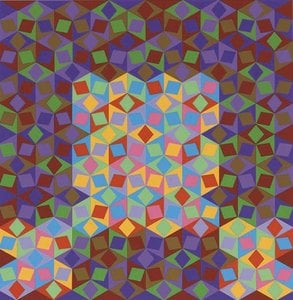
Victor Vasarely's "Maamor va" is more than just a painting; it’s an invitation to deconstruct reality, a visual meditation on perception itself. This captivating work, dominated by a vibrant interplay of blue and yellow geometric forms, embodies the core tenets of Op Art – Optical Art – a movement that emerged in the mid-20th century and profoundly impacted the course of modern art. The piece’s immediate impact lies in its dynamic surface; a mesmerizing mosaic of squares and triangles seemingly floating within a carefully orchestrated space. It's a testament to Vasarely’s meticulous approach, born from his early studies in medicine – an unexpected foundation for a revolutionary artist who sought to manipulate the viewer’s visual experience.
Vasarely's artistic journey began with a formal education in medicine, a path he ultimately abandoned to pursue his passion for visual expression. This pivotal shift occurred during his time at the Podolini-Volkmann Academy and, crucially, within Sándor Bortnyik’s “Műhely” workshop – a space deeply influenced by the Bauhaus movement. The Bauhaus, with its emphasis on functional design, geometric abstraction, and the exploration of industrial materials, provided Vasarely with the theoretical framework for his groundbreaking work. He absorbed the principles of reducing form to its essential elements – lines, planes, and colors – believing that these could be used to create optical illusions and manipulate perception in a controlled manner. This influence is clearly visible in “Maamor va,” where the precise arrangement of shapes generates a dynamic visual effect.
The beauty of "Maamor va" lies not just in its aesthetic appeal but also in its technical sophistication. Vasarely was fascinated by the way our eyes and brains interpret visual information, particularly how they perceive movement and depth. The seemingly random arrangement of squares and triangles is, in fact, a carefully calculated system designed to trick the eye. By manipulating color, size, and spacing, he created an optical illusion that generates a sense of dynamism and movement – a key characteristic of Op Art. The subtle variations in hue and tone within each shape contribute to this effect, further enhancing the painting’s visual complexity.
While abstract in its execution, “Maamor va” resonates with deeper symbolic meanings. The geometric forms can be interpreted as representing fundamental building blocks of reality – the elements that constitute our perception of the world. The vibrant colors evoke a sense of energy and excitement, reflecting Vasarely’s belief in the power of art to transform our experience of space and time. Ultimately, this artwork invites contemplation on the nature of visual perception and the relationship between the artist's intention and the viewer's interpretation. It is a powerful reminder that reality itself can be a construct, shaped by our own sensory experiences.

1906 - 1997 , Kroatia

Explore the profound spiritual depth of geometric abstraction. From Malevich's Suprematism to modern masters, our expert guide reveals how pure form and color command presence in fine art collections.

 Náhľad
 Odoslať
 Zdieľať
 Podrobnosti o dielo

 Stiahnuť
 Podobné diela
 RTG skúška
 Prezentácia

 Zobraziť viac







 Možnosť skla je dostupná len pri rozmeroch pod 110 cm