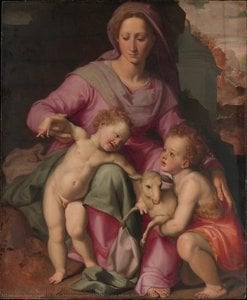
1of 71
Эль Греко 1541–1614
Греко-Испанский Born in Ираклион Маньеризм, Барокко Wikipedia in 31/32 languages


Mannerist художники, ranked
The most famous Mannerist художник is Эль Греко (1541–1614), known for Вид Толедо и Погребение графа Оргаза. Next come Тинторетто, Джузеппе Арчимбольдо, Аньоло Бронзино и Софонисба Ангиссола. This ranking of the 71 most famous Mannerist художники runs from Амико Аспертини (born 1475) to Кристофано Аллори (born 1577), across 14 countries.
How this list is ranked. Artists whose works our catalogue files under Mannerist, in the order of our fame ranking of artists. Artists without a Wikidata identifier born after 1955 are left out until verified. The Wikipedia figure next to each name is the number of our 32 languages in which Wikipedia has an article on the artist.
The essentials
Ranked, with their masterpieces
1of 71
Греко-Испанский Born in Ираклион Маньеризм, Барокко Wikipedia in 31/32 languages
2of 71
Итальянец Born in Венеция Маньеризм, венецианская школа Wikipedia in 31/32 languages

3of 71
Итальянец Born in Милан Маньеризм, сюрреализм Wikipedia in 30/32 languages

4of 71
Итальянский Born in Флоренция Маньеризм Wikipedia in 29/32 languages

Bronzino’s formative years were marked by exposure to the artistic currents of Florence under Pontormo's guidance. Simultaneously, he studied the monumental sculptures of Michelangelo and Leonardo da Vinci, absorbing their mastery of anatomy and perspective.
5of 71
Итальянская Born in Кремона Ренессанс Wikipedia in 29/32 languages

8of 71
Итальянец Born in Ареццо Маньеризм Wikipedia in 31/32 languages

This groundbreaking text wasn’t merely a collection of biographies; it established a narrative framework for the development of Italian Renaissance art, tracing its evolution from the early masters like Cimabue and Giotto to his contemporaries Michelangelo and Raphael.
Teacher of Jacopo Zucchi #54, Federico Zuccari #41
10of 71
Итальянец Born in Флоренция Маньеризм Wikipedia in 27/32 languages

11of 71
Итальянец Born in Венеция Высокий Ренессанс, Маньеризм Wikipedia in 23/32 languages

12of 71
Нидерландский Born in Брауншвейг Северный маньеризм Wikipedia in 19/32 languages

His early years were steeped in artistic tradition; his family’s lineage included painters who had served as court artists in Venlo, and his father, Jan Goltz II, was a skilled glass painter in Duisburg. This environment fostered an appreciation for visual arts from a young age, laying the groundwork for his future endeavors. His work served as a bridge between the artistic traditions of Northern Europe and Italy, introducing Mannerist styles to a wider audience.
13of 71
Итальянский Born in Кастельнуово-Берарденга Мannerизм, Ренессанс Wikipedia in 21/32 languages

Around 1509, Beccafumi journeyed to Rome, a transformative moment exposing him to the artistic ferment of the papal city. He didn’t simply copy the Roman style; he filtered it through a pre-existing Sienese aesthetic—one characterized by a certain provincialism, an emphasis on decorative detail, and a lingering medieval sensibility. Sienese Tradition with Mannerist Influences: He skillfully blended the decorative elements and emotional intensity of the Sienese school with the emerging stylistic features of Mannerism.
14of 71
Нидерландский Born in Амстердам Северный маньеризм Wikipedia in 28/32 languages

15of 71
Фламандская Born in Антверпен Северный маньеризм Wikipedia in 18/32 languages

16of 71
Итальянская Born in Болонья Маньеризм, Барокко Wikipedia in 26/32 languages

However, she quickly absorbed influences from other prominent artists, notably Denis Calvaert, whose school in Bologna was a hub of innovation during the late 16th century. She skillfully blended these influences with a distinctly Venetian richness—a luminous quality that added depth and luminosity to her paintings. Lavinia Fontana’s legacy extends far beyond her individual paintings; she remains an icon of female empowerment in the art world.
17of 71
Born in Урбино Wikipedia in 24/32 languages

“Композиционный эскиз” (“Circumcision”, Париж, Лувр) свидетельствует о его способности к тщательному планированию композиции и созданию выразительных образов. “Голова мужчины” (для картины “Призвание святого Андрея”, Брюссель, Королевские музеи изящных искусств Бельгии) поражает вниманием к деталям и глубиной психологического портрета. Особое место в его творчестве занимают религиозные полотна, такие как “Рождество” (1597 год, Прадо), “Мадонна дель Пополо” (Галерея Уффици, Флоренция) и знаменитая “Мадонна с котом” (“La Madonna del Gatto”).
Key works · The 100 most famous works
19of 71
Итальянец Born in Флоренция Маньеризм Wikipedia in 23/32 languages

20of 71
Итальянец Born in Флоренция Маньеризм Wikipedia in 24/32 languages

Allori’s art is inextricably linked to the Mannerist tradition – an era characterized by its deliberate artificiality, elegant complexity, and a conscious departure from the naturalistic ideals of the High Renaissance. This wasn't a criticism of laziness but rather a recognition of Allori’s role as a vital conduit for artistic knowledge within the vibrant Florentine art world. Alessandro Allori, born in Florence on May 31st, 1535, stands as a captivating figure within the late Mannerist school – an artist deeply shaped by circumstance and profoundly influenced by the tutelage of Agnolo Bronzino.
21of 71
Итальянец Born in Модена Маньеризм Wikipedia in 25/32 languages

24of 71
Итальянец Born in Флоренция Маньеризм Wikipedia in 17/32 languages

26of 71
Фламандский Born in Мёлебеке Северный маньеризм Wikipedia in 20/32 languages

29of 71
Italian Born in Bologna Late Renaissance & Mannerism Wikipedia in 18/32 languages

Beyond the Adoration, Fontana's contributions are visible in the frescoes at the Palazzo Vecchio in Florence (1563-65), where he skillfully integrated architectural elements into his paintings. Fontana’s legacy endures through his surviving works, which are housed in prestigious collections such as the Pinacoteca di Vicenza and the La collezione Bonello (Malta).
31of 71
Italian Born in Болонья Mannerism Wikipedia in 22/32 languages

Whether through the delicate line work of a chalk drawing like Ceres or the monumental scale of fresco fragments such as Ulysses Winning the Archery Contest in the Presence of Penelope, Primaticcio’s oeuvre remains a testament to an artist who could navigate the complexities of myth, majesty, and the human psyche with unparalleled grace.
32of 71
Нидерландский Born in Лейден Маньеризм Wikipedia in 15/32 languages

The subsequent journey to Rome around 1574 or 1575 proved transformative; immersing himself within the heart of the Italian Renaissance, Van Veen absorbed the stylistic nuances that would define his mature work: the elegance, the refined compositions, and the emphasis on idealized forms characteristic of Mannerism.
Pupil of Federico Zuccari #41
33of 71
Итальянец Born in Монелья Генуэзская школа, маньеризм Wikipedia in 15/32 languages

35of 71
Итальянец Born in Бассано-дель-Граппа Венецианское Возрождение Wikipedia in 12/32 languages

36of 71
Flemish Late Mannerism

Brussels Court Painter: In 1594, De Clerck ascended to the prestigious role of court painter to Archduke Ernest I of Habsburg Austria, securing patronage that afforded him considerable freedom and resources. The Iconoclastic Crisis & Altarpiece Commissions: The Protestant iconoclasm of 1566 profoundly impacted the religious landscape of Flanders, prompting a dramatic shift towards more restrained artistic expression. Collaborations with Jan Brueghel the Elder on landscapes such as “ Paradise ” further cemented De Clerck’s reputation as a visionary artist who skillfully blended tradition and innovation.
37of 71
Итальянский Born in Бассано-дель-Граппа Манерализм Wikipedia in 13/32 languages

38of 71
Italian Born in Florence Mannerist Painting Wikipedia in 15/32 languages

Beyond the walls of Rome, Perino’s influence stretched into the maritime strength of Genoa and the historic centers of Pistoia.
39of 71
Flemish Born in Bruges Renaissance, 16th Century Painting Wikipedia in 15/32 languages

His arrival coincided with a period of immense artistic patronage and experimentation within the court, orchestrated by Grand Duke Cosimo I de’ Medici and his advisor, Giorgio Vasari. The Metropolitan Museum of Art’s collection features a significant drawing by Stradanus – “ Allegory of America” – offering valuable insight into his artistic vision and providing a tangible connection to this remarkable Florentine master.
Teacher of Antonio Tempesta #56
40of 71
Итальянский Born in Порденоне Живопись эпохи Возрождения Wikipedia in 16/32 languages

41of 71
Italian Born in Sant'Angelo in Vado Mannerism Wikipedia in 18/32 languages

One cannot discuss the brilliance of Federico Zuccaro without acknowledging the profound influence of his brother, Taddeo Zuccaro. While Taddeo’s mastery of sculpture provided a structural strength to their shared visions, Federico’s painting prowess brought them to life with ethereal light and movement. Their collaborative spirit yielded masterpieces such as “The Holy Family ” in Palazzo Vecchio, a work that serves as a testament to their unified artistic language.
43of 71
Dutch Born in Gouda Mannerism Wikipedia in 13/32 languages

He spent time in Paris with Jean de la Hame, a glass-painter serving King Charles IX, before securing a position at Fontainebleau during the twilight years of the School of Fontainebleau.
44of 71
Flemish Born in Hulst Mannerism, Renaissance Wikipedia in 8/32 languages

His artistic style was deeply rooted in the Mannerist aesthetic, characterized by a naturalistic portrayal of nature alongside carefully constructed compositions. The influence of Hieronymus Bosch is also readily apparent in Mostaert’s oeuvre, particularly in compositions derived from tapestries based on Bosch's fantastical creations. Gillis Mostaert died in Antwerp in 1598, reportedly burdened by debt, which led to the dispersal of his workshop’s contents among creditors following his death.
45of 71
Итальянец Born in Флоренция Флорентийский маньеризм Wikipedia in 11/32 languages

47of 71
Italian Born in Florence Proto-Baroque & Counter-Maniera Wikipedia in 14/32 languages

His prolific output, including monumental altarpieces such as The Resurrection for Santa Croce, demonstrated that art could be both profoundly beautiful and deeply communicative.
48of 71
Итальянец Born in Караваджо Маньеризм Wikipedia in 10/32 languages

49of 71
Итальянец Born in Кремона Фламандский стиль / Ломбардский натурализм Wikipedia in 13/32 languages

50of 71
Italian Born in Zadar Baroque Sculpture; Mannerism Wikipedia in 14/32 languages

The career of Andrea Schiavone was one of prolific achievement, leaving behind a body of work that includes everything from intimate etchings to monumental religious narratives.
51of 71
Итальянец Born in Верона Позднее Возрождение и маньеризм Wikipedia in 11/32 languages

52of 71
Italian Born in Bologna Mannerism Wikipedia in 10/32 languages

His later works, influenced by Tuscan models such as Giorgio Vasari and Prospero Fontana, demonstrate a continuous evolution and an enduring curiosity about the changing tides of aesthetic taste.
53of 71
Italian Born in Vicenza Late Renaissance/Mannerist Wikipedia in 5/32 languages

Through his work, the halls of the palace—including the Sala del Senato and Sala dello Scrutinio—were transformed into theatrical stages where history and myth converged.
54of 71
Italian Born in Florence Mannerist Painting Wikipedia in 11/32 languages

His works often serve as windows into the complex allegories of the 16th century: Religious Devotion: In pieces such as Allegory of the Creation, Zucchi captures profound moments of divine connection, utilizing dramatic lighting and celestial figures to evoke a sense of awe and religious fervor.
55of 71
Итальянец Born in Венеция Маньеризм Wikipedia in 9/32 languages

56of 71
Italian Born in Florence Mannerism Wikipedia in 11/32 languages

As a fresco painter, he contributed significantly to some of the most celebrated decorative programs of the age, including works for Villa Lante and Palazzo Farnese. Narrative Allegories: Utilizing complex symbolism to communicate religious and political themes, such as in his evocative work The Expulsion of Heliodorus from the Temple. While his roots remained firmly planted in the disciplined Mannerism of Florence, his work anticipated the emotional intensity and theatricality of the Baroque.
Pupil of Stradanus #39
57of 71
Итальянец Born in Болонья Маньеризм Wikipedia in 11/32 languages

«Trionfo Militare» (Военный триумф), монументальная фреска, изображающая военную победу, демонстрирует его способность синтезировать классические образы с драматической театральностью. «Erocle e il cinghiale di erimanto» (Геракл и Эриманфский вепрь) — еще один поразительный пример, свидетельствующий о его мастерстве композиции и готовности искажать перспективу ради экспрессивного эффекта.
58of 71
German Born in Vienna Northern Mannerism

This rigorous training instilled in him a profound understanding of goldsmithing techniques—a craft that demanded precision, artistry, and meticulous attention to detail. Notably, he studied alongside Euclid's Elements and Plato’s Timaeus, texts considered foundational for geometric reasoning and philosophical contemplation – influences that would profoundly shape his later artistic pursuits. Born in Vienna, Italy, Wenzel was the son of Hans Jamnitzer the Elder, a goldsmith who established a tradition of excellence that would continue through subsequent generations.
59of 71
Italian Born in Vicenza

His monumental two-volume treatise, L'idea dell'architettura universale, published in Venice in 1615, stands as one of the final great works of the Renaissance.
60of 71
Italian Born in Melide Late Renaissance

He honed his skills in Rome before the death of Michelangelo, immersing himself in the architectural principles of the past while simultaneously embracing new approaches. His initial commissions were modest – designing villas for wealthy patrons like Cardinal Montalto – but these early projects laid the groundwork for a career defined by ambition and technical mastery. The Fontana dell'Acqua Felice (Fountain of Moses), built for Pope Sixtus V, stands as a prime example.
61of 71
Born in Antwerp Antwerp Mannerism Wikipedia in 9/32 languages

He was a contemporary of other great figures like Quentin Matsys and may have even collaborated with landscape innovators such as Joachim Patinir.
62of 71
Italian Born in Mazzo di Valtellina Mannerist Wikipedia in 10/32 languages

His most celebrated achievement remains the scaled oil copy of the Last Judgment, commissioned by Cardinal Alessandro Farnese.
63of 71
Французский Born in Париж Вторая школа Фонтенблуа; Маньеризм; Итальянское искусство влияния Wikipedia in 8/32 languages

Toussaint Dubreuil (c. 1561 – 1602), a French painter born in Paris, stands as a pivotal figure within the Second School of Fontainebleau—a movement that skillfully blended the stylistic grandeur of Mannerism with the vibrant aesthetics of Italian Renaissance art.
64of 71
Швейцарец Born in Шаффхаузен Мannerismus Wikipedia in 7/32 languages

65of 71
Italian Born in Florence Mannerist Wikipedia in 10/32 languages

Beyond his fresco cycles, Conte also produced a series of individual portraits, most notably his portrait of Michelangelo (c. 1540). The portrait is characterized by its dramatic lighting, intense gaze, and subtle gestures—elements that reflect Conte's growing mastery of chiaroscuro and his increasing interest in psychological realism. Conte's career took a significant turn in 1547-48 when he joined forces with Siciolante da Sermoneta on the ambitious fresco decoration of the chapel of San Remigio in San Luigi dei Francesi.
66of 71
Flemish Born in Antwerp Landscape with mythological and allegorical Wikipedia in 8/32 languages

In 1580, Fiammingo was tasked with creating extensive series of paintings to adorn Castle Kirchheim in Württemberg.
67of 71
French Born in Bassigny Northern Mannerism Wikipedia in 9/32 languages

Though his life was cut short in 1616, Bellange’s influence endured far beyond the borders of Lorraine.
68of 71
Italian Born in Parma Mannerist Painting Wikipedia in 8/32 languages

His contributions to the decoration of landmarks like the Santa Maria della Steccata underscore his role as a cornerstone of Parma’s artistic golden age.
69of 71
Italian Born in Novellara Mannerist Wikipedia in 7/32 languages

Born in the small town of Novellara around 1508 or 1511, Orsi navigated an era defined by shifting theological certainties and the complex intellectual currents of humanism.
70of 71
Italian Born in Florence Renaissance and Mannerism Wikipedia in 5/32 languages

The historical significance of Michele Tosini lies in his role as a bridge between eras. Whether depicting the tender intimacy of a Holy Family or the rustic devotion found in an Adoration of the Shepherds, Tosini possessed the rare ability to capture the profound intersection of the divine and the human. His early training under Lorenzo di Credi and Antonio del Ceraiolo anchored him in the refined traditions of the High Renaissance.
71of 71
Spanish Born in Mascaraque Renaissance, Mannerism Wikipedia in 6/32 languages

Correa's early commissions, such as the altarpiece for the monastery of Santa María de Guadalupe in Mascaraque (circa 1532-1534), demonstrate a clear adherence to Raphael’s principles – elegant figures, balanced compositions, and harmonious color palettes.
The paintings behind the names
Through time
In figures
| Италия | 34 |
|---|---|
| Italy | 15 |
| Нидерланды | 3 |
| Франция | 3 |
| Belgium | 3 |
| Германия | 2 |
| Бельгия | 2 |
| Netherlands | 2 |
| 1470s | 2 |
|---|---|
| 1480s | 3 |
| 1490s | 5 |
| 1500s | 11 |
| 1510s | 10 |
| 1520s | 8 |
| 1530s | 7 |
| 1540s | 11 |
| 1550s | 7 |
| 1560s | 4 |
| 1570s | 3 |
| Музей истории искусств | 18 |
|---|---|
| Государственный Эрмитаж | 10 |
| Национальная галерея | 8 |
| Баварские государственные живописные коллекции | 8 |
| Музей Прадо | 7 |
| Рейксмюзеум | 6 |
| Метрополитен-музей | 5 |
| Галерея Уффици | 5 |
All of them, in order
Эль ГрекоГреко-Испанский · 1541–1614ТинтореттоИтальянец · 1519–1594Джузеппе АрчимбольдоИтальянец · 1527–1593Аньоло БронзиноИтальянский · 1503–1572Софонисба АнгиссолаИтальянская · 1532–1625 ПонтормоИтальянский · 1494–1556
 Франческо Пармиджанино1503–1540Джорджо ВазариИтальянец · 1511–1574
 Джулио РоманоИтальянский · 1499–1546Россо ФьорентиноИтальянец · 1494–1540Себастьяно дель ПьомбоИтальянец · 1485–1547Хендрик ГольциусНидерландский · 1558–1617Доменико БеккафумиИтальянский · 1484–1551Питер АртсенНидерландский · 1508–1575Бартоломеус СпрангерФламандская · 1546–1611Лавиния ФонтанаИтальянская · 1552–1614Федерико Бароччи1535–1612
 Ханс фон АахенНемец · 1552–1615Кристофано АллориИтальянец · 1577–1621Алессандро АллориИтальянец · 1535–1607Никколо Дель АббатеИтальянец · 1512–1571
 Джованни Баттиста Морони1525–1578
 Бэнвентуто Челлини1500–1571Франческо СальвиатиИтальянец · 1510–1563
 ДжамболоньяФламандский · 1529–1608Карел Ван Мандер СтаршийФламандский · 1548–1606
 Даниэле Да Вольтерра1509–1566
 Жан ГужонФранцуз · 1510–1567Prospero FontanaItalian · 1512–1597
 Joachim WtewaelГолландская · 1566–1638Франческо ПриматиччоItalian · 1504–1570Отто ван ВеенНидерландский · 1556–1629Лука КамбьязоИтальянец · 1527–1585
 Джузеппе ЧезариИтальянец · 1568–1640Франческо Бассано МладшийИтальянец · 1549–1592Hendrick De ClerckFlemish · 1570–1630Леандро БассаноИтальянский · 1557–1622Perino del VagaItalian · 1501–1547StradanusFlemish · 1523–1605Джованни Антонио ПорденонеИтальянский · 1484–1539Federico ZuccariItalian · 1539–1609
 Чеккино Дель СальвиатиИтальянец · 1510–1563Cornelis KetelDutch · 1548–1616Gillis MostaertFlemish · 1528–1598Франческо БакьяккаИтальянец · 1494–1557
 Шипьоне Пульцоне1550–1598Santi di TitoItalian · 1536–1603Полидоро Да КараваджоИтальянец · 1499–1543Винченцо КампиИтальянец · 1536–1591Andrea SchiavoneItalian · 1522–1563Якопо ЛигоцциИтальянец · 1547–1627Bartolomeo PassarottiItalian · 1529–1592Andrea VicentinoItalian · 1542–1617Jacopo ZucchiItalian · 1542–1596Доменико ТинтореттоИтальянец · 1560–1635Antonio TempestaItalian · 1555–1630Амико АспертиниИтальянец · 1475–1552Wenzel JamnitzerGerman · 1507–1585Vincenzo ScamozziItalian · 1548–1616Domenico FontanaItalian · 1543–1607Jan De Beer1475–1528Marcello VenustiItalian · 1510–1579Дюбрёй, ТуссенФранцузский · 1561–1602Тобиас ШтимерШвейцарец · 1539–1584Jacopino del ConteItalian · 1510–1598Paolo FiammingoFlemish · 1540–1596Jacques BellangeFrench · 1575–1616Girolamo Mazzola BedoliItalian · 1500–1569Lelio OrsiItalian · 1508–1587Michele TosiniItalian · 1503–1577Juan Correa De VivarSpanish · 1510–1566
Your questions, answered
First place goes to Эль Греко (#1); Тинторетто (#2) and Джузеппе Арчимбольдо (#3) complete the podium.
Эль Греко (#1), Тинторетто (#2), Джузеппе Арчимбольдо (#3), Аньоло Бронзино (#4) и Софонисба Ангиссола (#5).
Most художники in this list were born in the 1540s (11 of 71), between 1475 and 1577 overall.
The highest-ranked художники born in Italy are Prospero Fontana (#29), Perino del Vaga (#38), Federico Zuccari (#41), Santi di Tito (#47) и Bartolomeo Passarotti (#52).
The museums holding the most key works of this list are Музей истории искусств (18), Государственный Эрмитаж (10) и Национальная галерея (8).
Джорджо Вазари (#8) taught Jacopo Zucchi (#54) и Federico Zuccari (#41); Stradanus (#39) taught Antonio Tempesta (#56).
The highest-ranked художники born in Италия are Тинторетто (#2), Джузеппе Арчимбольдо (#3), Аньоло Бронзино (#4), Софонисба Ангиссола (#5) и Понтормо (#6).
Флоренция: 8 of the художники in this list were born there.
The earliest-born художник in this list is Амико Аспертини (#57), born in 1475.
Италия: 34 of the 71 художники in this list were born there, then Italy (15) и Нидерланды (3).
The women of this list (2): Софонисба Ангиссола (#5) и Лавиния Фонтана (#16).
Our catalogue holds 5,179 works by these художники. Each one can be ordered as a hand-painted oil reproduction or a print.
Keep reading
Other movements
 Знаменитые художники BaroqueРембрандт ван Рейн · Рембрандт
 Знаменитые художники Contemporary RealistСборецы · Жан-Франсуа Милле
 Знаменитые художники ImpressionistЗвёздная ночь (Нью-Йорк, MoMA) · Винсент Ван Гог
 Знаменитые художники RomanticistСатурн пожирающий своего сына · Франсиско Гойя
 Знаменитые художники NeoclassicistСмерть Марата · Жак-Луи Давид
 Знаменитые художники RealistПроисхождение мира · Гюстав Курбе
 Знаменитые художники RenaissanceМона Лиза (Джоконда) · Леонардо Да Винчи
 Знаменитые художники Dutch Golden AgeДевушка с жемчужной серёжкой · Ян Вермеер
 Знаменитые художники ExpressionistКомпозиция VII · Василий Васильевич Кандинский
 Знаменитые художники RococoОтплытие на Кифере · Антуан Ватто
Other periods
 Знаменитые художники Early MedievalSnowy River · Ван Вэй
 Знаменитые художники High MedievalМадонна в Маэсти (Мадонна Оньисанти) · Джотто Ди Бондоне
 Знаменитые художники Late MedievalБлаговещение и два святых · Симоне Мартини
 Знаменитые художники RenaissanceСотворение Адама · Микеланджело
 Знаменитые художники Early ModernПризвание святого Матфея · Караваджо
 Знаменитые художники 19th CenturyВодяные лилии (или Нимфеи) · Клод Моне
 Знаменитые художники ModernГерника · Пабло Пикассо
 Знаменитые художники ContemporaryWind Sculpture III (one in a series of nine) · Yinka Shonibare
More rankings