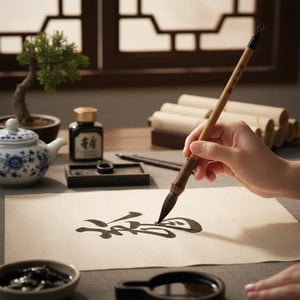
The Envoy of the Song Dynasty
The year is 1091 in Jiangxia, Ezhou. Floodwaters rise against the city walls, forcing a family toward the safety of the Yellow Crane Tower. Inside that tower, Xu Jing enters the world. He grows into a man of many titles: navigator, diplomat, official, and calligrapher. His life is defined by movement and observation. As an envoy to Goryeo, he crosses the sea, documenting the political systems, mountains, and customs of a foreign land. His writings on maritime routes and the use of the compass provide a rare, technical window into the naval technologies of the Song dynasty.
His intellect is not confined to the halls of government. He moves between the rigid duties of a diplomat and the fluid grace of a painter and calligrapher. He is known by his courtesy name, Mingshu, and his art name, Zixin Jushi. His perspective is shaped by the vast distances he travels and the diverse landscapes he witnesses, from the riverbanks of his ancestral home in Liyang to the distant shores of Korea.
The Art of Observation
Xu Jing’s creative output reflects a mastery of both the brush and the written word. His skills span the technical precision of seal script to the expressive qualities of landscape and figure painting. His work often captures the quiet tension between the seasons, a theme central to the Chinese aesthetic tradition.
- Calligraphy: Proficient in the disciplined art of seal script.
- Landscape Painting: Capturing the structural essence of the natural world.
- Figure Painting: Rendering the human form with intent.
- Literary Documentation: Recording the maritime and cultural details of the Xuanhe era.
Winter and Whiteness
In his painting The Pure Whiteness of Winter, the brush captures a specific, stark reality. The composition features branches that suggest the architectural arch of a cathedral, a structural choice that lends a sense of space to the hanging scroll. Blossoms emerge directly from the snow, a visual paradox that emphasizes the resilience of life. This work is a study in contrast, using the starkness of the season to highlight the delicate emergence of new growth.
His legacy remains tied to his ability to document the world as it is. Whether through the detailed accounts of his embassy or the ink on a scroll, Xu Jing preserves the textures of the Song dynasty. He remains a figure of the Northern Song, a man whose life was spent navigating the complexities of both the sea and the brush.
Întrebări și răspunsuri
De unde este Xu Jing?
Xu Jing s-a născut în Song dynasty.
Pot explora operele lui Xu Jing pe baza unor cuvinte cheie?
Pagina După cuvinte cheie a lui Xu Jing grupează operele de artă ale artistului în funcție de cuvintele cheie.
Cum s-a evoluat creația lui Xu Jing de-a lungul timpului?
Cariera lui Xu Jing se desfășoară etapă cu etapă pe pagina Cronologie a artistului: o cronologie orizontală a operelor de artă, grupate în capitole reprezentative ale perioadelor de activitate.
Unde pot vedea profilul cromatic al lucrărilor lui Xu Jing?
Profilul cromatic al lucrărilor lui Xu Jing este prezentat în pagina Genoma Paletei a artistului.