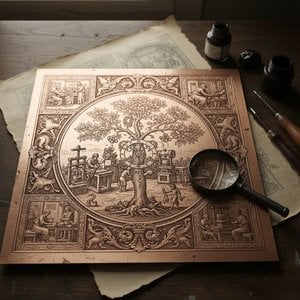
Mukul Chandra Dey: A Pioneer of Indian Printmaking
Early Life and Education
Born on July 23, 1895, in Sridharkhola, Bengal, India, Mukul Chandra Dey came from a family with inherent artistic inclinations. He was one of five children of Purnashashi Devi and Kula Chandra Dey. His early life was profoundly shaped by his education at Rabindranath Tagore’s Santiniketan, an institution that fostered a unique blend of traditional Indian aesthetics and modern artistic thought.
Artistic Development and Influences
Santiniketan played a pivotal role in shaping Dey's artistic style, exposing him to the principles of Contextual Modernism. He was deeply influenced by Tagore’s philosophy and approach to art. Alongside his studies, he benefited from a supportive family environment; his brother, Manishi Dey, was also a well-known painter, and his sisters, Annapura and Rani Chanda, were accomplished in arts and crafts.
A Pioneer of Drypoint Etching
Mukul Chandra Dey is widely recognized as a pioneer of drypoint-etching in India. He masterfully combined traditional techniques with modern sensibilities, creating a distinctive style that set him apart. His work often depicted scenes from rural Indian life, portraits, and landscapes, showcasing his keen observation skills and artistic sensitivity.
Notable Works and Artistic Style
While a comprehensive list of his works is extensive, examples like “Getting ready for meals” demonstrate his ability to capture everyday moments with depth and nuance. His style is characterized by delicate lines, subtle tonal variations, and a profound understanding of light and shadow. He skillfully used drypoint etching to create textures and effects that added richness and complexity to his compositions.
Key Artistic Movements
- Indian Modern Art: Dey’s work contributed significantly to the development of modern art in India, bridging the gap between traditional aesthetics and contemporary artistic expressions.
- Contextual Modernism: Influenced by Santiniketan's teachings, his art reflected a deep engagement with Indian culture and society while embracing modern techniques.
Legacy and Historical Significance
Mukul Chandra Dey’s legacy extends beyond his technical mastery of drypoint etching. He inspired generations of artists to explore new possibilities in printmaking and to embrace their cultural heritage while engaging with the global art world. He passed away on March 1, 1989, in Santiniketan, leaving behind a significant body of work that continues to be celebrated for its artistic merit and historical importance.
Family Life
Mukul Chandra Dey was married to Bina (née Bina Roy) from Khanakul, Bengal. They had one daughter, Manjari, who later married Shantanu Ukil, a leading painter of the Bengal School of Art, further cementing the family’s artistic legacy.
Întrebări și răspunsuri
Care sunt locul și anul nașterii lui Mukul Chandra Dey?
Mukul Chandra Dey s-a născut în Srirampuram, în anul 1895.
În ce perioade este împărțită cariera lui Mukul Chandra Dey?
O relatare cronologică a creației lui Mukul Chandra Dey este disponibilă pe pagina Cronica a artistului, unde operele de artă se succed în ordinea creației lor, capitol cu capitol.
Pot vizita un muzeu virtual al lucrărilor lui Mukul Chandra Dey?
O vizită virtuală este posibilă: pagina Muzeu 3D lui Mukul Chandra Dey prezintă lucrările artistului într-o galerie tridimensională.
În ce oraș și țară s-a născut Mukul Chandra Dey?
Mukul Chandra Dey s-a născut în Srirampuram, în India.
Unde pot vedea operele lui Mukul Chandra Dey în ordine cronologică?
Pagina Cronologia operelor de artă a artistului prezintă lucrările lui Mukul Chandra Dey ordonate cronologic, an de an.
Unde pot fi găsite lucrările lui Mukul Chandra Dey, grupate pe tehnici?
Pentru a găsi toate lucrările lui Mukul Chandra Dey dintr-un anumit mediu, utilizați pagina Toate mediile a artistului.
Ce stări exprimă operele lui Mukul Chandra Dey?
Spațiu pe stări de spirit lui Mukul Chandra Dey este o pagină care organizează operele de artă ale artistului în funcție de starea de spirit.
Unde pot vedea profilul cromatic al lucrărilor lui Mukul Chandra Dey?
Utilizarea culorii de către Mukul Chandra Dey în lucrările enumerate pe acest site poate fi studiată pe pagina Genoma Paletei a artistului.