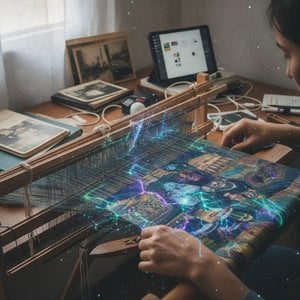
Maud Fredin-Fredholm: A Pioneer of Scandinavian Textile and Ceramic Art
Maud Fredin-Fredholm (1919–2013) stands as a cornerstone figure in mid-century Scandinavian design, celebrated primarily for her transformative contributions to textile artistry and collaborative ventures with ceramic manufacturers. Born in Gothenburg, Sweden, she possessed an innate artistic spirit that blossomed into a prolific career marked by innovation and a deep connection to Swedish folk traditions. Her legacy resides not merely in aesthetically pleasing patterns but also in establishing a distinctive visual language that continues to inspire designers today.Early Life and Artistic Beginnings
Details about Maud Fredin-Fredholm’s early life remain somewhat sparse, yet anecdotal evidence suggests she cultivated her passion for design from a young age—a dedication that would ultimately propel her toward remarkable achievements. Her formative years instilled within her a profound appreciation for craftsmanship and artistic exploration. She pursued her studies at Slöjdföreningens skola (Guild School of Handicrafts) in Gothenburg between 1935 and 1941, honing her skills in textile design alongside exploring broader artistic concepts. Subsequently, she enrolled at Valands målarskola (Valand Art Academy) in Göteborg during the same period, furthering her understanding of painting techniques and expanding her creative horizons. These experiences solidified her commitment to mastering both visual arts and artisanal practices—a dual focus that would prove instrumental in shaping her distinctive artistic style.Textile Designs: Knäckebröd and Snurran – Icons of Scandinavian Style
Fredin-Fredholm’s fame rests principally upon her iconic textile designs, particularly the ‘Knäckebröd’ (Crispbread) and ‘Snurran’ (Spinner) motifs. These patterns—characterized by bold geometric forms and vibrant hues—became synonymous with Scandinavian aesthetic sensibilities during the 1950s and 60s. The ‘Knäckebröd,’ resembling the traditional Swedish crispbread, embodies a playful juxtaposition of organic shapes against a striking chromatic backdrop. Designers deliberately contrasted natural textures with assertive color palettes to convey a sense of both comfort and visual dynamism. Similarly, the ‘Snurran,’ referencing the spinning wheel used in Swed ish rural life—a symbol of industriousness and heritage—captures the essence of Swedish folk art while maintaining a modern sensibility. Her collaboration with Rörstrand and Bobergs Fajansfabrik ensured that these designs weren’t confined to fabric; they flourished on ceramic surfaces, amplifying their visual impact and cementing Fredin-Fredholm's position as a pivotal figure in shaping Scandinavian design history.Collaboration and Ceramic Innovation
Recognizing the potential to extend her artistic vision beyond woven fabrics, Fredin-Fredholm skillfully adapted her distinctive motifs—particularly those derived from Swedish folk art—to ceramic creations. This endeavor resulted in a captivating fusion of tradition and innovation, where bold colors and geometric forms breathed new life into familiar shapes. Her ceramics achieved considerable acclaim for their aesthetic merit and contributed significantly to the broader evolution of Scandinavian ceramic design. She worked closely with Bobergs Fajansfabrik, translating her textile patterns onto porcelain tableware—a testament to her versatility and willingness to experiment with different mediums. The resulting pieces showcased a harmonious blend of Swedish heritage and contemporary elegance.Legacy and Historical Significance
Maud Fredin-Fredholm’s influence extends far beyond her immediate artistic output. She served as an inspiration to subsequent generations of designers, demonstrating how cultural heritage could be reimagined within a contemporary framework. Her enduring appeal lies in her ability to capture the spirit of Swedish folk art—a celebration of natural forms and vibrant colors—while simultaneously upholding principles of minimalist elegance. Today, Fredin-Fredholm’s textile designs continue to adorn homes across Scandinavia and internationally, testifying to their timeless beauty and enduring relevance. She remains a celebrated figure within the annals of Scandinavian design history, embodying creativity, collaboration, and an unwavering commitment to artistic excellence. Her work continues to be studied and admired for its contribution to establishing a distinctive visual language that defines mid-century Scandinavian aesthetics.Întrebări și răspunsuri
Pot să explorez lucrările lui Maud Barbro Fredin Fredholm în funcție de tehnică?
Operele lui Maud Barbro Fredin Fredholm pot fi explorate pe baza mediului utilizat în pagina de Toate tehnicile a artistului.
Din ce epocă face parte Maud Barbro Fredin Fredholm?
Maud Barbro Fredin Fredholm a activat în perioada Era modernă. Această perioadă situează activitatea artistului în context istoric.
Unde pot găsi statistici despre operele lui Maud Barbro Fredin Fredholm?
Există o pagină Statistici pentru Maud Barbro Fredin Fredholm, care prezintă statistici despre operele de artă ale acestuia pe acest site web.