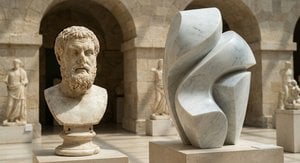
Mary Frank: A Sculptor of Grief and the Human Condition
Born in London in 1933, Mary Frank’s artistic journey is a remarkable tapestry woven from displacement, dance, and a profound engagement with the complexities of human emotion. Her life began amidst the turmoil of World War II, an experience that indelibly shaped her perspective and fueled a lifelong exploration of themes like grief, love, and the enduring power of memory. The early years spent navigating boarding schools and then residing with her maternal grandparents in Brooklyn, New York – a stark contrast to her London upbringing – provided a crucial foundation for her artistic development, exposing her to diverse cultural influences and fostering a sense of both belonging and alienation.
Frank’s initial connection to art stemmed from her passionate involvement in modern dance under the tutelage of Martha Graham. This immersion in movement instilled within her an acute awareness of the body's capacity for expression – a sensibility that would later permeate her sculptural work. Her studies at the High School of Music & Art and subsequent enrollment at the Professional Children’s School further solidified her artistic foundation, introducing her to influential figures like Max Beckmann and Hans Hofmann, who encouraged experimentation with form and technique. The early mentorships were pivotal, laying the groundwork for her distinctive style, characterized by a blend of abstraction and figurative representation.
Early Influences and Artistic Evolution
Frank’s artistic trajectory took an unexpected turn when she married Robert Frank in 1950. The couple embarked on a transformative journey across the United States during the mid-1950s, traveling with Robert's Guggenheim fellowship. This period proved to be profoundly influential, exposing Mary to the vibrant art scene of New York and introducing her to Margaret Ponce Israel’s captivating sculptures and pottery – works that celebrated organic forms and a sense of earthy beauty. Inspired by this encounter, Frank began working in clay, a medium she would continue to explore throughout her career.
Following Robert Frank's divorce in 1969, Mary established a home in Lake Hill, New York, where she built her own kiln and further honed her craft. This period marked a significant shift in her artistic focus, as she began to grapple with the profound grief resulting from the tragic death of her daughter, Andrea, in 1974. This personal tragedy became a central theme in her work, manifesting through hauntingly beautiful sculptures that captured the fragility and intensity of human emotion. The loss also profoundly impacted her son, Pablo, who struggled with schizophrenia and ultimately died in 1994, adding another layer of sorrow to her artistic exploration.
Sculptural Style and Techniques
Mary Frank’s sculptures are immediately recognizable for their distinctive aesthetic – a captivating blend of abstraction and figurative representation. She often employs a fragmented approach, assembling disparate forms into evocative compositions that suggest both solidity and vulnerability. Her use of clay is particularly noteworthy, allowing her to create surfaces with remarkable texture and depth. Frank's work frequently features elongated figures, reminiscent of dancers caught in mid-movement, conveying a sense of suspended time and emotional intensity.
Beyond clay, Frank experimented with various materials throughout her career, including wood, bronze, and stone. She was particularly adept at manipulating these materials to achieve a desired effect – creating works that seemed to shimmer with an inner light or possess a palpable weight. Her sculptures are not merely representations of the human form; they are expressions of feeling, imbued with a quiet dignity and profound emotional resonance.
Legacy and Recognition
Mary Frank’s work has been exhibited in major museums across the United States and internationally, including the Metropolitan Museum of Art, the Whitney Museum of American Art, and the Brooklyn Museum. Her sculptures are held in numerous private collections, testament to their enduring appeal and artistic merit. Frank's influence extends beyond her own creations; she has mentored countless artists and served as a passionate advocate for solar cooking and water pasteurization – demonstrating a commitment to both artistic innovation and social responsibility.
Despite facing personal tragedies, Mary Frank continued to create art until her death in 2019. Her sculptures remain powerful testaments to the human capacity for resilience, beauty, and profound emotional expression. She is remembered not only as a gifted artist but also as a woman who transformed grief into a source of creative inspiration, leaving behind a legacy that continues to resonate with viewers today.
Key Influences
- Martha Graham: Her dance training profoundly shaped Frank’s understanding of movement and the human form.
- Robert Frank: His photographic approach influenced her exploration of composition and perspective.
- Margaret Ponce Israel: Her sculptural work inspired Frank's interest in organic forms and earthy aesthetics.
- Max Beckmann & Hans Hofmann: Their instruction fostered experimentation with abstraction and technique.