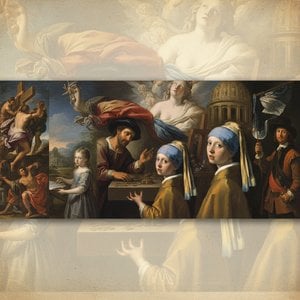
A Life Illuminated: The World of Mary Beale
Born in the quiet Suffolk rectory of Barrow in late March 1633, Mary Cradock entered a world where artistic inclination was considered an acceptable pastime, but a profession for a woman remained largely uncharted. Her father, John Cradock, a rector with a painter’s hand himself, provided her initial grounding in the arts—a fortunate circumstance that would shape her destiny. Growing up near Bury St Edmunds, young Mary likely encountered established artists like Peter Lely and Matthew Snelling, absorbing influences that would later blossom into her own distinctive style. This early exposure to the burgeoning London art scene planted a seed of ambition within her, even as societal expectations sought to confine her talents to the domestic sphere. The loss of her mother at age ten brought hardship, but also a strengthened bond with her father and an increased focus on artistic pursuits as a source of solace and expression.Navigating Convention: Portraiture and Family Life
In 1652, Mary married Charles Beale, a civil servant who would become not only her husband but also her indispensable partner in navigating the complexities of a professional life. Theirs was an unusual collaboration for the era—a true partnership built on mutual respect and shared ambition. The Beales established a home and family, welcoming two sons, Bartholomew and Charles Jr., while simultaneously building Mary’s artistic career. Initially working from their residences in Covent Garden and later Albrook, Hampshire, she began to accept commissions, slowly gaining recognition for her skill. Charles played a pivotal role, managing the practicalities of her studio—preparing materials, handling finances, meticulously recording every detail of her work in his now-famous notebooks. These records offer an invaluable glimpse into 17th-century artistic practice and provide compelling evidence of Mary’s burgeoning success. Her portraits weren't merely likenesses; they were intimate studies of character, capturing the essence of her sitters with a remarkable degree of realism and sensitivity. She specialized in depicting members of her family, friends, local gentry, nobility, and clergy—a diverse clientele that speaks to her growing reputation.A Baroque Sensibility: Style and Technique
Mary Beale’s artistic style was deeply rooted in the Baroque period, characterized by dramatic lighting, rich colors, and a keen attention to detail. However, she wasn't simply an imitator of prevailing trends. She developed a distinctive approach that set her apart from contemporaries like Lely, infusing her portraits with a warmth and psychological depth that resonated with her sitters. Her technique involved careful observation and meticulous rendering, but also a willingness to experiment with materials and methods. Charles Beale’s notes reveal her innovative exploration of cheaper supports for paintings—such as onion bags and bed-ticking—demonstrating both resourcefulness and a commitment to accessibility. She was particularly adept at capturing the textures of fabrics and the nuances of human expression, creating portraits that felt remarkably alive. Her 1663 manuscript on painting techniques, specifically focusing on apricot hues, stands as the earliest known instructional text by a female painter in English—a testament to her knowledge, skill, and willingness to share her expertise.Breaking Barriers: Legacy and Historical Significance
Mary Beale’s career was not without its challenges. As a woman artist in 17th-century England, she faced societal constraints that limited opportunities for professional advancement. Yet, she persevered, establishing a thriving practice while simultaneously fulfilling her roles as wife and mother—a remarkable feat in an era when women were largely excluded from public life. Her financial independence, achieved through her art, was particularly noteworthy, challenging conventional expectations and demonstrating her business acumen. She received praise from prominent artists like Sir Peter Lely and recognition in contemporary writings about British art, solidifying her position within the artistic community. Beale’s legacy extends beyond her individual achievements; she paved the way for future generations of women artists, proving that talent knew no gender. In recent decades, her work has experienced a well-deserved rediscovery, with increased scholarly attention and exhibitions showcasing her remarkable contributions to English portraiture. The detailed records kept by Charles Beale provide invaluable insights into the art world, social customs, and daily life of 17th-century England, ensuring that Mary Beale’s story—and her artistry—continues to inspire and captivate audiences today. Her work is preserved on platforms like WahooArt, WahooArt, and others, guaranteeing her enduring presence in the cultural landscape.Key Figures Influencing Mary Beale
- Peter Lely: A prominent court painter whose style profoundly influenced Mary’s approach to portraiture, particularly regarding composition and lighting.
- Matthew Snelling: Another influential artist of his time, whose work provided a foundation for Mary's artistic development.
- John Cradock (her father): Provided her initial artistic training and instilled in her a love for painting.
Notable Commissions & Clients
- Members of the Suffolk gentry
- Clergy from across England
- Aristocrats and landowners
- Several prominent figures within the royal court (though details are scarce)
Întrebări și răspunsuri
În ce oraș și țară s-a născut Maria Belă?
Maria Belă s-a născut în Suffolk, în Regatul Unit al Marii Britanii și Irlandei.
Ce culori a folosit cel mai des Maria Belă?
Utilizarea culorii de către Maria Belă în lucrările enumerate pe acest site poate fi studiată pe pagina Genoma Paletei a artistului.
Există un tur virtual 3D al operelor lui Maria Belă?
Operele de artă ale lui Maria Belă pot fi vizualizate într-o galerie 3D, pe pagina Muzeu 3D a artistului.