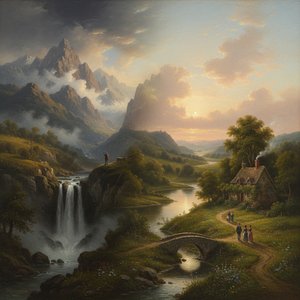
Lazzaro Pasini - A Tuscan Landscape Painter
Lazzaro Pasini (1861–1949) stands as a prominent figure in Italian landscape painting, particularly within the Macchiaioli movement—a group of artists who championed direct observation and expressive brushwork to capture the essence of nature. Born in Reggio Emilia, Italy, Pasini’s artistic journey began under the tutelage of Romualdo Belloli, a respected engraver who instilled in him a foundational understanding of visual representation. This early training proved crucial as it shaped his stylistic approach—one characterized by a profound connection to the Tuscan countryside and a commitment to portraying its beauty with uncompromising honesty.
- Early Life & Education: Pasini’s formative years were marked by academic pursuits, culminating in a scholarship that propelled him to Florence where he immersed himself in the studio of Giovanni Fattori—a pivotal encounter that solidified his fascination with Macchiaioli principles.
- The Macchiaioli Style: The Macchiaioli movement profoundly influenced Pasini’s artistic vision. Rejecting academic conventions, these painters favored bold color palettes and loose brushstrokes to convey emotion and immediacy. Pasini skillfully adopted this technique, prioritizing atmospheric effects and capturing the fleeting moments of light and shadow.
- Notable Works: Among Pasini's most celebrated paintings are landscapes depicting Tuscan vistas—particularly those bathed in golden sunlight. His meticulous attention to detail combined with expressive brushwork resulted in works that resonate with a palpable sense of place and emotion.
Technique & Artistic Evolution
Pasini’s artistic technique evolved throughout his career, reflecting both his unwavering dedication to Macchiaioli ideals and his growing mastery of color theory. Initially, he embraced the “separazione dei colori” method—a revolutionary approach that involved applying pigments in distinct layers to achieve luminous effects previously unattainable by traditional painters. This technique allowed him to capture the vibrancy of Tuscan landscapes with unprecedented brilliance.
- Color Palette & Luminosity: Pasini’s color palette was dominated by warm hues—particularly yellows and oranges—which he skillfully blended to simulate the radiant glow of sunlight. His meticulous layering process ensured that each brushstroke contributed to a harmonious interplay of light and shadow, creating images brimming with atmospheric depth.
- Religious Themes & Luminism: Pasini’s artistic interests extended beyond landscape painting; he explored religious subjects with considerable sensitivity—often employing luminist techniques to convey spiritual contemplation. His canvases depict serene scenes bathed in ethereal light, reflecting his profound belief in the transformative power of nature.
Museum Collections & Legacy
Pasini’s artworks are housed in prestigious museums across Italy, including the Pinacoteca di Vicenza and Museo del Novecento in Milan—institutions that recognize his enduring contribution to Italian art history. The Pinacoteca di Vicenza showcases a comprehensive collection of Pasini's landscapes—providing visitors with invaluable insight into his artistic style and creative vision.
- The Palazzo Chiericati Collection: Located in the magnificent palazzo chiericati, designed by Andrea Palladio, this museum’s holdings represent a cornerstone of Venetian art heritage.
- Other Notable Collections: Pasini's paintings are also part of private collections—demonstrating their continued appreciation and scholarly interest. The Palumbo-fossati collection exemplifies the breadth of Pasini’s artistic influence.
Concluding Remarks
Lazzaro Pasini remains a significant figure in Italian landscape painting—a testament to his unwavering commitment to Macchiaioli principles and his masterful execution of color theory. His evocative depictions of the Tuscan countryside continue to captivate audiences today—inspiring admiration for his artistic talent and celebrating his enduring legacy as one of Italy’s foremost painters.