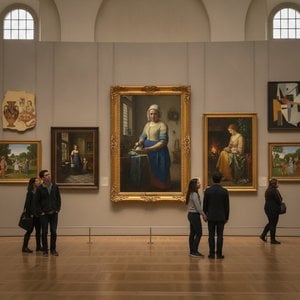
A Legacy Carved in Metal and Canvas
Born into a lineage where the strike of a hammer and the precision of an engraver defined daily life, David van der Kellen grew up surrounded by the rhythmic industry of the Royal Mint in Utrecht. His ancestors had long held positions as die-sinkers and medallists, and while the family name was synonymous with the official coins and medals of the Netherlands, young David sought a different path through the brush. He moved away from the metallic luster of his forebears to find his voice within the softer textures of oil and board.
His education took him far beyond the minting workshops of his childhood. He sought refinement at the Rijksacademie in Amsterdam and later traveled to the art academy in Düsseldorf, absorbing the techniques of the great masters. These studies allowed him to transition from a mere descendant of craftsmen into a painter capable of capturing the quiet nuances of human existence. He eventually found a home within the Dutch artist's society, Arti et Amicitiae, where his presence marked his integration into the professional art world.
The Quiet Observance of Daily Life
The works produced by his hand often turned inward, focusing on the intimate corners of domesticity and the humble interactions of common folk. He favored a romantic style, one that looked upon the world with a gentle, sentimental eye. His canvases frequently depicted genre scenes and interiors, where light might spill through an open door or settle upon a figure in quiet contemplation. In pieces such as Interieur met openstaande deur, he invited the viewer to peer into a private, still moment.
There was a particular tenderness in his treatment of his subjects, whether they were peasants or children. He captured the innocence of a Girl with a Doll and the heavy, grounded reality of a Peasant Visiting a Lawyer. His ability to render the weight of a knight's armor in Ridder in volle wapenrusting or the somber gravity of a Wounded Soldier demonstrated a versatility that bridged the gap between simple domesticity and more dramatic, historical subject matter. He did not seek to shock, but rather to document the human condition through recognizable, relatable scenes.
A Life of Stewardship and Art
Beyond the easel, David van der Kellen occupied a position of significant responsibility within the Dutch cultural landscape. His deep connection to the institutions of his country led him to serve as the director of the Rijksmuseum in Amsterdam, a role he held from 1876 until his death in 1895. This period of his life was defined by a stewardship of the very history he helped to document through his paintings.
His career remains a bridge between two worlds: the meticulous, technical precision of the engravers who preceded him and the emotive, narrative depth of the nineteenth-century painters. While his family name is etched into the coins of the realm, his own legacy resides in the quiet rooms and populated landscapes he brought to life on canvas.
Întrebări și răspunsuri
Unde pot fi explorate operele lui David van der Kellen, grupate pe teme și cuvinte cheie?
Operele lui David van der Kellen pot fi explorate pe baza cuvintelor cheie, în pagina de După cuvinte cheie a artistului. Fiecare cuvânt cheie grupează operele aferente.
Unde pot vedea operele lui David van der Kellen organizate după atmosferă?
Pagina Galerie pe stări de spirit lui David van der Kellen organizează operele de artă ale artistului în funcție de starea de spirit.
Unde pot fi găsite lucrările lui David van der Kellen, grupate pe tehnici?
Pentru a găsi toate lucrările lui David van der Kellen dintr-un anumit mediu, accesați pagina Toate tehnicile a artistului.
Din ce epocă face parte David van der Kellen?
David van der Kellen a activat în perioada 19th Century. Această perioadă situează activitatea artistului în context istoric.