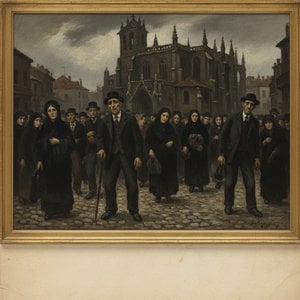
The Symbolist Outsider
Alberto Fuster remains a difficult figure to pin down, a painter who operated on the periphery of the dominant trends of his era. Born in Tlacotalpan, Mexico, his work refused to align with the prevailing movements that defined the early twentieth century. Instead, he leaned into symbolism, creating a body of work that polarized the specialists of his time. He was an artist of a different sort, an escapist whose vision did not seek to document the world as it was, but rather to interpret it through a private, symbolic lens.
His output was not a product of mass popularity but of a specific, singular intent. While his contemporaries were often preoccupied with the shifting currents of Mexican modernism, Fuster looked inward. This refusal to conform made him a polarizing figure, yet it is precisely this deviation that gives his work its lasting, if niche, relevance. He did not seek consensus; he sought a specific kind of expression that bypassed the standard categories of his period.
A Divergent Path
To understand Fuster is to understand the tension between his regional origins and his stylistic choices. His presence in the art history of Mexico is marked by this very friction. He did not follow the established paths of his peers, choosing instead a route that favored the psychological and the symbolic over the literal or the social.
- His primary medium was painting.
- His stylistic focus was centered on symbolism.
- His work is held in the Museo Nacional de Arte, Mexico City.
The Weight of the Work
The historical significance of Fuster lies in his refusal to be categorized. His 1903 work, Apotheosis of Peace, currently held in the Museo Nacional de Arte in Mexico City, serves as a primary example of his ability to handle complex, allegorical themes. It is a work that demands a different kind of reading than the more direct, social-realist works that would later dominate the Mexican landscape. He was a painter of ideas and metaphors, often operating in a space that felt disconnected from the immediate political or social realities of his time.
Today, his legacy is found in the way his work challenges the rigid definitions of art history. He represents a specific moment where an artist could exist entirely outside the mainstream, creating a body of work that remains distinct because it never attempted to belong. He was a painter of the margins, and in that margin, he found a voice that was entirely his own.
Întrebări și răspunsuri
Există o listă completă a operelor lui Alberto Fuster?
Toate lucrările lui Alberto Fuster de pe acest site web pot fi explorate în pagina Toate operele de artă a artistului.
Pot să explorez lucrările lui Alberto Fuster în funcție de starea de spirit?
Pagina Galerie pe stări de spirit lui Alberto Fuster organizează operele de artă ale artistului în funcție de starea de spirit.
Pot studia utilizarea culorii de către Alberto Fuster în toate lucrările sale?
Genoma Paletei lui Alberto Fuster este o pagină care prezintă profilul cromatic al întregii creații a artistului.
Unde pot fi explorate operele lui Alberto Fuster, organizate pe subiecte?
Operele lui Alberto Fuster pot fi explorate pe temă în pagina Atlas pe teme a artistului.