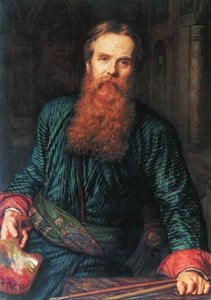
Biografie artist
A Life Dedicated to Vision
William Holman Hunt, born in Cheapside, London on April 2, 1827, wasn’t merely a painter; he was a profound seeker—a philosopher and spiritual explorer who translated his deepest convictions into the vibrant language of canvas. His early life, nestled within the bustling commercial heart of his father's warehouse business, held an unexpected artistic spark, one that would ultimately defy expectations and forge a path radically different from the predetermined course laid out for him. Initially destined for a career mirroring his father’s mercantile pursuits, Hunt discovered solace and purpose in art, beginning with clandestine sketching sessions and, after considerable struggle, formal training at the prestigious Royal Academy Schools. This initial apprenticeship proved restrictive, however; he yearned for an artistic expression that transcended the rigid conventions of academic painting—a desire that would soon propel him toward a revolutionary movement. He felt stifled by what he perceived as the artificiality and detachment prevalent in contemporary art, seeking instead a return to the sincerity, meticulous detail, and profound symbolism found in pre-Renaissance masters – a sentiment that became central to the formation of the Pre-Raphaelite Brotherhood. Hunt’s journey wasn't simply about aesthetics; it was a relentless quest for truth, morality, and spiritual resonance within the realm of visual representation—a deeply personal and profoundly influential ambition.
The Genesis of a Revolutionary Brotherhood
In 1848, amidst a climate of artistic dissatisfaction, William Holman Hunt, alongside Dante Gabriel Rossetti and John Everett Millais, established the Pre-Raphaelite Brotherhood (PRB). This collective wasn’t merely an artistic movement; it was a deliberate rebellion against what they viewed as the decline of art since Raphael. The PRB championed a return to meticulous detail, vibrant colors, and sincere subject matter—drawing inspiration from the perceived purity and emotional depth of early Italian painting – specifically works created before the supposed artificiality and intellectualism of the High Renaissance took hold. Hunt’s commitment to this philosophy remained unwavering throughout his career; he consistently sought to maximize the popular appeal and public visibility of his work, while remaining steadfast in his adherence to the Brotherhood's core principles. Early masterpieces like *The Hireling Shepherd*, painted in 1851, exemplify this dedication with breathtaking realism – from the individual strands of wool on the sheep’s fleece to each meticulously rendered blade of grass. This wasn’t simply a depiction of rural life; it was an ambitious attempt to convey complex moral and symbolic meanings through precise observation of nature, reflecting Hunt's belief that art could be a powerful tool for social commentary and spiritual enlightenment. The Brotherhood’s manifesto challenged the established norms of artistic production, rejecting what they considered formulaic academic painting in favor of a more direct, honest engagement with the world around them—a bold declaration that resonated deeply within the artistic community.
A Pilgrimage of Faith and Symbolic Depth
Hunt's artistic journey took an extraordinary turn during his extensive travels to the Holy Land between 1853 and 1856. Driven by a profound desire for historical accuracy and a deep-seated spiritual quest, he embarked on a pilgrimage to Palestine and Syria, meticulously documenting landscapes, costumes, customs, and architectural details with unparalleled precision. This immersive experience profoundly influenced his later works, imbuing them with an unprecedented sense of realism and spiritual resonance—a testament to the transformative power of direct observation and personal engagement. *The Shadow of Death*, painted during this period, stands as a particularly compelling example of this synthesis – depicting the scene of Christ’s sacrifice in a way that was both visually arresting and deeply symbolic, reflecting Hunt's profound religious convictions. The meticulous detail of the landscape, the expressions on the faces of the onlookers, and the overall composition all contribute to a powerful meditation on mortality, redemption, and the enduring presence of faith. Hunt wasn’t merely recording historical events; he was attempting to capture the essence of spiritual truth through the lens of visual representation—a testament to his belief in art as a vehicle for moral guidance and profound understanding.
Iconic Works and Lasting Influence
Perhaps Hunt's most enduring legacy rests upon *The Light of the World* (1852-1853), an iconic painting that captured the imagination of Victorian England and beyond. This powerful depiction of Christ extending his hand to offer salvation resonated deeply with a society grappling with questions of morality, faith, and social justice. The image—a solitary figure standing before a door radiating divine light—became instantly recognizable and profoundly influential, inspiring countless artists, writers, and thinkers. The painting’s popularity was further amplified through the publication of engraved reproductions, which disseminated its message to a wider audience. Hunt's commitment extended beyond mere representation; he sought to imbue his works with layers of symbolic meaning, drawing upon biblical texts, medieval allegory, and contemporary social commentary—reflecting his belief that art had a moral purpose – to uplift, inspire, and guide viewers toward spiritual enlightenment. His meticulous attention to detail, combined with his profound understanding of symbolism and religious themes, cemented his place as one of the most important artists of the Victorian era.
A Life of Artistic Pursuit
William Holman Hunt (born April 2, 1827 in Cheapside, London; died September 7, 1910 in London) remained a dedicated artist throughout his life, navigating personal challenges and artistic criticisms with unwavering resolve. He married twice: first to Fanny Waugh, who tragically died in childbirth, and later to her sister Edith. Despite facing significant personal loss and the physical limitations imposed by failing eyesight, Hunt continued to create art until his death, relying on the assistance of his loyal assistant, Edward Robert Hughes. His dedication was recognized with appointment to the Order of Merit by King Edward VII in 1905—a testament to his enduring contribution to British art and culture. William Holman Hunt’s legacy extends far beyond the beauty of his paintings; he revolutionized Victorian art by championing realism, symbolism, and spiritual depth, leaving an indelible mark on generations of artists and viewers alike. His works continue to inspire awe and contemplation, reminding us of the power of art to illuminate the human condition and explore the mysteries of faith.



 Vezi în context
 Comută pe versiunea Print
 Trimite
 Distribuie
 Detalii
 Ghid
Ghid

 Descarcă
 Produse similare
 Radiografie
 Diaporama
 Statistici


 Citește mai mult